Former professional baseball player-turned urban evangelist. Follow this daily blog that chronicles the life and ministry of revivalist preacher William Ashley "Billy" Sunday (1862-1935)
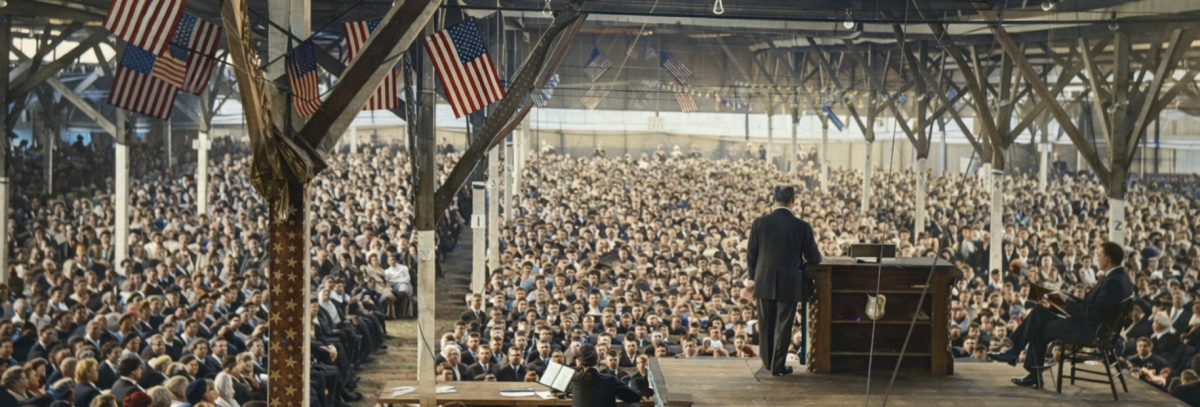
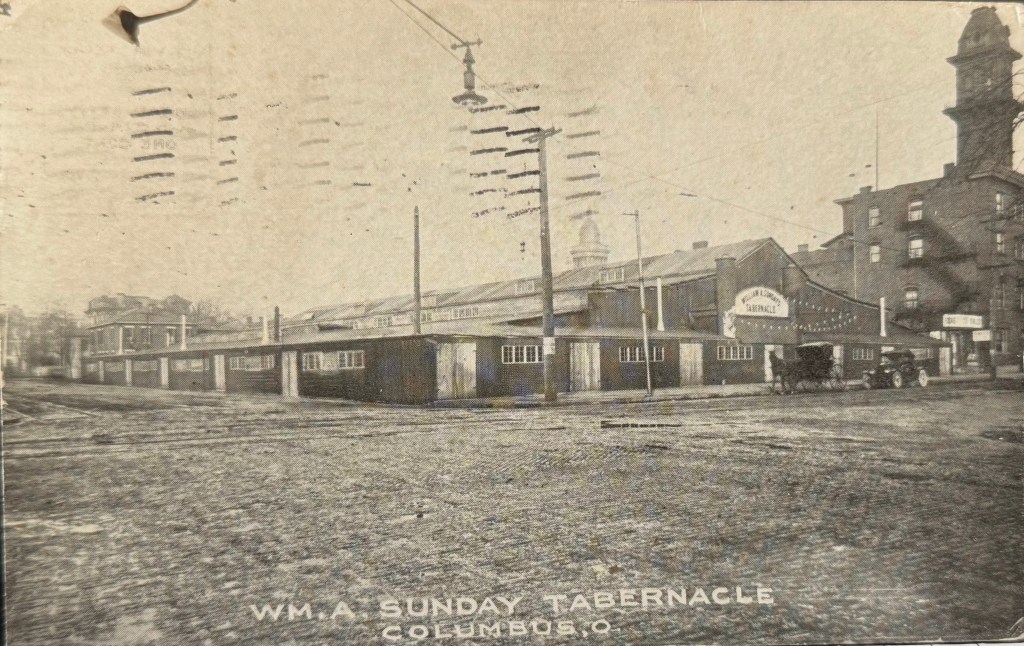
Before another issue of the Times-Leader reaches its readers, Rev. Billy Sunday and his co-workers will have left. This community has been stirred up as never before. We desire at this time to reproduce an editorial of the Ohio State Journal published at Columbus, when Mr. Sunday conducted a campaign just previous to his visit here:
“As a result of his mission in Columbus, we should say there is a stronger moral sense in this community than there ever was before; and now the pressing question is, how to preserve it, how to make it vital in civic, religious and business life. He has made of religion a thoroughly practical matter, and has made the people feel it to be that way; and now it becomes the duty of every one who loves his neighbor and his city to put into practice in his own life the high lessons of duty, and honor, and faith, which Rev. Sunday has been preaching to us for the past seven weeks.”
That’s the correct summing up of the entire situation. Sunday has recruited the soldiers. The responsibilities and duties rest with those who remain here.
Source: Wilkes-Barre Times Leader. Sat, Apr 12, 1913 ·Page 6
The Columbus, Ohio Billy Sunday Tabernacle. Author’s Collection.
The following information* was addressed to the Wilkes-Barre Editor in 1913, probably just before the February revival. It was likely drafted by Billy himself or someone else close to him from his campaign team. The revival at Wilkes-Barre took place February 22 (23), thru April 13th, 1913.
Image made by J. Inbody, Elkhart, Indiana. Author’s collection. From a 1915 postmarked postcard.
“He [Billy] has skimmed the literature of the English race for information and illustrations, and has a slang vocabulary that is simply astounding. He uses his knowledge with such telling effect that those who come to scoff remain to pray. His earnestness, his transparent honesty, carries his hearers with him, and his slang is all forgotten in his clarion call for repentance; his denunciation of all that is bad, vile and wicked, and in his praise of God, home and country.
“The old school of evangelists were of the itinerant class, moving rapidly through the country, their evangelism seemed sudden in its effects, and I am afraid somewhat evanescent in its results. It is just here that Sunday’s campaign gives promise of more lasting good. His coming has been carefully prepared for, and his meeting place is undenominational and unconventional in character. His is a movement conducted with great business acumen and sound common sense. He trains the ministers and church workers in such a way as to make them capable of caring for the harvest when it comes. Like a good farmer, he prunes the fruit trees with vigor, cuts out all the dead wood and sprays well to get rid of moths, beetles, and such like, so that when the new fruit shall ripen it will be sound and good. Mr. Sunday is a man with a great faith. He prays for the blessing, he prepares for the blessing, and he is sure of getting it. It is therefore no surprise to him when it comes.”
*Original artifact is in the Billy Sunday Archives at the Morgan Library, Grace College.
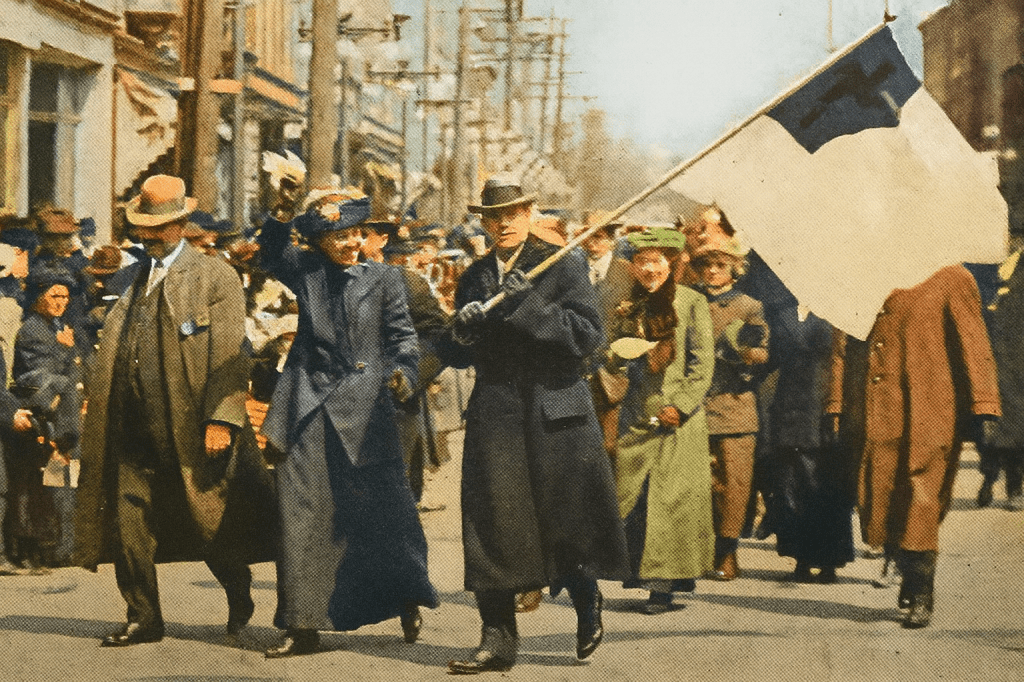
Billy Sunday, and wife Helen, lead a procession of around 20,000 people in a Sunday School parade at Wilkes-Barre. Colorized by the author.
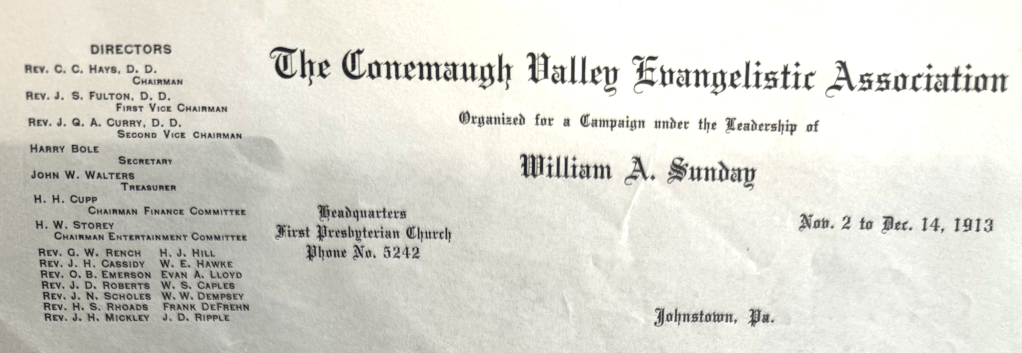
The logistics behind each revival campaign Billy held was simply massive. Here is an example of letterhead pertaining to his Johnstown, PA campaign (November 2, to December 14, 1913.
His letterhead usually indicated the key local personnel who were part of the Committee, the name of the organization formed to promote the revival, the name of a local host church serving as the revival headquarters, and the date of the event.
Permission to use artifact granted by the Morgan Library, Billy Sunday Archives, Grace College.
Here is First Presbyterian Church, Johnstown, PA (picture credit from their web site)
“Dr. Sunday (Westminster College had just conferred an honorary doctorate upon Sunday) knows his Bible which is the true body of divinity in theological lore. Mr. Sunday has devoted his life to the supreme task of world evangelization for which the Bible is the great charter.
He is, therefore, both in scholarship and practical effort entitled to the degree. Just as a Doctor of Medicine is supposed to know the Science of Medicine and practice the art of healing, so a Doctor of Divinity who know the truth about God and practices the art of saving 1s entitled to the degree. In many institutions it is customary to bestow the honorary degree of Doctor of Divinity upon those who are men noted for their knowledge of “the traditions of the scribes and pharisees” than for knowledge and practical use of the Bible itself.”
Sincerely yours,
R.M. Russell to T.T. Frankenberg (Columbus, Ohio) August 30, 1913
Artifact credit: Morgan Library, Grace College
The recipient of this letter, Theodore Thomas Frankenberg, was no casual correspondent. A Columbus-based journalist and author, Frankenberg was in the midst of gathering materials for what would become the first popular biography of the evangelist, Billy Sunday: The Man and His Message (published in 1914). Letters like Russell’s provided him with both anecdotal color and institutional validation—evidence that Sunday was not just a charismatic revivalist but a figure respected by the academic establishment.
This exchange captures an important cultural moment. Westminster’s degree signaled a rare bridging of worlds: a Presbyterian college recognizing a frontier-style evangelist whose power lay not in polished scholarship but in the raw urgency of his preaching. To Sunday’s critics, the degree may have looked like a concession to populism. To his supporters, it was overdue acknowledgment that the man who knew his Bible best and preached it most widely deserved the honor more than those “scribes and Pharisees” who merely debated it in lecture halls.
In the end, Frankenberg’s biography helped cement Sunday’s reputation, weaving together stories, letters, and testimonies like this one. And tucked inside that narrative is the 1913 moment when Westminster College draped Billy Sunday in academic robes, placing him—at least symbolically—among the doctors of divinity.
How Industrialization, Urbanization, and Moral Upheaval Set the Stage for Revival
When Billy Sunday’s voice rang out across America’s wooden tabernacles, he wasn’t just preaching sermons—he was answering a cultural cry. From 1900 to the early 1920s, the United States was spinning in the whirlwind of transformation. Old institutions were cracking, new cities were rising, and the American soul was searching for an anchor. Into that spiritual vacuum stepped Sunday—a preacher who didn’t just understand the moment; he embodied it.
By the early 20th century, America was moving from farm to factory. In 1870, only 25% of the population lived in cities. By 1920, over 50% did. The dizzying shift from rural life to urban sprawl left many disoriented. Long-standing community structures—churches, front porches, family farms—were being replaced by crowded tenements, anonymous factory work, and the fast pace of modern life. People needed clarity, direction, and moral certainty.
Sunday gave it to them—loudly, plainly, and with baseball-player bravado.
The U.S. was also undergoing its greatest wave of immigration, with over 14 million new arrivals between 1900 and 1920. While these immigrants enriched the nation’s culture, they also stoked fears among native-born Protestants about identity, religion, and national character. Sunday’s revivals, though not overtly anti-immigrant, often appealed to a kind of nostalgic Protestant Americanism that comforted people who felt their world slipping away.
Meanwhile, the Industrial Revolution was rewriting the rules of labor and wealth. Robber barons rose; workers organized. Socialist ideas were gaining traction. Against this backdrop, Sunday didn’t call for revolution—he called for regeneration. He told workers to repent, not revolt. He urged bosses to clean up their lives, not just their payrolls. In an age when ideologies were competing to explain human brokenness, Sunday offered the most American answer imaginable: personal repentance and individual transformation.
And of course, moral reform movements were gaining steam—chiefly the push for Prohibition. The saloon had become a symbol of urban vice, immigrant excess, and male irresponsibility. Billy Sunday didn’t just preach against alcohol—he declared war on it. His famous line, “I’m against the saloon with all the power I’ve got,” wasn’t just rhetoric; it helped catalyze a national movement that led to the 18th Amendment.
So why did Billy Sunday rise when he did?
Because he stepped into a nation off balance, morally confused, spiritually hungry, and socially uprooted. He didn’t just ride the wave—he harnessed it. His sermons shouted what many Americans were whispering: that the old truths still mattered, that the Bible still had authority, and that one man’s conviction could still move a crowd.
In an age of massive upheaval, Billy Sunday stood like a lightning rod—conducting fear, hope, outrage, and repentance into one electrifying movement.
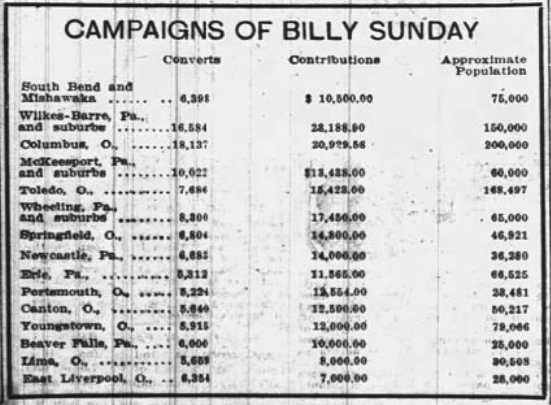
Location South Bend & Mishawaka Wilkes-Barre, PA Columbus, OH McKeesport, PA Toledo, OH Whelling, PA Springfield, OH Newcastle, PA Erie, PA Porstmouth, OH Canton, OH Youngstown, OH Beaver Falls, PA Lima, OH East Liverpool, OH
Citation: The South Bend Tribune. Mon, Jun 16, 1913 ·Page 12
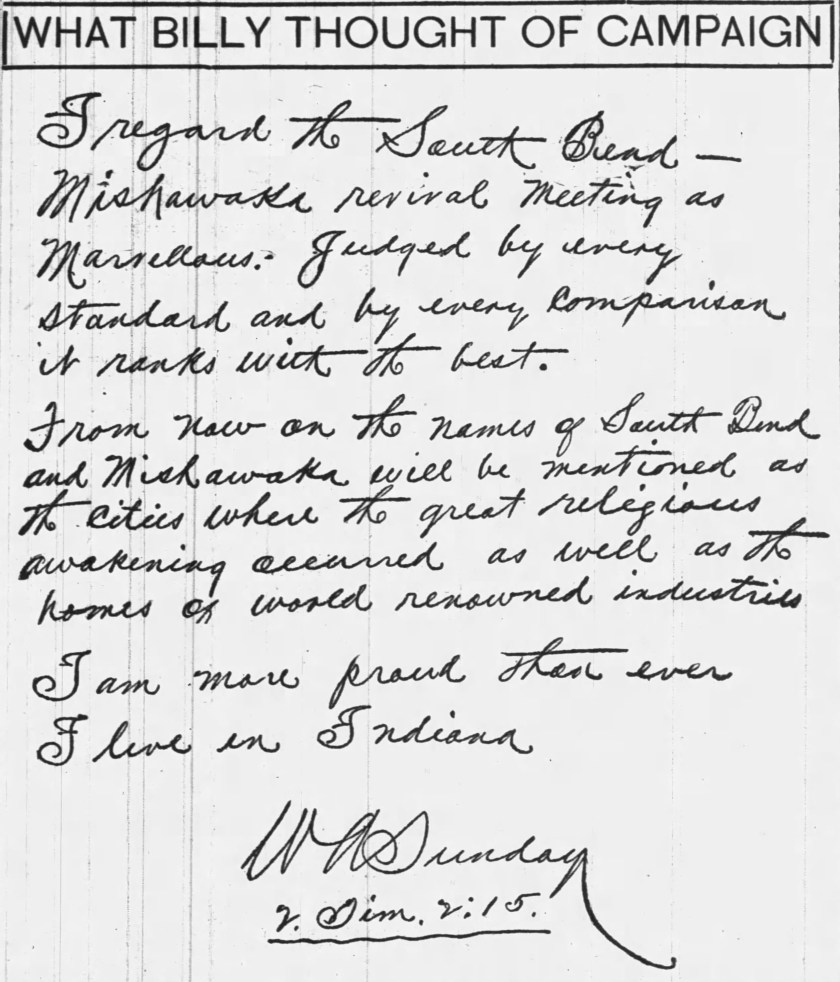
I regard the South Bend – Mishawaka revival Meeting as Marvelous. Judged by every standard and by every comparison it ranks with the best.
From now on the names of South Bend and Mishawaka will be mentioned as the cities where the great religious awakening occurred as well as the homes of world renowned industries.



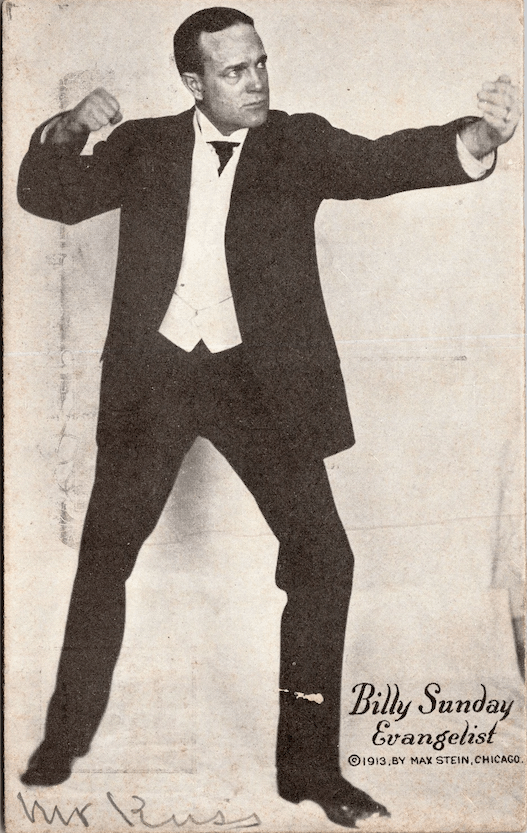
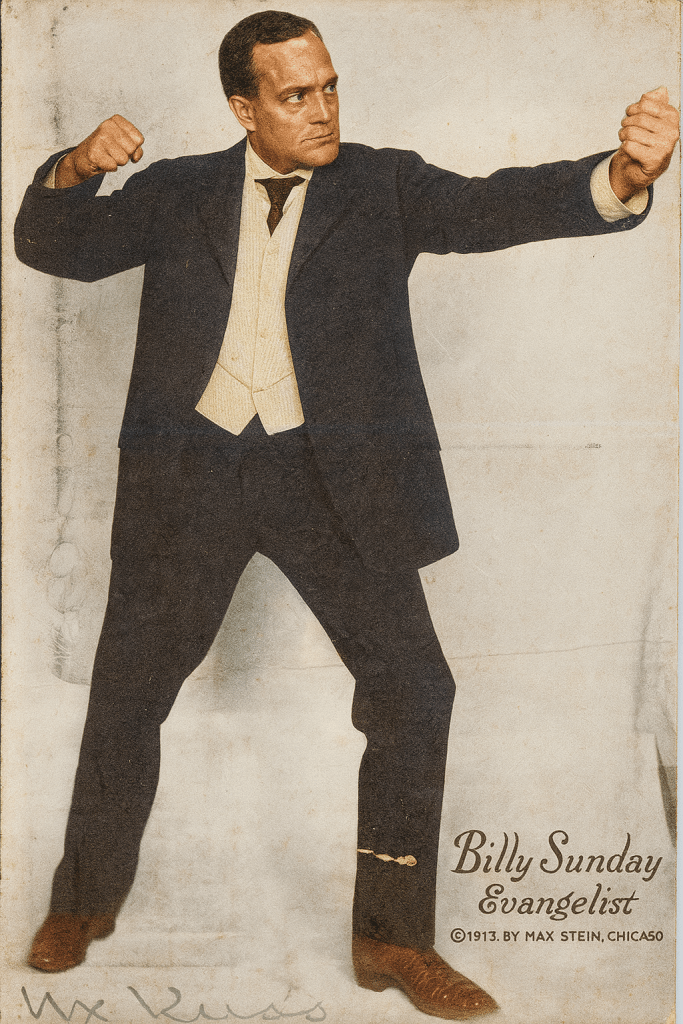

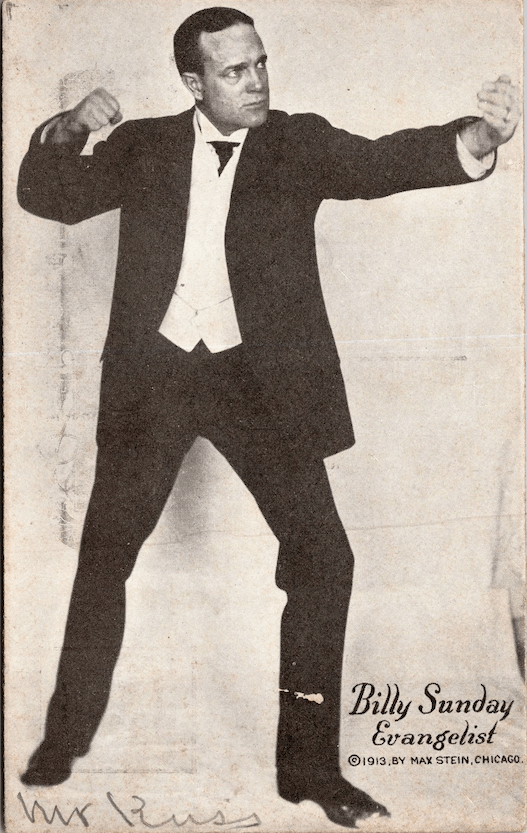

 Evangelist Billy Sunday (1862-1935)