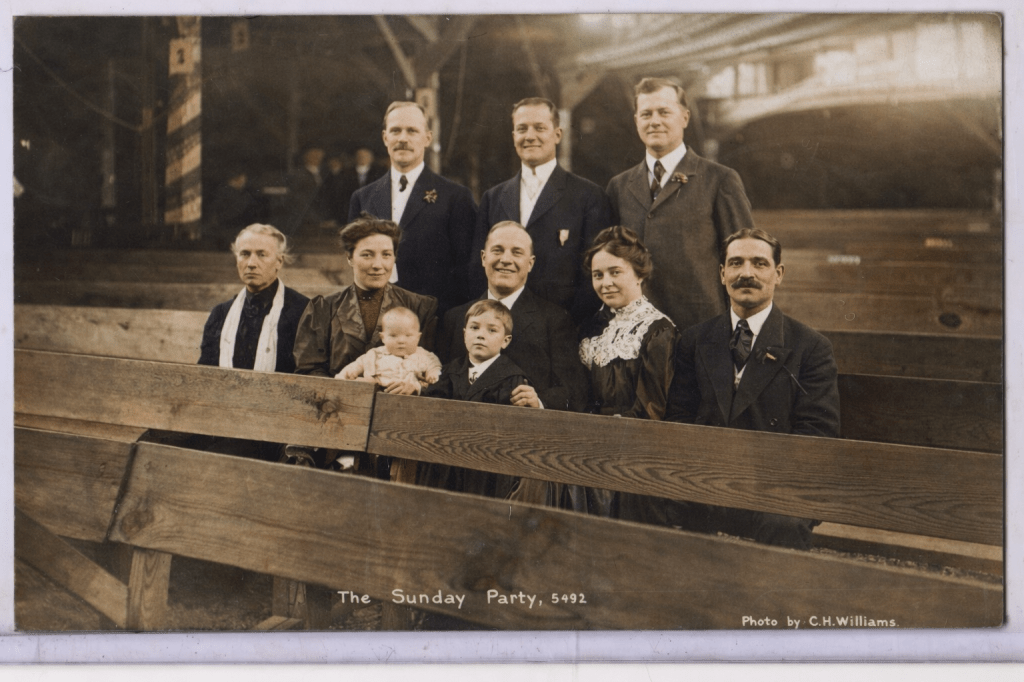
Billy Sunday family, and party, c. 1912
Evangelist Billy Sunday (1862-1935)
Former professional baseball player-turned urban evangelist. Follow this daily blog that chronicles the life and ministry of revivalist preacher William Ashley "Billy" Sunday (1862-1935)
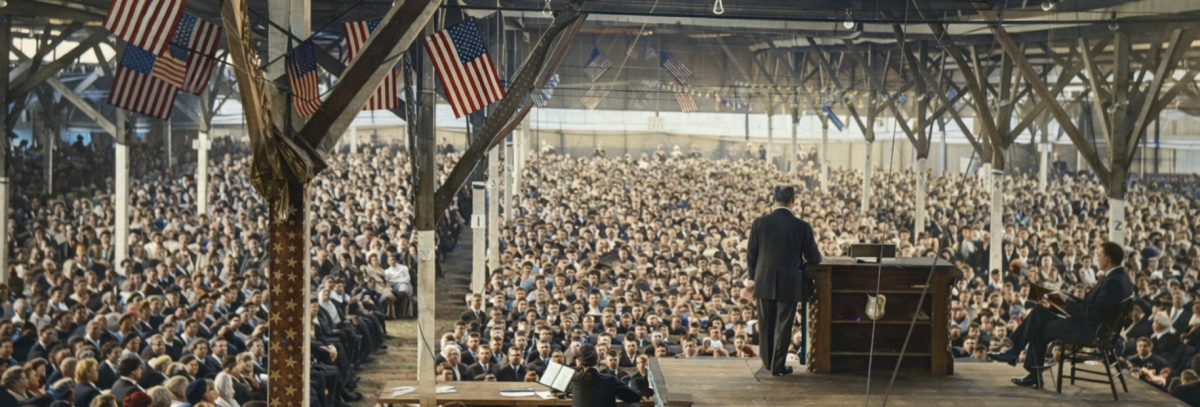
When Billy Sunday rolled into Beaver Falls, Pennsylvania, in the spring of 1912, the town was not simply hosting another traveling preacher — it was about to experience one of the most energetic revival campaigns of the Progressive Era.
From May 19 to June 24, 1912, Sunday’s massive wooden tabernacle stood as the focal point of community life. Every night the building filled with the noise of hymns, sawdust underfoot, and Sunday’s unmistakable mix of athletic bravado, homespun humor, and urgent gospel appeal.
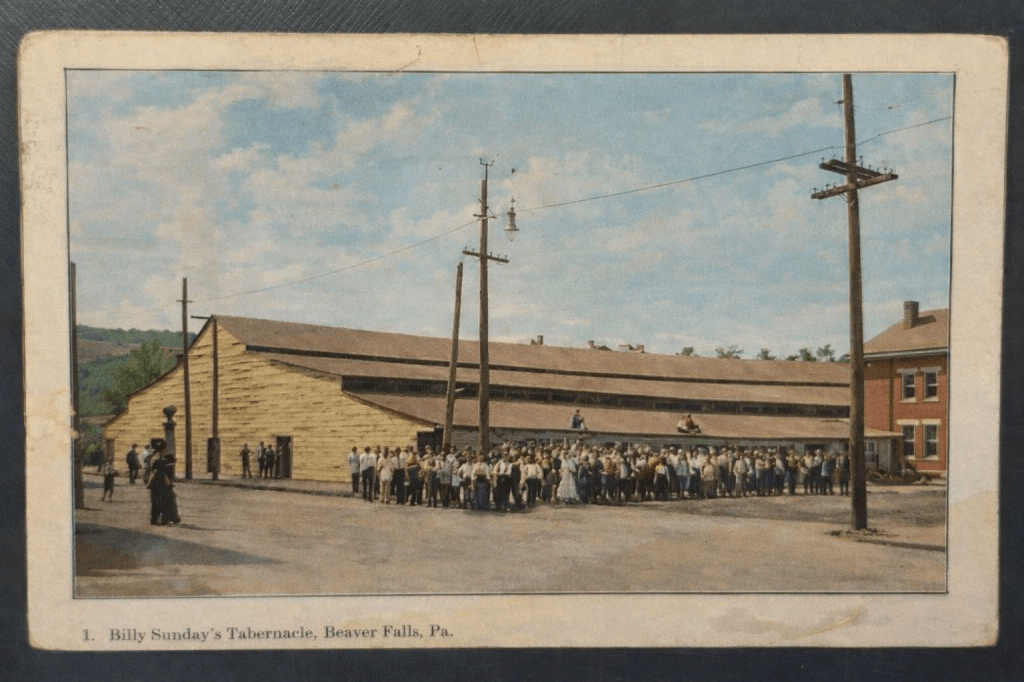
The campaign opened on Sunday, May 19, 1912, and the response was immediate. Newspapers report that 5,000 people packed the tabernacle that first day — a remarkable turnout for a town the size of Beaver Falls.
This wasn’t curiosity alone. People came expecting something — conviction, hope, or perhaps just the spectacle of America’s most famous evangelist in action. What they received was classic Billy Sunday: vivid stories, blunt moral challenge, and a call for personal decision.
Over the next five weeks, the revival became the center of local conversation. Businesses adjusted hours, families planned around evening services, and local pastors cooperated in ways that were rare in an age of denominational competition.
By the end of the campaign, the results were striking:
Newspapers emphasized that this was not simply emotional enthusiasm. Churches reported new members, families reconciled, and local leaders spoke of a noticeable moral impact on the town.
Perhaps the most surprising moment of the campaign came not in the tabernacle, but on a college campus.
While in Beaver Falls, Sunday was awarded an honorary doctorate from Westminster College in Pennsylvania.
This was no small thing.
Sunday had no formal theological training. He was a former baseball player turned evangelist — rough around the edges, energetic, and deeply practical. Yet Westminster recognized that his cultural influence and moral leadership were shaping American religious life in ways few professors ever could.
In many ways, the honor symbolized something larger: Billy Sunday had moved from being a popular revivalist to a nationally respected religious figure.
The Beaver Falls campaign illustrates why Billy Sunday mattered in American history:
For six weeks in 1912, Beaver Falls became a spiritual crossroads where ordinary people encountered an extraordinary evangelist — and many left changed.
Location of tabernacle—Second and Washington streets.
All hats must be removed within building.
Members of choir required to be in their places promptly.
Tabernacle may be entered from any side and ushers will look after all.
A section of reserved seats is provided in the front for those whose hearing is defective. Another block, in direct center, is for the children.
First to arrive have choice of seats, except those in the choir loft which are reserved by checks for members of that body.
No one is permitted to walk through the aisles of the tabernacle while Sunday is preaching. All are expected to refrain from talking or making other unnecessary noises during the services.
Those who attend services are expected to start early so as to not create a disturbance by entering late. Late comers are admitted, but are required to enter building from rear doors. The purpose is to make as little disturbance as possible.
Ushers, officers and firemen, detailed by police and fire departments, will be on duty at all services to prevent disorder or accidents.
Hand books of the campaign, giving detailed information concerning transportation facilities, telephones, committee headquarters, prayer meeting districts and many other important items of information are distributed gratuitous at the tabernacle.
Changes in the hour of holding services, or any other important development, will be given in the Evening Review.
Sept 1912 paper
The Evening Review (East Liverpool, Ohio) · Mon, Sep 16, 1912 · Page 4
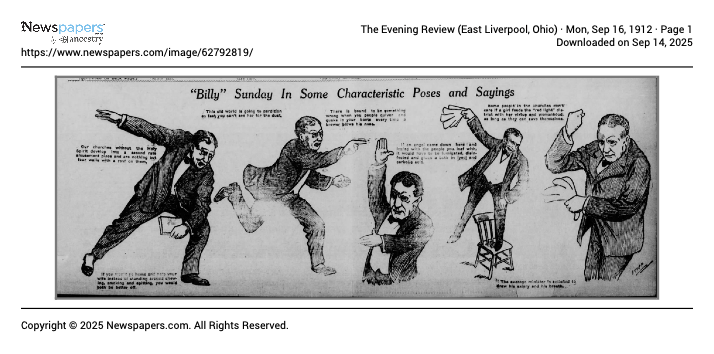
A Human Dynamo.
That is Billy Sunday in action—a human dynamo working for the cause of religion. No one could listen to the evangelist, yesterday, without absorbing some of his wonderful energy as he sent it out in great dynamic waves through the huge tabernacle. The air of the big structure was saturated with it.
Billy Sunday literally pumps religious enthusiasm into people. And no matter how much of it he pours out, the supply seems inexhaustible. It is almost incredible that one man could have such a lot of vim and vinegar stored up in his one little body and his brain.
Billy Sunday believes in a Christianity that does things, that is carried out into the lives of people, that accomplishes results, that “delivers the goods.” This is the core of his evangelism. This is why he is so vitriolic in his denunciation of the Christian who sits back and is satisfied with announcing that he believes in the Lord but does nothing for the Lord.
Nothing in oratory could be more impressive or effective than the evangelist’s word painting of histrionic scenes, especially those of the battlefield, and the application of some striking incident to the life and work of the soldier in the Christian army. It is the very essence and soul of eloquence.
The audiences that met yesterday to hear Sunday’s first three sermons, would have been most encouragingly large on the pleasantest of days. On a rainy day such as it was, they may well be regarded as remarkable, and as most auspicious.
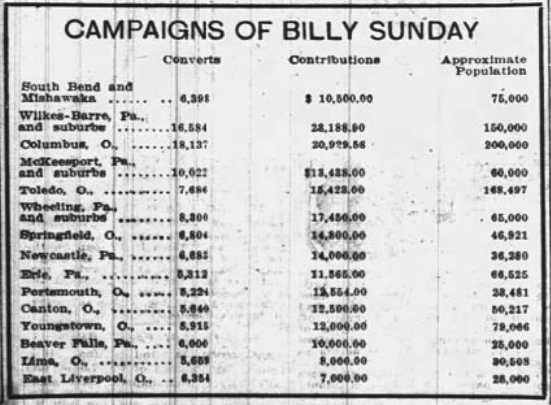
| Location South Bend & Mishawaka Wilkes-Barre, PA Columbus, OH McKeesport, PA Toledo, OH Whelling, PA Springfield, OH Newcastle, PA Erie, PA Porstmouth, OH Canton, OH Youngstown, OH Beaver Falls, PA Lima, OH East Liverpool, OH | Converts 6,391 16,584 18,137 10,022 7,684 8,300 6,804 6,683 5,312 5,224 5,640 5,915 6,000 5,669 6,354 | Contributions $ 10,500.00 $ 28,188.90 $ 20,929.58 $ 13,438.00 $ 15,423.00 $ 17,450.00 $ 14,800.00 $ 14,000.00 $ 11,565.00 $ 12,554.00 $ 12,500.00 $ 12,000.00 $ 10,000.00 $ 8,000.00 $ 7,000.00 | Approx. Pop. 75,000 150,000 200,000 60,000 163,497 65,000 46,921 36,380 66,525 23,481 50,217 79,066 25,000 30,508 25,000 |
South Bend Tribune. Mon, Jun 16, 1913 ·Page 12
 Evangelist Billy Sunday (1862-1935)