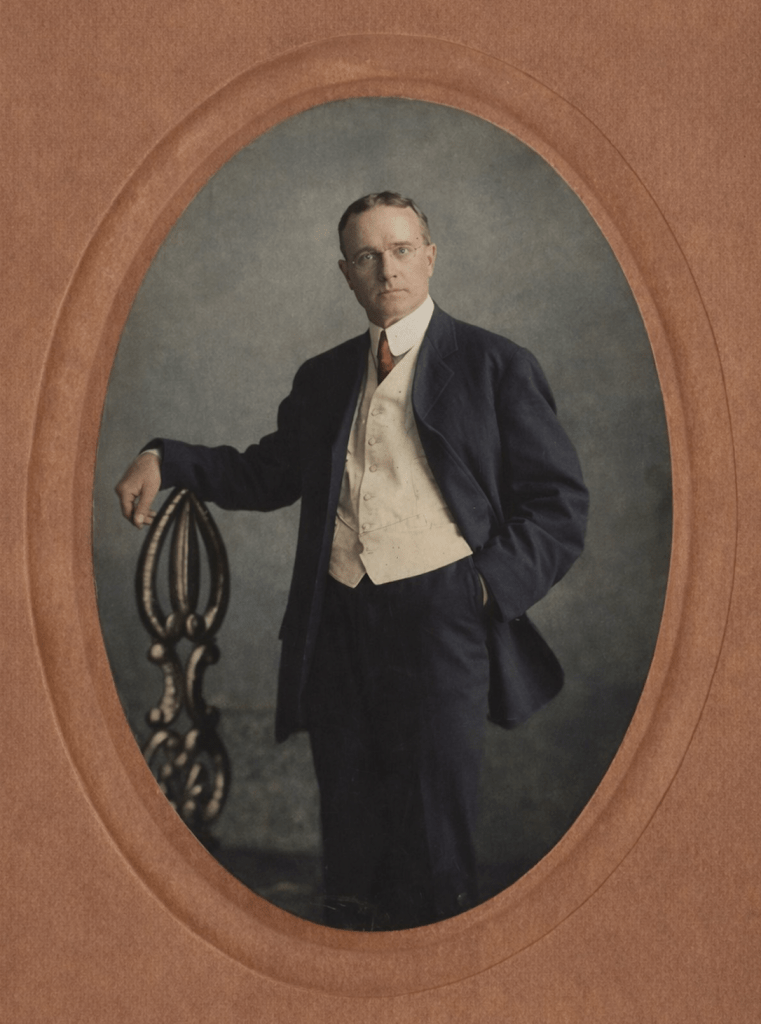
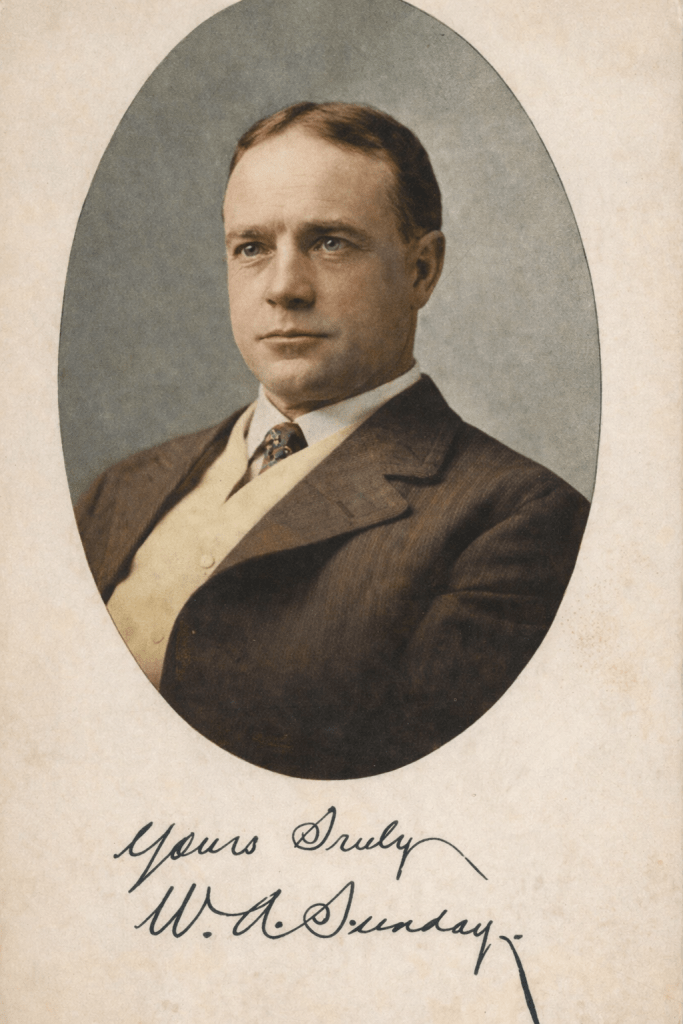
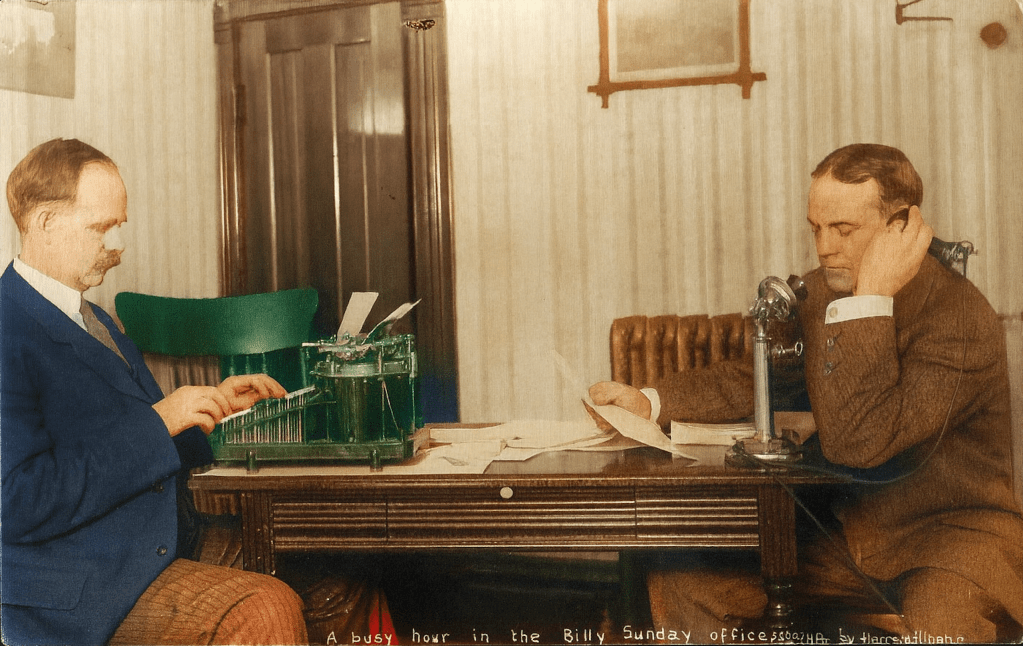
Evangelist Billy Sunday. Original is a b/w image. C. 1910s or earlier.
Evangelist Billy Sunday (1862-1935)
Former professional baseball player-turned urban evangelist. Follow this daily blog that chronicles the life and ministry of revivalist preacher William Ashley "Billy" Sunday (1862-1935)
Evangelist Billy Sunday. Original is a b/w image. C. 1910s or earlier.
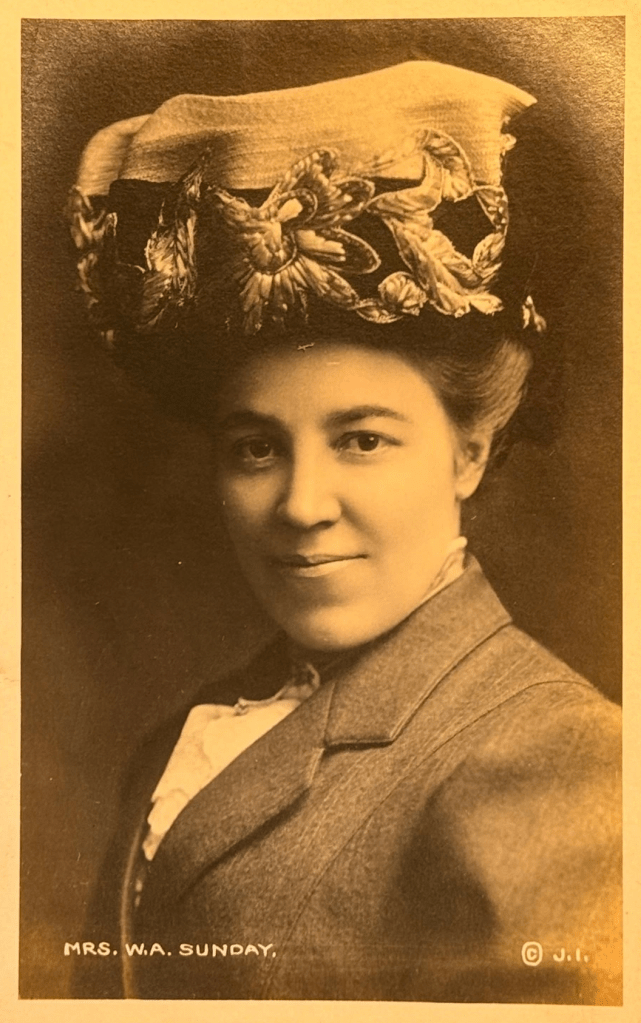
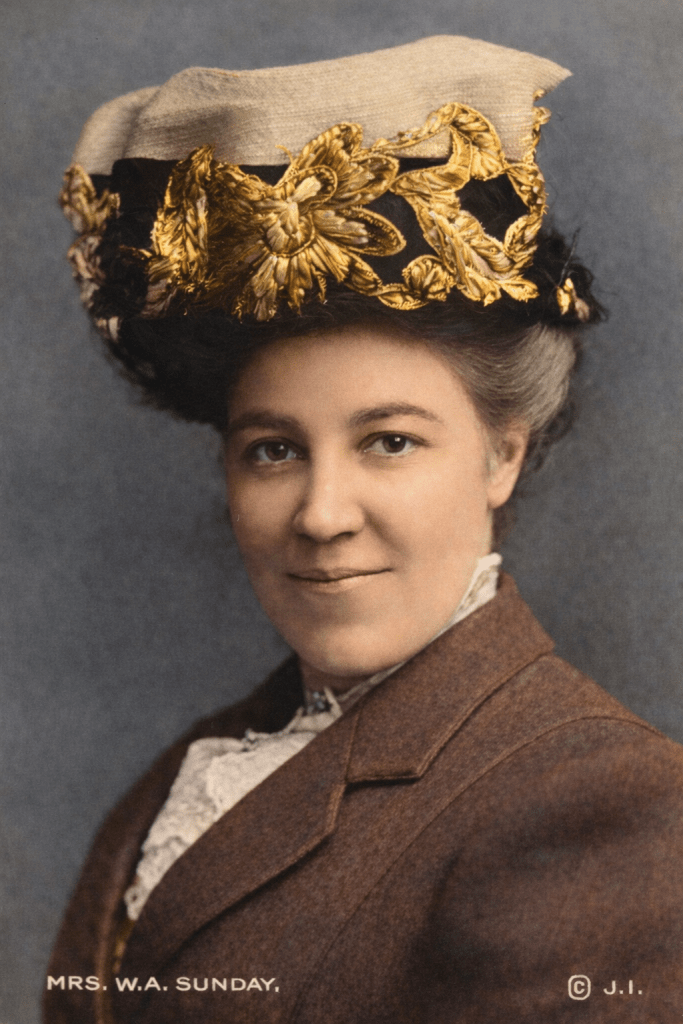
From a postcard, colorized by author.
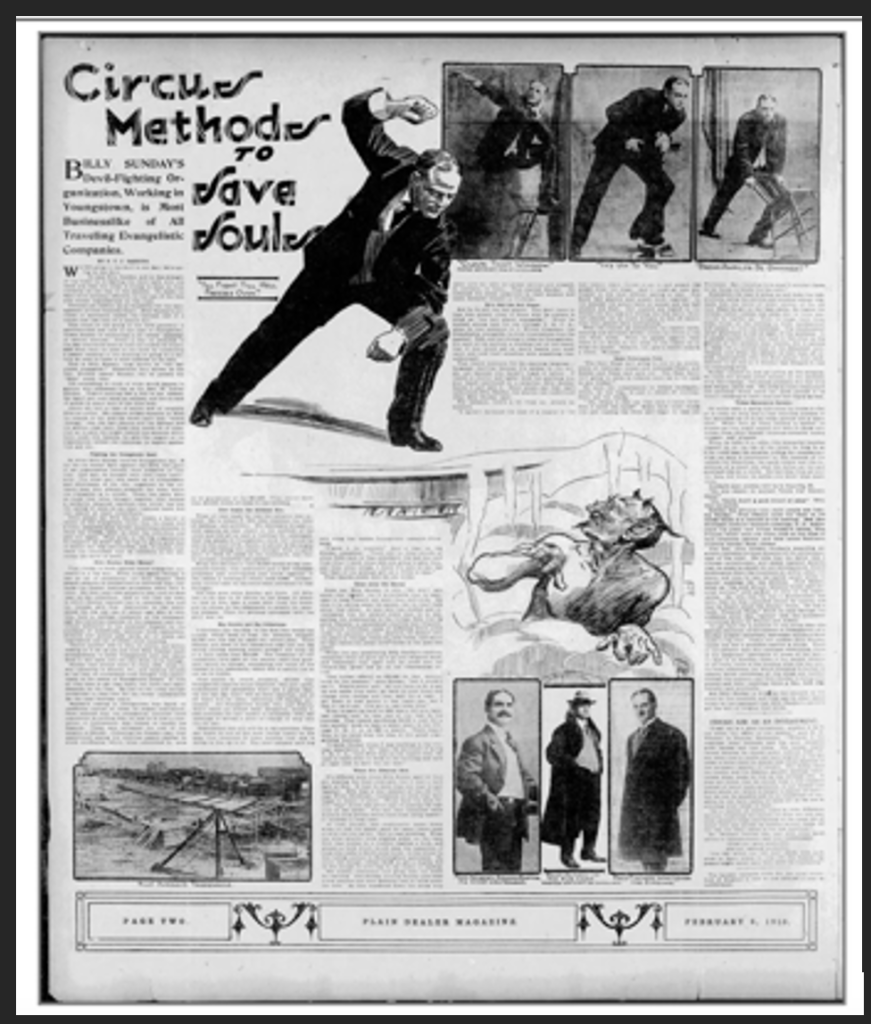
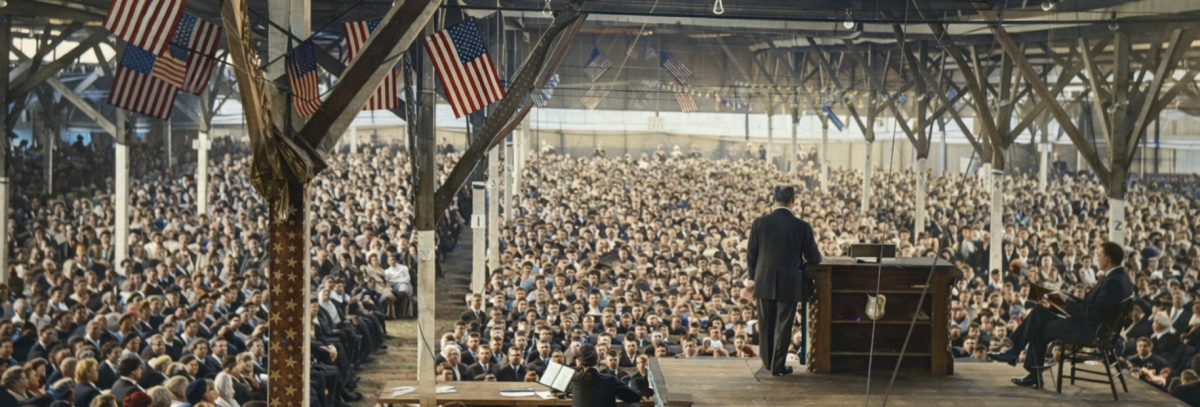
When Billy Sunday rolled into Youngstown, Ohio, in January 1910, he did not arrive quietly—and Youngstown did not receive him quietly either.
From the very first night, it was clear that this industrial city, filled with steel mills, rail yards, immigrants, laborers, and restless energy, was primed for revival. Sunday began his campaign on January 8, 1910, and within hours it was obvious that this would be no ordinary meeting.
On opening night, 5,000 people packed the tabernacle, according to the New Castle News (Jan. 10, 1910). The very next evening, crowds swelled to 7,000, as reported by The Pittsburgh Post (Jan. 10, 1910). The word had spread fast: Billy Sunday was in town, and Youngstown wanted in.
As the weeks unfolded, the numbers only grew more astonishing.
By February 4, the campaign had already recorded 2,221 conversions. That same night, 15,000 people attempted to crowd into a tabernacle that could seat only 7,000—a vivid picture of spiritual hunger and civic excitement. The Cleveland Press marveled at the scene, noting the crush of humanity trying simply to hear Sunday preach.
Youngstown had become a revival city.
The campaign reached its crescendo on February 20, 1910.
That final day, 10,000 people attended, while 6,000 more were turned away for lack of space. The Marion Daily Star reported that 5,900 total conversions had been recorded over the course of the meetings, including 970 decisions on the closing day alone.
It was a stunning finish—one of those great climactic Sundays that made Sunday’s name synonymous with American revivalism.
At the conclusion of the campaign, Sunday received his customary purse of 10,000 dollars, a significant sum in 1910 and a sign both of the city’s appreciation and of the scale of the event.
The Youngstown campaign illustrates several hallmarks of Billy Sunday’s ministry:
Most of all, Youngstown demonstrates why Sunday was “the man for the moment.” In an era of rapid industrial change, social tension, and moral anxiety, he spoke with clarity, fire, and confidence—and cities like Youngstown listened.
More than a century later, the Youngstown campaign stands as one of the great urban revivals of Sunday’s early career. The numbers are impressive, but the deeper story is about a city temporarily transformed—its people stirred, challenged, and moved to decision.
Writing just days after the Youngstown campaign ended, J. Wilbur Chapman offered this striking tribute to Sunday in The Dayton Herald (Feb. 23, 1910):
“Some of the sermons he preaches now are not mine. I love him. I know his sincerity and passion for Jesus. I thank God for his ministry. Most of us are too dignified. Let rules of grammar and conventionality be broken if souls can be saved. As soon as he begins to speak the doors will be closed so you can’t get out. You’ve got to take your dose for once. If ever a man was called to preach; if ever a man had the seal of God’s approval on his ministry, that man is Sunday. I take off my hat to any man that can turn men to Jesus Christ.”
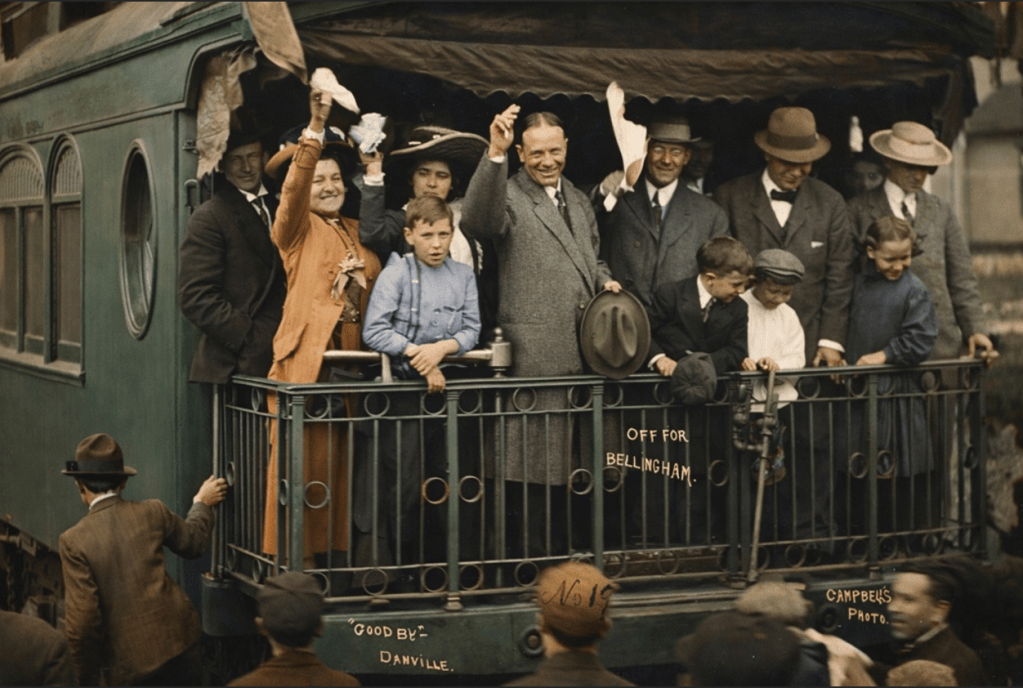
When Billy Sunday arrived in Bellingham, Washington, in the spring of 1910, the city knew something significant was about to happen.
His campaign formally began on April 17, 1910, and was scheduled to run for six weeks through May 29. Even before the opening service, anticipation was high. On April 16, The Bellingham Herald placed the coming revival on the front page, signaling that this was not just another religious meeting but a major civic event.
From the start, the campaign drew extensive attention. Local and regional newspapers covered Sunday’s meetings with unusual depth and frequency. By May 2, The Seattle Star was featuring the revival prominently on its own front page, evidence that Sunday’s influence extended far beyond Bellingham into the broader Pacific Northwest.
One of the most remarkable days came on Sunday, May 1. That evening, approximately 15,000 people crowded into the tabernacle and surrounding grounds to hear Sunday preach. The turnout was stunning for a city of Bellingham’s size at the time. Collections that day totaled $3,201.10, a substantial sum in 1910, reflecting both the generosity of the crowd and the financial scale of Sunday’s campaigns. That same service also recorded 140 conversions, showing that this was not merely spectacle but a movement that claimed measurable spiritual results.
Interest in Sunday’s work went beyond daily newspaper reports. On May 8, The Bellingham Herald devoted magazine-style coverage to the revival, suggesting that the meetings had become a defining moment in the city’s public life rather than a passing event.
Perhaps the most revealing glimpse into Sunday himself came from an interview published in The Daily Herald of Everett on May 18 under the title “Billy Sunday: His Methods, His Ideas and His Work.” In it, Sunday rejected the idea that his success came from showmanship or gimmicks. He explained his approach in characteristically plain terms:
“I haven’t any tricks. I’m just an old-fashioned preacher. I tell people in plain words the simple truth, that they are lost in sin and need salvation. I just preach the Bible – that’s all.”
That statement captures the heart of his appeal in Bellingham. He did not present himself as a social reformer, a political activist, or a religious entertainer. He came as a straightforward revival preacher who believed that the Bible, clearly proclaimed, could still change lives.
By the time the campaign concluded on May 29, Bellingham had experienced six weeks of intense preaching, packed crowds, and sustained public attention. For many residents, these meetings likely became a defining memory of the year 1910—a season when their city was temporarily at the center of a national religious movement.
The Bellingham campaign illustrates why Billy Sunday was such a powerful figure in early twentieth-century America. He could command enormous crowds, attract front-page coverage, inspire generous giving, and still insist that his effectiveness rested not on method but on message. In Bellingham, as in so many other cities, Sunday left behind not just statistics, but stories of a community stirred by revival.
When Billy Sunday came to New Castle, Pennsylvania, in the fall of 1910, the city quickly discovered that it was not ready for what was about to happen.
The campaign opened on September 18, 1910, and from the very first service it was clear that the tabernacle—built to hold 7,500 people—was not nearly large enough. According to the New Castle Herald (Sept. 19, 1910), crowds overflowed the structure on opening day, spilling into the streets and surrounding grounds. What had been intended as a major civic event immediately became something larger: a public phenomenon.
For six weeks, New Castle lived inside a revival. Night after night, thousands gathered to hear Sunday preach in his unmistakable style—direct, forceful, unsparing, and deeply earnest. Newspapers across western Pennsylvania followed the meetings closely, treating the campaign as front-page news rather than mere church business.
By the time the final service concluded on October 30, the numbers were staggering.
In total, $12,500 was collected during the campaign, as reported by the Warren Times Mirror on November 3, 1910. But far more striking were the spiritual results reported by local churches: 6,383 recorded conversions, including 1,050 decisions on the final evening alone.
The New Castle Herald captured the meaning of those numbers in a powerful editorial reflection on October 31:
“Just think of 6,383 souls being added to the churches of this city and county. This means one out of every six persons residing in this city. It means a very much larger proportion in reality, for these 6,383 are all of age to think and to accept for themselves the doctrines of Christianity. In the light of this, the money given yesterday to the evangelist seems a trivial sum, when compared with the good he has done.”
That statement goes to the heart of why New Castle mattered in Sunday’s career. This was not simply a revival that filled a building or generated headlines. It reshaped congregations across an entire region. Local churches suddenly found themselves filled with new members, new energy, and new responsibility for discipleship.
The New Castle campaign also illustrates why Billy Sunday became such a defining figure in early twentieth-century America. In an era before radio, television, or social media, he could command massive crowds purely through reputation, word of mouth, and the sheer force of his preaching. Cities did not merely host Sunday; they were changed by him.
More than a century later, the New Castle revival stands as one of Sunday’s most dramatic successes. For six weeks in 1910, a steel-town community experienced a spiritual earthquake—one that newspapers, pastors, and ordinary citizens remembered long after the tabernacle was torn down.
For historians of revival, New Castle offers a vivid case study in how Sunday’s campaigns worked: huge crowds, intense emotion, measurable results, and lasting impact on local churches.
For the people of New Castle, it was simply the season when their city met Billy Sunday—and was never quite the same again.
As published in the The Akron Beacon Journal. Sat, Jun 18, 1910 ·Page 3
Attorney W. S. Anderson of Youngstown, who defended Bert Petty, is a staunch supporter of “Billy” Sunday, the celebrated evangelist. He was one of Sunday’s many converts in Youngstown. Sunday spent six weeks in Youngstown this spring and Mr. Anderson says that the effect upon Youngstown was great and it has been lasting also.
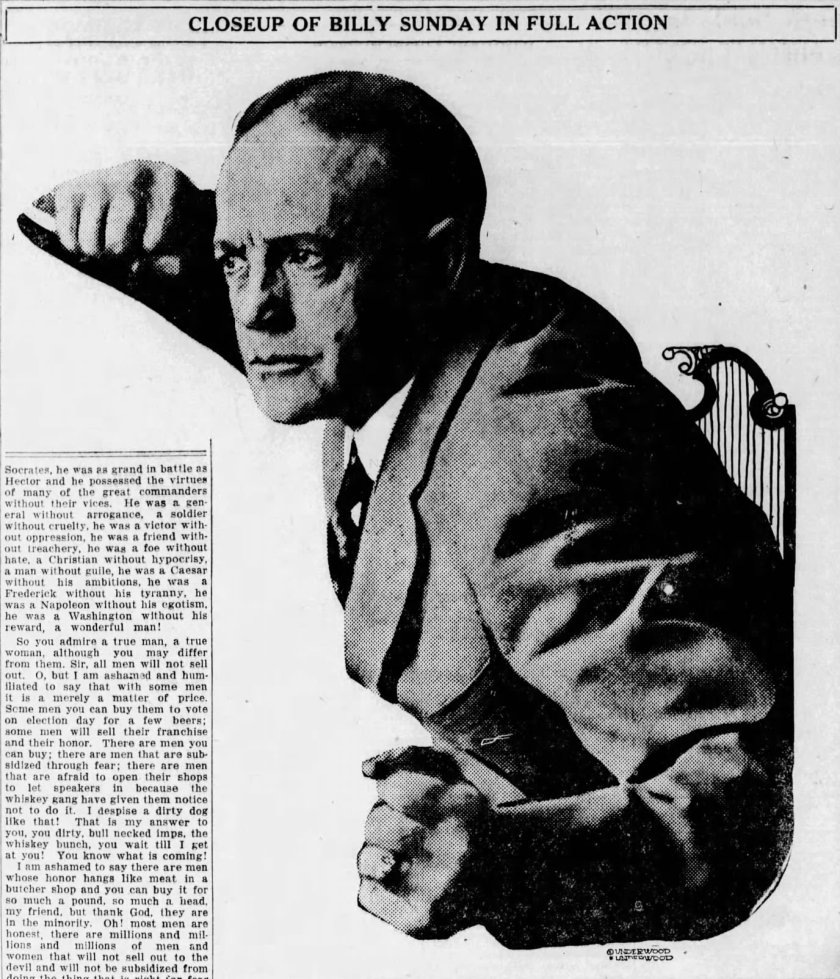
“When I first went to hear him I was disgusted,” he said, “but I went several times more just out of curiosity and I grew to be a great admirer of his work. The first two weeks he spent in Youngstown he used a great deal of slang. This drew the crowds and when he had them coming he got down to work and his work was wonderful.”
Mr. Anderson says that all classes of people have been effected by Sunday’s work. “The lawyers are a pretty hard class of men to reach with religious services but Sunday did it. One night in his prayer he said, ‘Help the lawyers because we know they are a tough bunch.’ They were too, but many became followers of the evangelist.
“The work of Sunday can not be judged only by the number who came forward. It is the influence on all the people and their relations with one another.”
Mr. Anderson says Akron should get Billy Sunday here. “It will do the town a lot of good,” he said.
The Bellingham Herald. Mon, Jun 13, 1910 ·Page 1
The church membership of Bellingham has been practically doubled as the result of the Rev. W. A. Sunday evangelistic campaign.
The meeting was fully attended, and perhaps the most remarkable feature of the session, was the enthusiasm with which the work of Rev.
W. A. Sunday in this city was referred to. Practically all of the pastors stated that their church membership had doubled, and in some cases almost trebled, while there is yet no sign of any cessation of the additions.
It is claimed now that the actual campaign itself has been but the start of a religious movement which is crystalizing in the different churches in a manner far beyond the highest expectation of the association.”
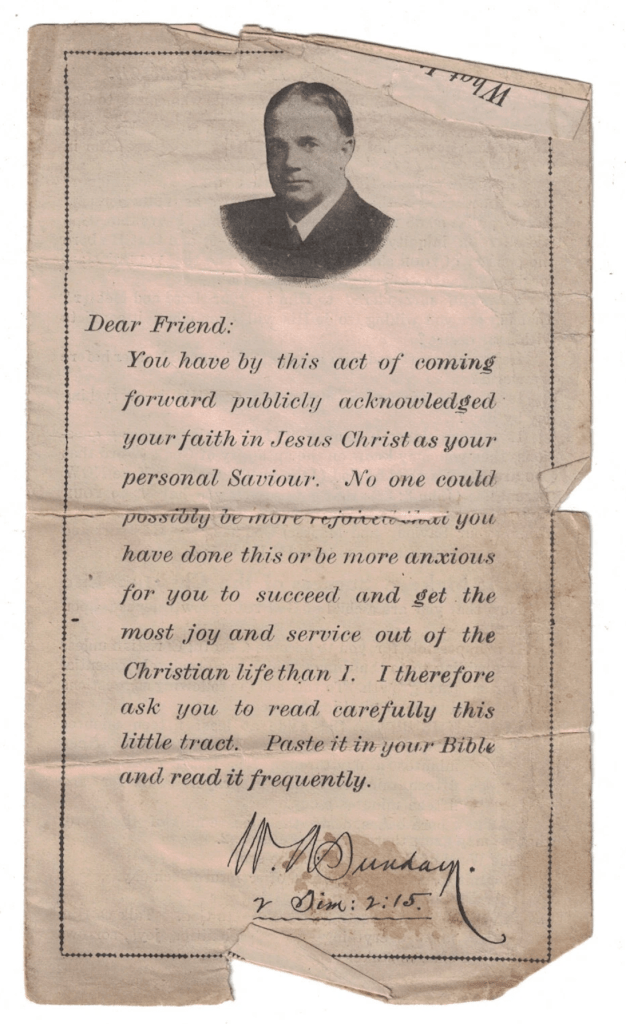
W. A. Sunday
2 Tim: 2:15
Dear Friend:
You have by this act of coming forward publicly acknowledged your faith in Jesus Christ as your personal Saviour. No one could possibly be more rejoiced that you have done this or be more anxious for you to succeed and get the most joy and service out of the Christian life than I. I therefore ask you to read carefully this little tract. Paste it in your Bible and read it frequently.
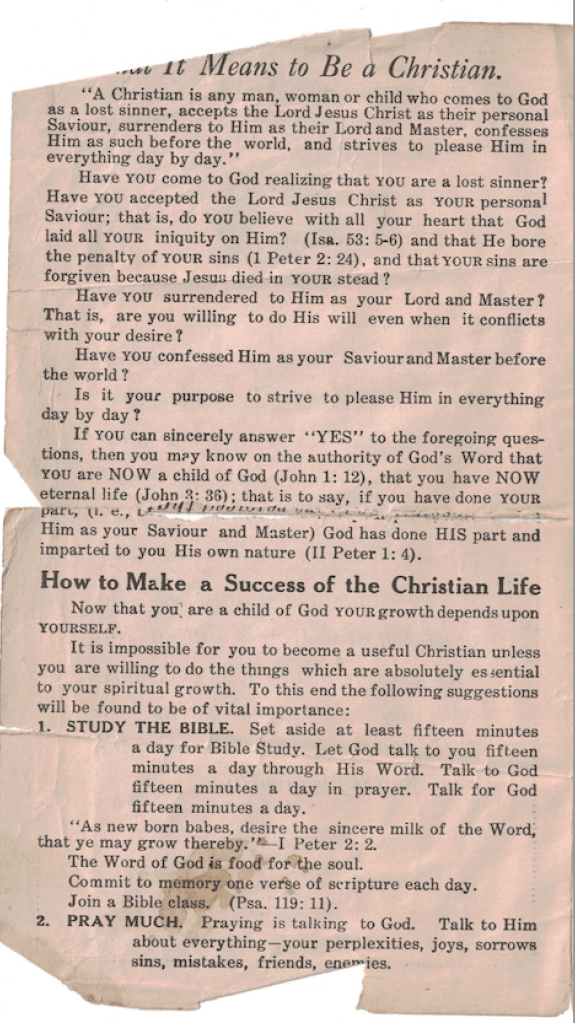
What it means to be a Christian
“A Christian is any man, woman or child who comes to God as a lost sinner, accepts the Lord Jesus Christ as their personal Saviour, surrenders to Him as their Lord and Master, confesses Him as such before the world, and strives to please Him in everything day by day.”
Have you come to God realizing that you are a lost sinner?
Have you accepted the Lord Jesus Christ as your personal Saviour; that is, do you believe with all your heart that He bore the penalty of your sins (I Peter 2: 24), and that now your sins are forgiven because Jesus died in your stead?
Have you surrendered to Him as your Lord and Master?
That is, are you willing to do His will even when it conflicts with your desire?
Have you confessed Him as your Saviour and Master before the world?
Is it your purpose to strive to please Him in everything day by day?
If you can sincerely answer “YES” to the foregoing questions, then you may know on the authority of God’s Word that you are NOW a child of God (John 1: 12), that you have NOW eternal life (John 3: 36); that is to say, if you have done your part (i.e., accept the Lord Jesus Christ as your Saviour and Master) God has done HIS part and imparted to you His own nature (II Peter 1: 4).
Now that you are a child of God your growth depends upon YOURSELF.
It is impossible for you to become a useful Christian unless you are attending to the things which are absolutely essential to your spiritual growth. To this end the following suggestions will be found to be of vital importance. that ye may grow thereby.” — I Peter 2: 2.
The Word of God is food for the soul.
Commit to memory one verse of scripture each day.
Join a Bible Class. (Psalm 119:11
2. PRAY MUCH. Praying is talking to God. Talk to Him about everything: your perplexities, joys, sorrows sins, mistakes, friends, enemies.
“Be careful for nothing; but in every thing by prayer and supplication with thanksgiving let your requests be made known unto God
3. WIN SOMEONE FOR CHRIST. For spiritual growth we need not only food (Bible study) but exercise. Work for Christ. The only work Christ ever set for Christians is to win others.
“Go ye into all the world and preach the gospel to every creature” Mark 16:15.
“When I say unto the wicked, Thou shalt surely die; and thou givest him not warning, nor speakest to warn the wicked from his wicked way, to save his life; the same wicked man shall die in his iniquity; but his blood will I require at thine hand.” Ezek. 3:18.
4. SHUN EVIL COMPANIONS. Avoid bad people, bad books, bad thoughts. (Read the 1st Psalm.)
“Be ye not unequally yoked together with unbelievers: for what fellowship hath righteousness with unrighteousness, and what communion hath light with darkness—what part hath he that believeth with an infidel—wherefore come out from among them and be ye separate saith the Lord” II Cor. 6:14-17.
Try to win the wicked for God but do not choose them for your companions.
5. JOIN SOME CHURCH. Be faithful in your attendance at the Sabbath and mid-week services.
“Not forsaking the assembling of ourselves together, as the manner of some is;” Heb. 10:25
Co-operate with your pastor. God has appointed the pastor to be a shepherd over the church and you should give him due reverence and seek to co-operate with him in his plans for the welfare of the church
6. GIVE TO THE SUPPORT OF THE LORD’S WORK. Give as the Lord hath prospered you. I Cor. 16:2.
“Give not grudgingly or of necessity, for God loveth a cheerful giver.” II Cor. 9:7
7. DO NOT BECOME DISCOURAGED. Expect temptations, trials, suffering and persecution; The Christian life is warfare.
“Yea and all who will live godly in Christ Jesus shall suffer persecution” II Tim. 3:12.
The eternal God is thy refuge. We have the promise that all things, even strange and hard unaccountable obstacles work together for our good. Many of God’s brightest saints who are now in glory, have passed through dark trials, the hottest fire, and were blessed and used mightily in the world made better because they had lived in it.
Read often the following passages of Scripture: Romans 8:18; I Corinthians 10:13
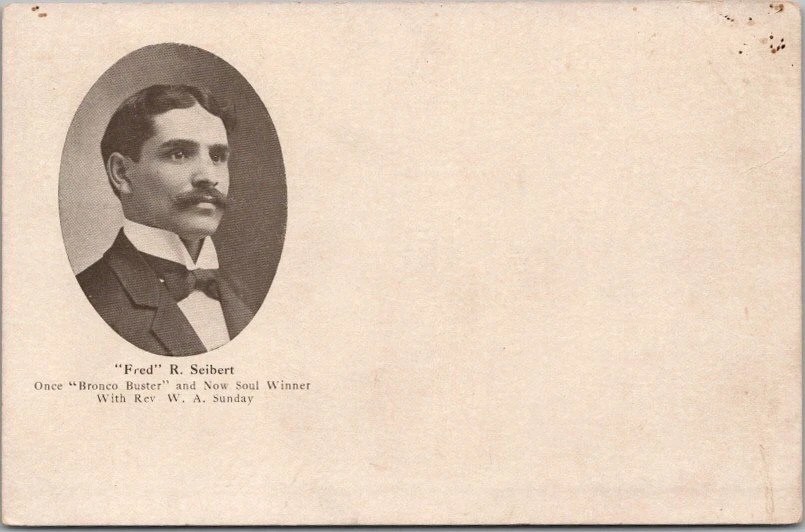
Fred R. Seibert played a pivotal role in Billy Sunday’s evangelistic campaigns during the early 20th century. As a member of Sunday’s core team, Seibert was known as the “handy man of the tabernacle,” overseeing the logistical and operational aspects of the revival meetings. His responsibilities included managing the physical setup of the tabernacle, coordinating volunteers, and ensuring the smooth execution of events.
Beyond his logistical duties, Seibert was deeply involved in the spiritual mission of the campaigns. He authored Rescue the Perishing, a guide aimed at assisting new converts in their Christian journey. Published in 1921, this work provided practical advice and biblical teachings to support individuals in their newfound faith.
Seibert’s contributions were integral to the success of Billy Sunday’s revivals, combining organizational acumen with a commitment to spiritual mentorship.
BELOW – Article in The South Bend Tribune. May 1, 1913.
HERE IS STORY OF FRED’S LIFE
If you have heard Billy Sunday, you have also heard him say, “Here, Fred, open some of these ventilators, it’s too hot in here,” or “If you people want song books, you can get them from Fred.”
In fact, Billy started talking about Fred long before South Bend people ever knew there was a Fred. But most of the people who are going to the tabernacle these days, know Fred now.
Fred is a stock sort of a fellow, with raven black hair. His last name is Seibert and his initials might be “A. B.”—always busy—but they are not.
Fred Seibert is official custodian of the big Sunday tabernacle on Vistula avenue and he guards the immense building day and night. If you want to hear an interesting story sometime, just step up to Fred and ask him to tell something of his life history.
But maybe Fred would be backward in speaking to a stranger about the matter, so you can be saved the trouble of approaching Fred by continuing to read this story.
Eighteen years ago, in a little town out in Iowa, there lived a young man who, like many other young men, was wasting his life away on cards and similar vices.

One night the young fellow got up from the gaming table with no money. Some people call it “broke,” while others who are without money, say they are “strapped.”
Well, “broke” or “strapped,” the gambler had no money, and he was disgusted with cards, the world and himself. He left the place and went out in the street. Near the corner he heard music. It was the singing of a church choir, but the fellow did not know that when he entered the building.
He knew it a minute after, however, when an evangelist in the front of the room arose to announce his text for the evening.
The man tried to leave the building, but a usher held him.
“I guess I done passed by my station,” said the gambler, but the usher thought otherwise and told the other so.
That gambler, broken spirited and penniless, was Fred Seibert, the “Fred” to-day of the Billy Sunday party.
And to-day Seibert can look the best man in the world in the eye and say casually:
“My friend, my life has not been in vain for the reason I have had the pleasure of bringing 12,000 people to the altar, and showing them the presumptive military pages to them who accept it.”
And Fred has earned a nation wide reputation as a Bible student and a personal worker. He has committed 1,400 books of scripture to memory and can do a trick with the Bible which is a common enough one with playing cards, but is a decidedly unique one when it comes to the Bible. He also enjoyed the privilege of assisting to escort his mother and six brothers and three sisters to the altar.
Pick up the Bible and turn to any page in it, and Fred will tell you the name of the book and just about the chapter you have your hand on.
Seibert was born in Waverly, Ia., and worked as a broom twister for nine years. After he was converted he entered the Moody Institute, where he stayed for a year and a half. Five years ago he joined the Sunday party. Ever since his duties have been that of taking care of the tabernacle and personal work.
To assist himself and others in this work, Fred wrote a little pamphlet, “Rescue the Perishing,” which has been accepted as an authority by experts of the Bible throughout the country.
Seibert is married, and as two children, who live in Santa Monica, Cal., but the greatest thing, next to his family and his God, is the greatest respect.
Fred pays his children so much for learning scripture and they have to memorize every week and recite it word for word.
The little boy and girl of mine keep on learning scripture and they interrupt their “daddy,” said Fred.
And they that follow me, because I do not believe he doesn’t care.
 Evangelist Billy Sunday (1862-1935)