Billy Sunday’s take on society (c 1907) in his day?

The following appeared in The Times (Streator, Illinois) · Sat, Jan 26, 1907 · Page 2

REV. BILLY SUNDAY DEFINES WHAT HE TERMS SOCIETY OF THE PRESENT DAY.

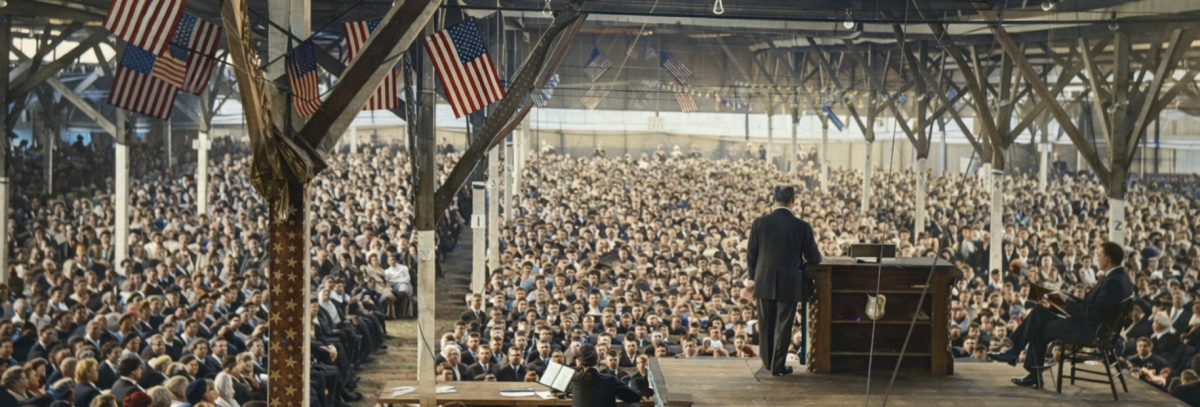
In one of his series of revival sermons at Kankakee Rev. William Sunday paid his respects to present day “society.” Following are a few spitballs that he tossed over the plate:

“I believe in Christian society, but nine-tenths of society is on the road to perdition.
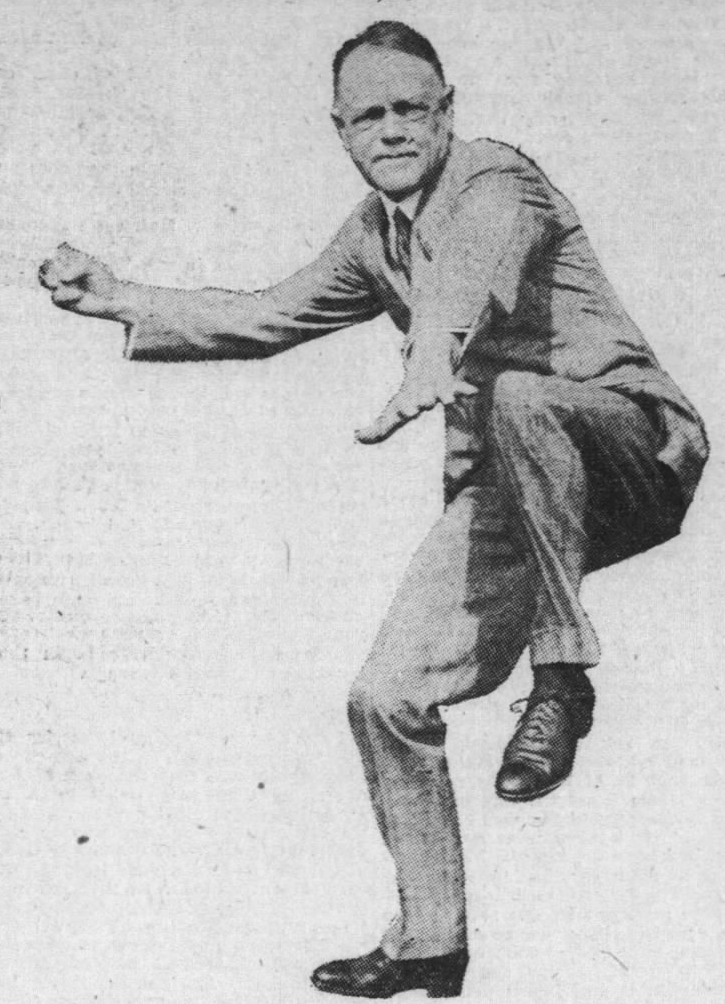
Society’s going to hell at a rate that’s dazzling. Where will you find the sheriff or judges who dare arraign the rich law breaker?

What is the reason they, don’t? Damnable politics. Society is hastening to the judgment that overtook Pompeii and Herculaneum, and some time may be buried in cinders and ashes thirty feet deep. I don’t know what method God will use to purify society, whether it will be fire or pestilence or famine. The only law some people will recognize; is the law of their desires.

“If you people don’t turn from your cussedness, God will do something to stagger you. He’s done it before and don’t think that He won’t do it again.” Sunday then drew a lurid word pie-ture of a brilliant drawing room in which a number of society dames were drawn about, a card table playing progressive euchre, while a waiter served them frappe.

On the other hand he pictured the back room of a stale beer joint, where four blear eyed, vermin covered old soaks, without clothing enough on their backs to flag a hand car, played penny ante for a jack pot of a few greasy old pennies.

“I fear that cursed gang of society more than I do all the town loafers in that beer joint.” shouted the speaker.

“There’s where your boy matriculates.

Here’s where he graduates. There’s where he backs out of the yard.

Here’s where his ticket is punched on the last division to hell.

“Society’s all right, lodges are all right, clubs are all right; but don’t think that’s all. I pity those whose visions are bounded by soups, frappes, and their Falstaffian appetites. I respect more one God-fearing, sox, darning old mother in Israel than a train load of good for nothing, gum chewing fudge eating, sizzle headed eissies who sit down and play rag time all day.”

And here the speaker gave a side-rending interpretation of a rendition of two popular rags.

“What America needs is not more railway extension and a lower tariff and a bigger wheat crop, but a baptism of the oldtime religion.”

The Times (Streator, Illinois) · Sat, Jan 26, 1907 · Page 2
The Greatest Show You’ve Never Heard Of: Circuit Chautauqua and the Performance of America


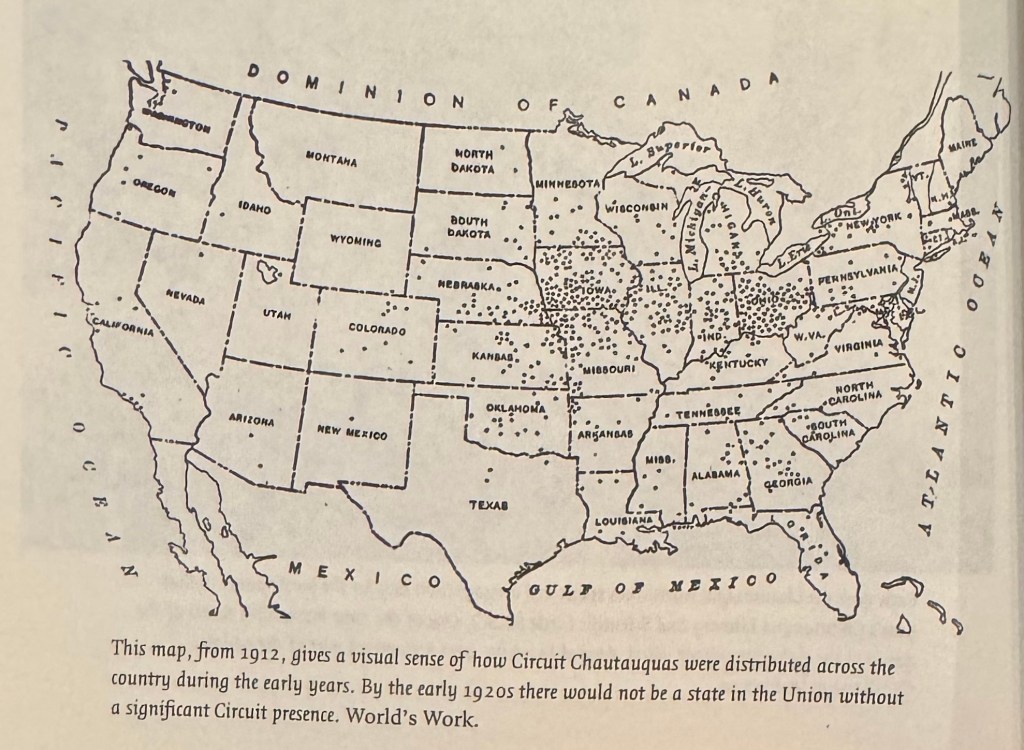
If you lived in small-town America a century ago and heard that a massive tent was going up just outside of town, you knew exactly what was coming: the Chautauqua was back.

Canning, p. 26

But not just any Chautauqua. This was the circuit Chautauqua—a full-blown cultural caravan, rolling into communities like a blend of TED Talk, county fair, gospel revival, and Broadway road show. It was, as historian Charlotte Canning describes it, “the greatest aggregation of public performers the world has ever known.”

Forget the dusty image of civic lectures and sober-minded schoolteachers. Circuit Chautauquas were performance-driven experiences, intentionally designed to shape the American imagination. They were mobile festivals of ideas, music, drama, and moral vision—staged under a giant canvas tent, and scheduled with industrial precision across the country.

Canning helps us see these not merely as education-on-wheels, but as orchestrated acts of cultural storytelling. At their heart, circuit Chautauquas were about performing a kind of “Americanness”—a staged identity that included democracy, morality, individual responsibility, and civic pride. And these weren’t abstract ideas: they were embodied in actors, lecturers, and musicians who took the platform with everything from Shakespearean monologues to lectures on temperance and suffrage.

The Paradox? These events, often remembered as wholesome and nostalgic, were also deeply commercial. Promoters like Roy Ellison and Keith Vawter didn’t just want to elevate the public—they wanted to make a million. Yet that’s part of the genius: they succeeded in selling culture as spectacle, without cheapening either.

To Canning, the tent was a stage—not just for performers, but for the entire community to see itself. Who belonged? Who was excluded? What did it mean to be an American in 1910 or 1920? Every act—whether musical trio or biblical dramatist—answered those questions in subtle (and sometimes not-so-subtle) ways.

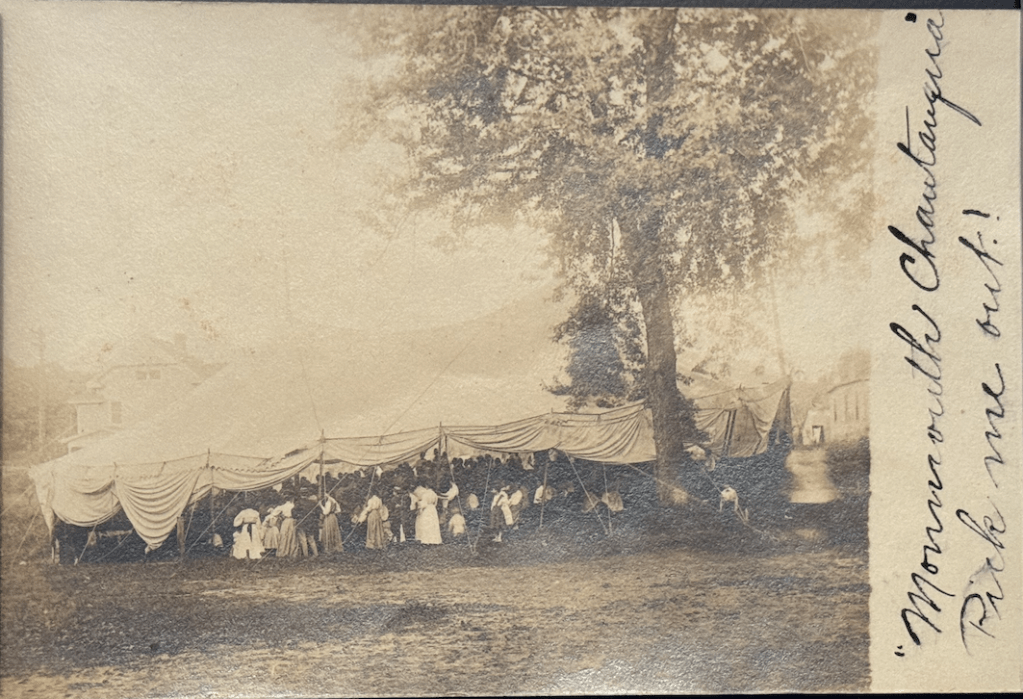
Monmouth, Illinois chautauqua, 1907 postcard. Author’s collection.
Billy spoke at Monmouth, August 17, 1906.

So the next time you think of rural America in the early 20th century, don’t just imagine plows and porches. Picture the circus-sized tent at the edge of town. The banners. The folding chairs. The packed crowd.

And inside that tent? America on stage.


Resource cited
Charlotte M. Canning. The Most American Thing in America: Circuit Chautauqua as Performance. 2005.

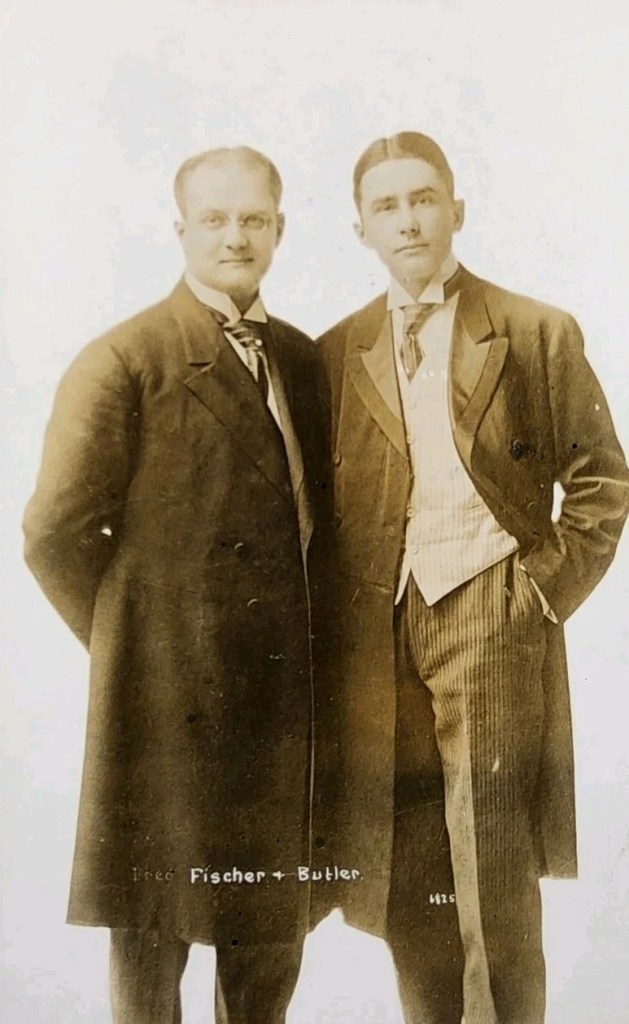
Fred G. Fischer – Choir Leader and Soloist and Charles Butler – Soloist

We recently acquired this image.

The reverse back of the postcard is blank.

Billy Sunday worked closely with two key musical assistants: Fred G. Fischer and Charles Butler, both of whom played significant roles in his evangelistic campaigns.

Fred G. Fischer – Choir Leader and Soloist

Fred G. Fischer was among Sunday’s earliest and most trusted collaborators. Serving as both choir leader and soloist, Fischer was instrumental in organizing and directing the musical components of Sunday’s revival meetings. His tenure with Sunday spanned approximately from 1900 to 1910, during which he helped cultivate the energetic and participatory musical atmosphere that became a hallmark of Sunday’s campaigns.

Charles Butler – Soloist

Charles Butler served as a soloist in Billy Sunday’s team, contributing to the musical aspects of the revival meetings. His role involved performing solo pieces that complemented the choir’s performances and supported the overall worship experience. Butler’s involvement with Sunday’s campaigns was notably during the years 1907–1908.

Both Fischer and Butler were integral to the musical dimension of Billy Sunday’s revival meetings, enhancing the emotional and spiritual resonance of the events through their leadership and performances.

Circa 1907 (1900-1910)

Billy Sunday 1907 Revival Campaigns

Worthington, MN – Began Dec 9, 1906. Ended Jan 5th, after four weeks.

Kankakee, ILL – Began January 6th, ending Feb 20th.

Murphysboro, ILL – Began Feb 23, 1907, ended March 31st.

Fairfield, IA – Began April 4th til May 6th.

Knoxville, IA

Gibson City, ILL – Began 9 June thru July 14th

Galesburg, ILL – Began 28 Sept thru 4 Nov 1907

Muscatine, IA – Began 10 Nov thru 15 Dec, 1907.

Above data cited in In Rare Form, Firstenberger: 121-22.

Also:

  • The Minneapolis Journal. Sat, Nov 24, 1906 ·Page 11
  • Gibson City Courier. Fri, Jul 19, 1907 ·Page 9
  • The Baltimore Sun. Sat, Oct 26, 1907 ·Page 11(“Billy” Sunday’s Way: Converted Ballplayer Converts 100,000 People)
  • The La Crosse Tribune. Thu, Jan 10, 1907 ·Page 1
  • Mattoon, ILL: Journal Gazette and Times-Courier. Tue, Jan 01, 1907 ·Page 7
  • Illinois: Cooksville Enterprise. Fri, Feb 22, 1907 ·Page 1
  • St. Joseph, MO: St. Joseph News-Press. Wed, Mar 27, 1907 ·Page 6
  • Joplin, MO: Joplin News-Herald. Wed, Apr 03, 1907 ·Page 4
  • Freeport, ILL: The Daily Journal. Tue, Jun 19, 1906 ·Page 5
  • The Muscatine Journal. Tue, Mar 05, 1907 ·Page 6
  • The Muscatine Journal. Fri, Apr 05, 1907 ·Page 1
  • Gibson City Courier. Fri, Jun 07, 1907 ·Page 4
  • Ottumwa Semi-Weekly Courier, Tue, Apr 30, 1907 ·Page 5