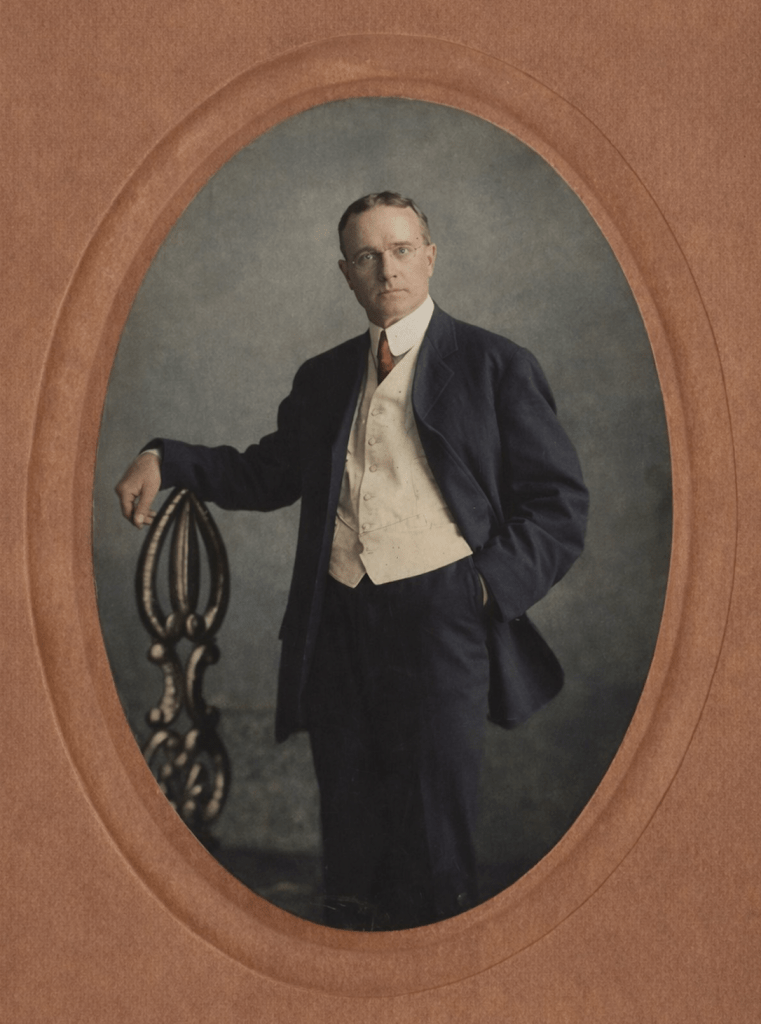
Evangelist Billy Sunday. Original is a b/w image. C. 1910s or earlier.
Evangelist Billy Sunday (1862-1935)
Former professional baseball player-turned urban evangelist. Follow this daily blog that chronicles the life and ministry of revivalist preacher William Ashley "Billy" Sunday (1862-1935)
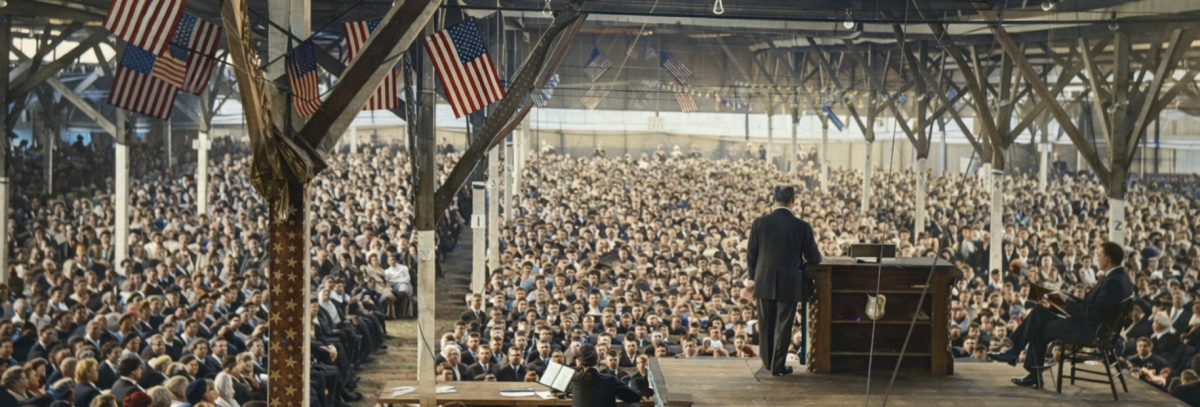
Evangelist Billy Sunday. Original is a b/w image. C. 1910s or earlier.
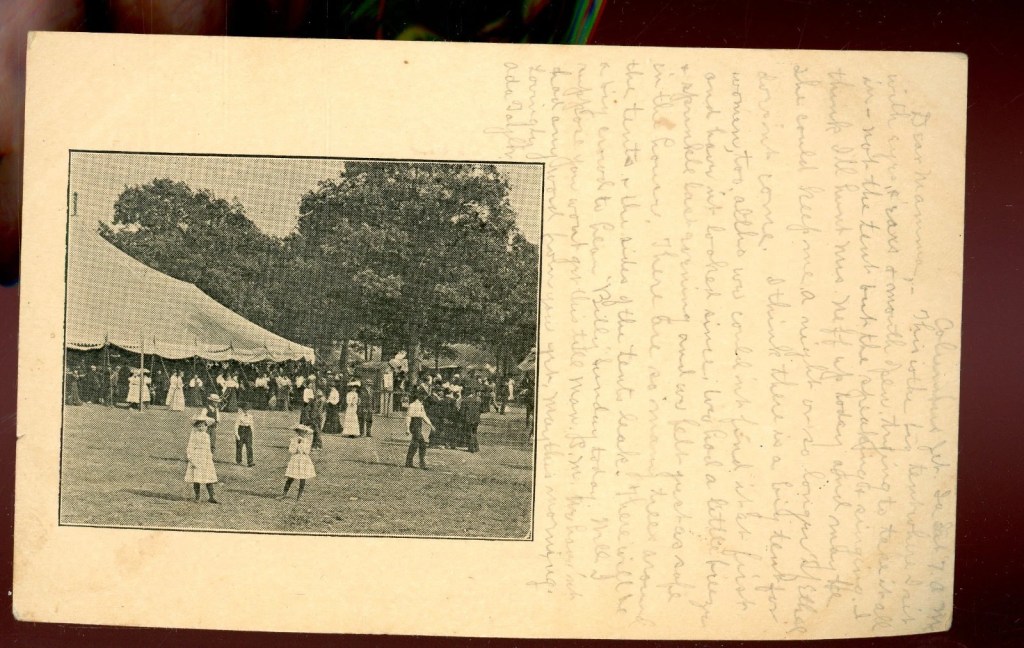
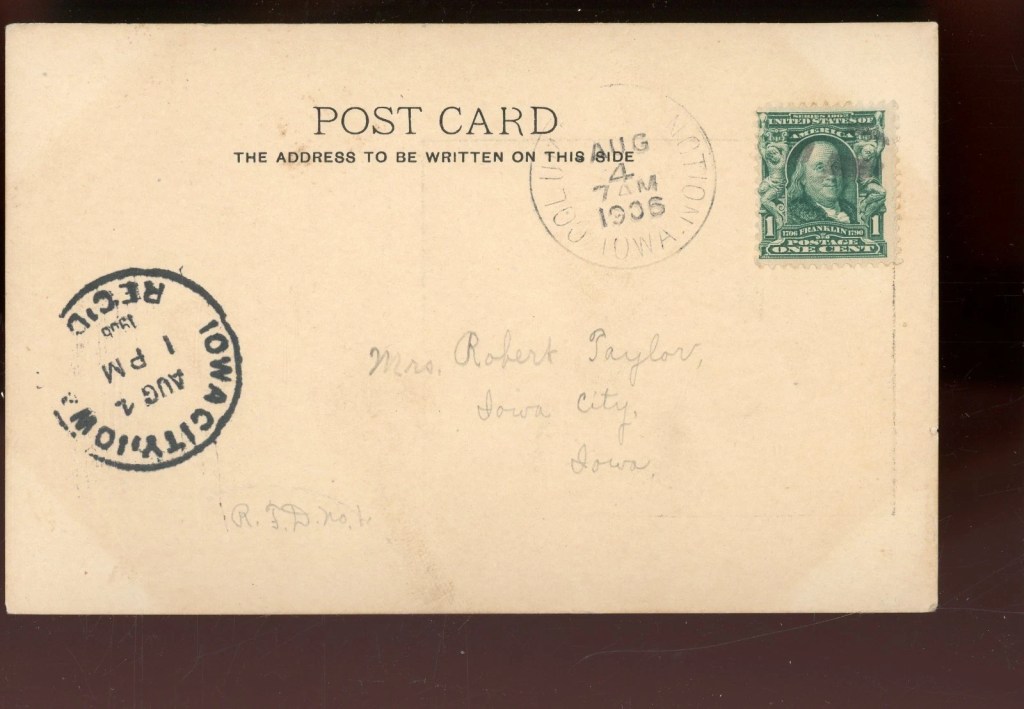
Postcard verifies Billy spoke “today” in Columbus Junction, Iowa (Chautauqua)
In October 1906 Billy preached to a crowd of roughly 800 people in Salida, Colorado, at First Presbyterian Church. During his message he exhorted the crowd…..
Read good books and keep good company. Every gambler and drunkard became so by imitating the gang he went with. Good books and good companions are to character what water is to the fruit trees, the grasses and the vegetables in this beautiful valley.
There are a few hundred books in the present Winona Lake home that Billy lived in for the last 30 years of his ministry. On the shelf, one can find A History of the American People, by Wodrow Wilson in the first edition (1902).
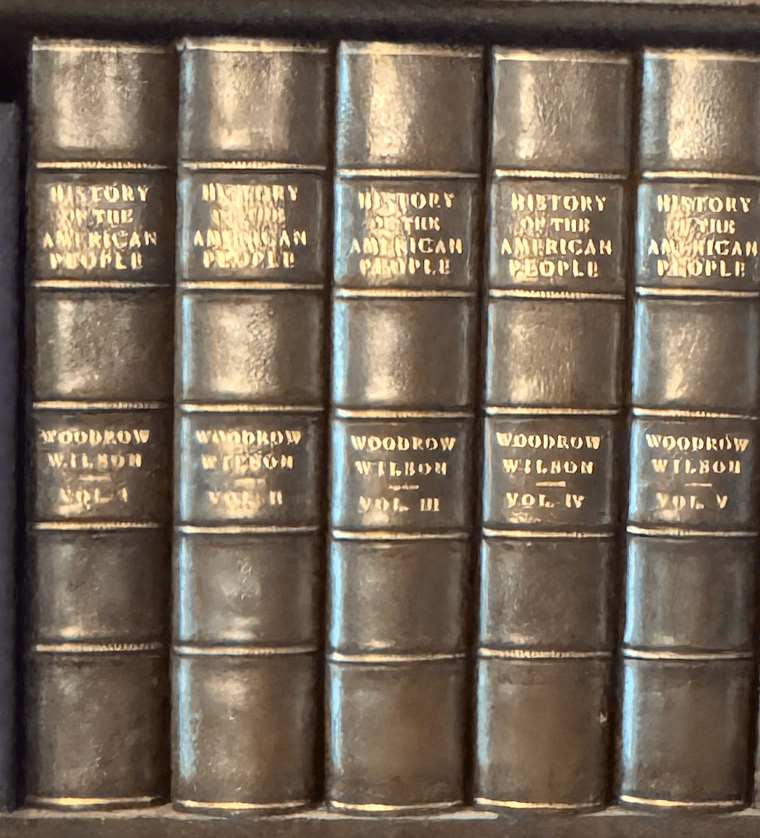
While Sunday’s authority came from Scripture, A History of the American People offered a grand, moral narrative of the United States that fit seamlessly with his revivalistic call: a chosen nation needing repentance and reform to fulfill its destiny. Wilson’s combination of national mission, moral urgency, and literary flair reinforced Sunday’s belief that evangelism and patriotism were inseparable in early-20th-century America.
Morgan Library at Grace College (Winona Lake) has several cards or notes in which Sunday and Wilson communicated together. They seemed to have liked each other.

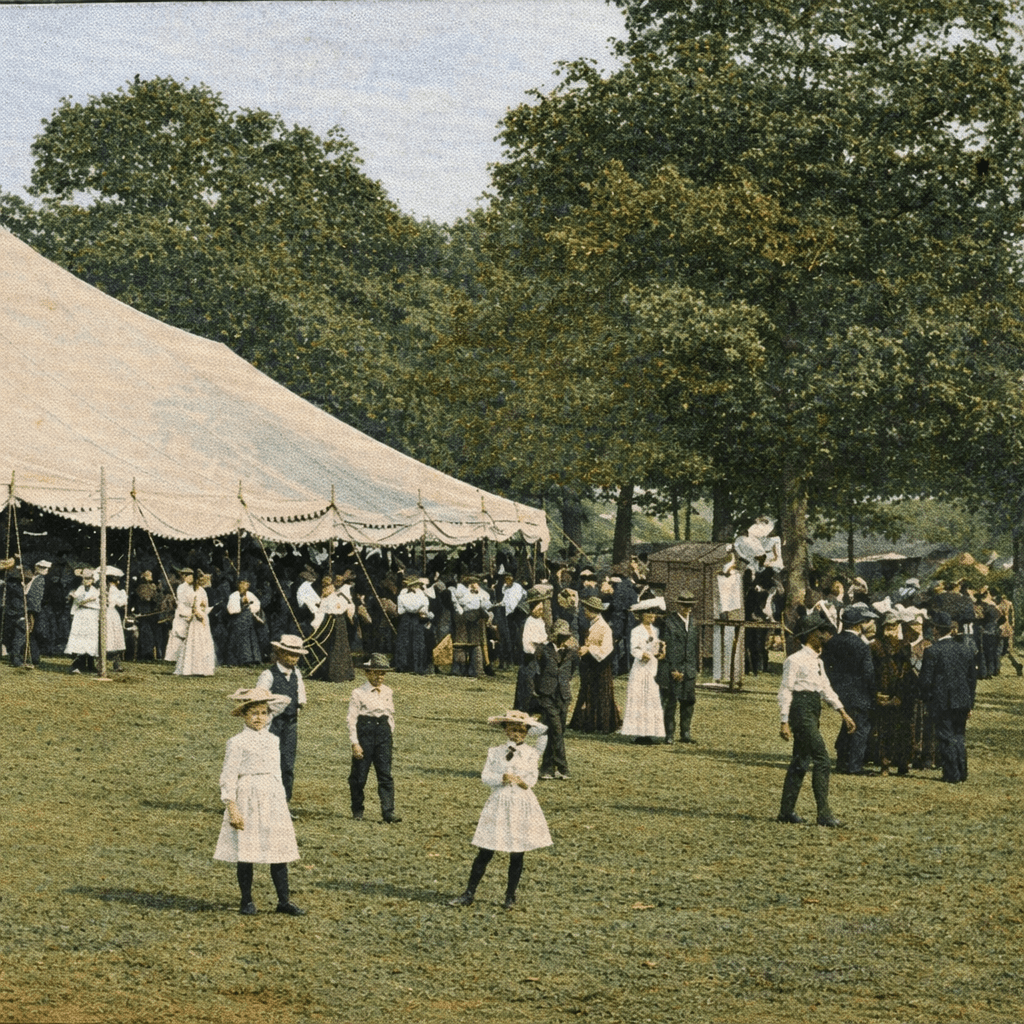
Colorized image. Billy ministered in Princeton,IL in February 11-March 17, 1906.


If you lived in small-town America a century ago and heard that a massive tent was going up just outside of town, you knew exactly what was coming: the Chautauqua was back.
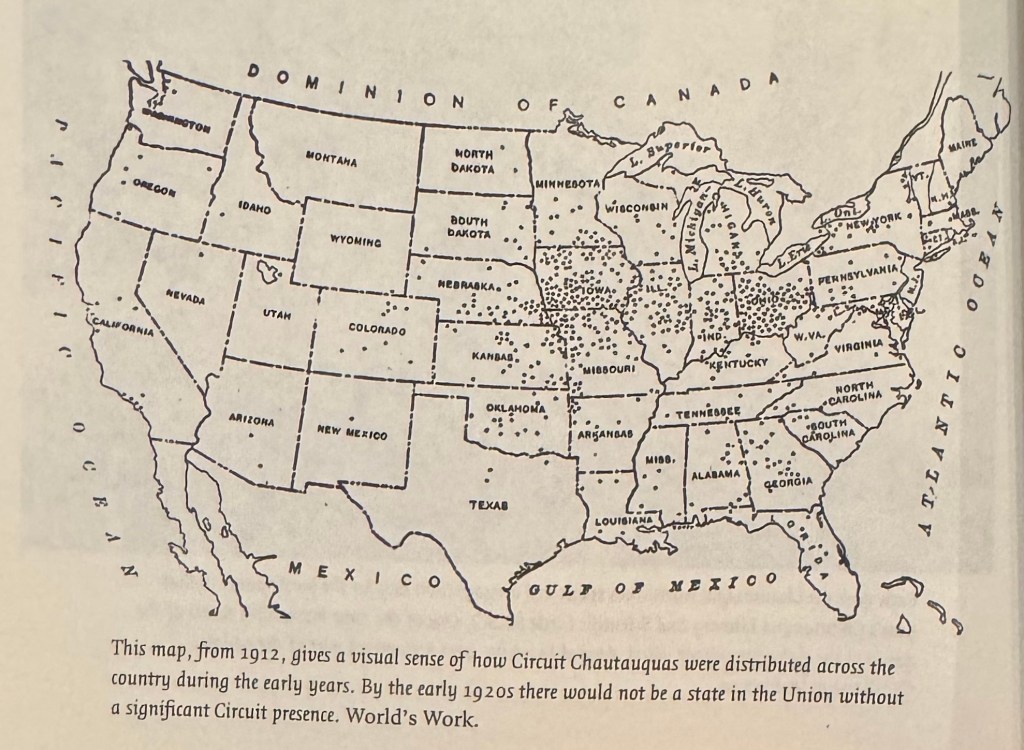
But not just any Chautauqua. This was the circuit Chautauqua—a full-blown cultural caravan, rolling into communities like a blend of TED Talk, county fair, gospel revival, and Broadway road show. It was, as historian Charlotte Canning describes it, “the greatest aggregation of public performers the world has ever known.”
Forget the dusty image of civic lectures and sober-minded schoolteachers. Circuit Chautauquas were performance-driven experiences, intentionally designed to shape the American imagination. They were mobile festivals of ideas, music, drama, and moral vision—staged under a giant canvas tent, and scheduled with industrial precision across the country.
Canning helps us see these not merely as education-on-wheels, but as orchestrated acts of cultural storytelling. At their heart, circuit Chautauquas were about performing a kind of “Americanness”—a staged identity that included democracy, morality, individual responsibility, and civic pride. And these weren’t abstract ideas: they were embodied in actors, lecturers, and musicians who took the platform with everything from Shakespearean monologues to lectures on temperance and suffrage.
The Paradox? These events, often remembered as wholesome and nostalgic, were also deeply commercial. Promoters like Roy Ellison and Keith Vawter didn’t just want to elevate the public—they wanted to make a million. Yet that’s part of the genius: they succeeded in selling culture as spectacle, without cheapening either.
To Canning, the tent was a stage—not just for performers, but for the entire community to see itself. Who belonged? Who was excluded? What did it mean to be an American in 1910 or 1920? Every act—whether musical trio or biblical dramatist—answered those questions in subtle (and sometimes not-so-subtle) ways.
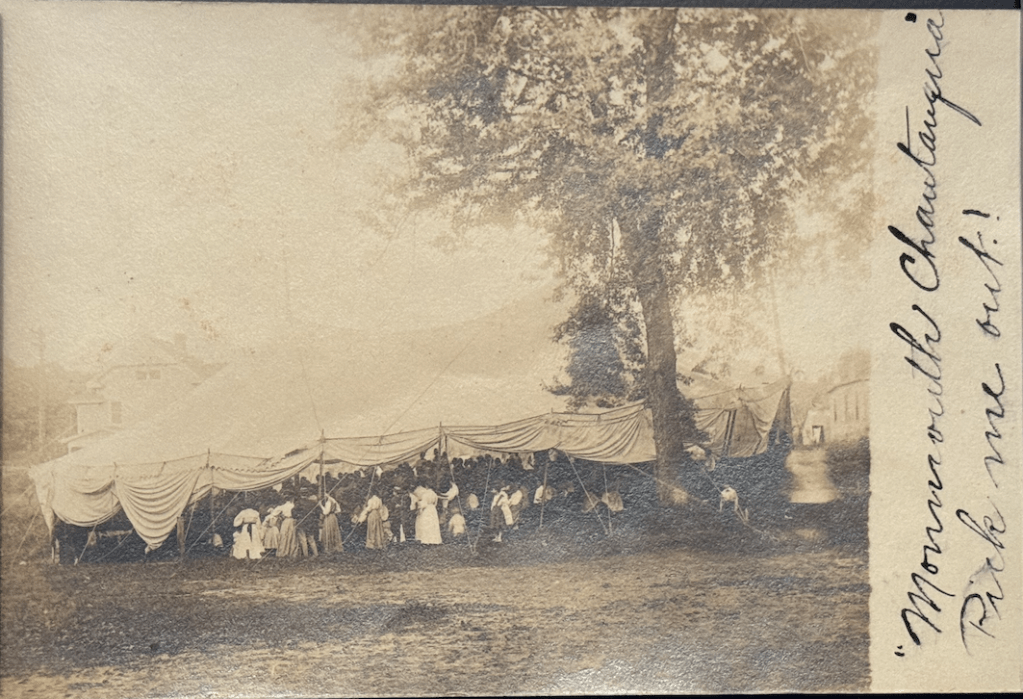
So the next time you think of rural America in the early 20th century, don’t just imagine plows and porches. Picture the circus-sized tent at the edge of town. The banners. The folding chairs. The packed crowd.
And inside that tent? America on stage.
Resource cited
Charlotte M. Canning. The Most American Thing in America: Circuit Chautauqua as Performance. 2005.
Sterling Standard. Fri, Jun 08, 1906 ·Page 2
WORK BEGINNING AT PROPHETSTOWN
SPLENDID MEETING IN TABERNACLE MONDAY NIGHT.
HISTORY OF MOVEMENT
The Men Who Were First Interested and Their Work to Interest Others.—Sunday Coming Wednesday.
Excerpt:
The tabernacle extends north and south, with entrances on the north and west. It is built on the plans of the Sterling tabernacle of two years ago, only of course it is not so large. It’s dimensions are 80×128 and 32 feet to the gable. The seating capacity, including the choir, seats and platform is easily 2,200, while the spacious isles, the outer circle and space to the east of the platform will comfortably accommodate three or four hundred more. The cost of the building complete is $1,500.00. Contractor John Blackmore completed his work nearly six weeks ago, so that Prophetstown has been ready and waiting for Rev. Sunday, with her lamps trimmed and burning. The choir and platform are at the south end of the building. A natural contour of the ground as it rises from this point to the north forms a natural amphitheater for the audience.
SUNDAY REVIVAL AT PROPHETSTOWN (June 8)
Evangelist Says Freeport, “Except Bunch That Devil Has Got,” Sends Greetings.
In opening his revival at Prophetstown Wednesday evening Rev. William A. Sunday said he understood that “a lot of derogatory stuff had been sent out broadcast concerning the Freeport meeting, but not one-hundredth part of what you have heard is the truth.” As to his being a grafter, he said that he would give $100 to prove any of the lies that had been said against him.
Freeport people, he said, with the exception of “a bunch that the devil had got,” sent Prophetstown their love and greetings. He kicked a little about the small contributions at the first two meetings and sent out the ushers with tin pans instead of pie plates.
Freeport Journal-Standard. Fri, Jun 08, 1906 ·Page 1
PROPHETSTOWN’S GREAT REVIVAL OPENED IN TABERNACLE BY SUNDAY (June 8)
All the Southern Half of Whiteside Represented Wednesday Night
GREAT PREACHER IS IN EARNEST IN WORK
Professor F. C. Fisher Marshaling the Singers of the Place for a Grand Chorus-Rev. Mr. Sunday Introduces Himself to the people, as no stranger-Wants Better Lights-Daily Reports
Rev. W. A. Sunday opened what will without doubt be the greatest revival in Prophetstown’s history, in the big tabernacle last night, before a congregation representative of the southern half of Whiteside and northern part of Henry counties. While not so many attended the opening meeting as might have been expected, yet the interest was great among all who were present—sinner and saint alike. It is a question how anyone could hear and see ‘Billy’ Sunday in action and not become interested. We do not mean converted, but interested. Convincing a lot of hard shell sinners is not so easy at first, but no one could have been in the tabernacle last night without being deeply interested and satisfied in his own mind that Rev. Sunday is in earnest.
On the platform last night besides the choir, and supporting the evangelist, were Reverend Elijah P. Brown, who opened the two preceding nights; Rev. J. E. Courter of the Lyndon M. E. church, Rev. C. T. Brown, and Rev. J. F. Fumston of the local churches, Prof. G. P. Fletcher, who accompanies Rev. Sunday, was on hand, early, marshalling the singers towards the platform and hurriedly forming them into a choir. Fletcher is a songster and the way he drilled that choir right before the congregation and then the congregation, before the choir was inspiring to lovers of vocal music. Some of the best known of the gospel hymns were used and it was surprising how Prof. Fletcher’s individuality was felt and made manifest in that short half hour of song service. Prof. Fletcher says: ‘Pound out every one of those words in that chorus,’ and they were pounded out, and with vim.
The Introduction.
Rev. Sunday introduced himself in a way which seemed to please everyone; he had met many from here at his meetings in Dixon, Sterling, Princeton and Aledo, and therefore felt that he did not come to Prophetstown as a stranger; those whom he did not know he requested to forget that he was a stranger and know him as they would any other man. He thought the splendid tabernacle and the people of the city and the country, due to their earnestness and the enthusiasm of the meetings, a great feast. Freeport, with the exception of a bunch that the devil has got, sends Prophetstown her love and greetings.
Defends Position.
Rev. Sunday said he understood that a lot of derogatory stuff had been sent out broadcast concerning the Freeport meeting, but, that not one-hundredth part of what you have heard is the truth. As to his being a grafter, he said that he would give $100 to prove any of the lies that had been said against him. The lighting of the tabernacle he thought was a little dim and he would have it improved tomorrow. A dimsey little lamp in the home drives many a boy to town where the lights are brighter, and Rev. Sunday don’t want anyone to leave the tabernacle to go where the lights are better. He congratulated the Daily Standard on its enterprise in securing a daily report of these meetings; kicked a little about the small contributions at the first two meetings and sent out the ushers with tin pans instead of pie plates; announced his meeting for next time for next Sunday afternoon at 2:30 and then read his text—Genesis, 32nd chapter, 28 verses—And he said Thy name shall be called no more Jacob, but Israel: for as a prince hast thou power with God and with men, and hast prevailed.”
The Sermon.
The speaker said that the history of Jacob was the history of the Jewish nation. Jacob cheated his brother, deceived his father and was compelled to leave home. When it came time to return at the Lord’s command Jacob wished to find out what sort of a reception he would meet, so he sent out messengers, who returned and said his brother Esau was coming to meet him with 400 men.
This made Jacob afraid, and he thought to appease Esau with presents. The Rev. Mr. Smith can illustrate in these people who try to buy their way into the kingdom through their works. How the spectacle of Jacob’s mind must have appeared to the Lord. Here, you poor little creature, such an one is unfit and you and think that these gifts money will buy them anything, even to a reserved seat in Heaven.
When to Pray.
You pray when you are distressed—when the physician shakes his head you make all kinds of promises, but when the clouds roll away, then you swell out your chest and bid God good-bye. But God heard Jacob’s prayer, even if he wasn’t sincere, that night He sent an angel to him and he wrestled with God all day. God had to use forcible means with Jacob before he got him into a his right frame of mind, just as He has to do things these days in order to get people to think. No one ever won out in a fight against God yet. Jacob prayed for deliverance.
Gave Some Advice.
Here Rev. Sunday told of a lot of things from which he thought some Protestant people ought to pray for some kind of deliverance. Jacob reached a crisis out there wrestling with God. He is wrestling with you to give up your lives and this, this will be your crisis. Oh, many of you are in your crisis. You get religion and get the right get the kind that pays your debts whether they are outlawed or not. The speaker figured that we can’t expect the merchant down town to have any respect for or faith in religion when some old skin-flint in the front pew in the church owes him a debt that’s been
outlawed for years.
Jacob Renamed.
The re-naming of Jacob was compared with God’s re-naming and making new men of the present day sinners. God will hear all of you, red or yellow, black or white. When you kneel before the Lord it’s either as a saint or sinner, not a labourer or a millionaire. Rev. Sunday made it plain that he would rather see the tabernacle half full of people wanting to be saved than to see it full of people praying for other folks to be saved.
Went After Society.
He said people are inclined to eat and sleep too much over this old world going to hell; and he dealt some fierce blows over the indifference of man’s last condition generallly. Prophetstown society also got a few rare, possibly gentle, reminders of what will follow when ‘Billy’ Sunday unwinds himself a few more coils; he intimated that old Prophetstown would roll over on its pillow and hope for a new place to rest its head. People are not brought to God on an excursion, said the speaker, some one has got to lay awake nights and we’ve got to do it. God will cash your check if your name is good and you have the right kind of a signer with you; when you go with the name of Jesus Christ, you have a name that moves the world.
Canine Interruption.
A barking dog under the platform here caused the speaker to ask that the canine be removed, remarking that it was hard enough to preach to humanity without adding dog to the proposition.
His next line of thought was that as we plow, plant and harrow, God doing the rest to produce crops, so if we want to save people at this revival we must go to praying—Jacob did—and God will do the rest; he will save souls if the prayers of these people come to Him. Rev. Sunday reminded his hearers how this republic and its constitution was brought forth in prayer and went on to assert that great things are accomplished only by prayer. He brought up the matter of Jacob’s mother mixing in the mess between the brothers and father and making it worse, and said that many a child was going to the devil on account of a fool mother. His final effort was the portrayal of the meeting of Jacob and Esau; when Jacob prevailed with God it didn’t take him long to prevail with his brother, and the reconciliation was complete.
A Happy Religion.
Rev. Sunday pleaded for a smiling, happy religion; be joyful and pray to that end; live your religion—bake bread, govern your children, plow corn with religion. Here the speaker looked at a watch and announcing that he had already spoken over his time, abruptly closed the meeting without prayer, song or benediction.
Rev. Sunday is a gymnast and most of his new Prophetstown friends cannot help but smile at some of his gymnastics and character work in the pulpit or rather on the platform; you don’t keep “Billy” in any old pulpit—he covers the whole platform and will probably be all over the old tabernacle before he gets through.
The Town Waking.
Prophetstown, after hearing Sunday in her midst just once, has already begun to sit up and take notice, for what manner of man is this who calls things by their right names, does character work and gymnastic stunts in the pulpit—calls the evil one devil and the the bad place hell, and many more things of this order, yet keeps up a steady rapid fire of scorching gospel truths against the ramparts of sin and unrighteousness? Prophetstown will no doubt see.
Sterling Standard. Fri, Jun 08, 1906 ·Page 1
CROWDS AT PROPHETSTOWN HEAR REV. WILLIAM SUNDAY’S SERMONS (June 12)
Address of Convincing Nature Delivered Friday Evening
EVANGELIST WILL PLAY BALL EARLY NEXT WEEK
Miss Miller Coming From Chicago to Hold Meetings For Children-Text Friday Night was, “Lord, it is I?”. Large Number of People Respond to First Call For Workers From the Platform
The attendance and interest at the Sunday revival meetings in Prophetstown is increasing and it begins to look as though they would have a revival, down in the little city of the Prophet. Probably as many more as were there last night could be crowded into the tabernacle, but nevertheless it was an encouraging crowd that greeted Rev. Wm. A. Sunday at his third meeting. The choir now nearly numbers 200 and is still growing.
Visitors Coming In.
People from outside towns are beginning to come, many from Tampico, Lyndon, Leon and Hooppole vicinities being in the congregation.
The baseball fans have also become quite regular attendants for the news has gone out that Billy Sunday is to play center field with the Prophetstown team on the local diamond in a game with Walnut some day next week. Mr. Sunday is now getting acquainted in Prophetstown; he spent much of yesterday on the streets in company with States Attorney Waite, meeting the business men and citizens.
Children’s Meetings.
Miss Miller of Chicago will be here early next week to take charge of the children’s meetings. Mr. Sunday talked contributions to his congregation last night in a manner that made the Prophets think they were pretty tight with their pocketbooks.
$18.00 was the sum total collected Thursday night and Sunday handed the folks a heart-to-heart talk about it. Then he let loose a few more hot shots about the graft talk which has run riot in Prophetstown concerning him. He warned these old character highwaymen that this talk would have to cease or he would make some of them hunt their holes:
“If I had gone to playing the races or the devil after I quit baseball,” said Sunday, “these old reprobates wouldn’t have had a word to say against my character.”
Submits Proposition.
The evangelist said it cost him just $350.00 to preach in Prophetstown; would some of the old snarling devils do as much for humanity?
“If it’s necessary,” he said, “I’ll preach here for a month and pay $350 for the privilege of doing it; will some of these old sons of perdition do that? Prophetstown shows much evidence of prosperity; you have fine homes, plenty of money in the banks and all that, now let’s be stingy in showing your gratitude to God. A $50 per capita would just about do the business and let the money stay right here; I don’t need it. You folks sit right here in a religious way on your own bills, now then, dig up!”
The Sermon.
Rev. Sunday took as his text last night, a part of the 22nd verse of the 26th chapter of St. Matthew— “Lord is it I?” A synopsis of this sermon follows: God placed man in the garden of Eden, he ate of the forbidden fruit and the world became a graveyard. If man hadn’t done this we wouldn’t have had all the ills and sins of this world to contend with. God’s plan was overthrown because man disobeyed him, therefore a plan of redemption was made and it is that man can be saved if he will; it’s off God’s shoulders and on your own; it’s up to you. If you do not grasp the opportunity, no one will lie to blame but yourself. Jesus, Christ came to fulfill God’s promise.
Selling Jesus.
“You are selling Jesus Christ,” he told his hearers, “for a mug of beer, for adultery, for a bank account and for the pleasures of the world; don’t you condemn Judas; you’re as black a blot as he. Mr. Sunday described in detail the scene of Judas’ leaving the supper and of the movements of Christ and the disciples till they reached Gethsemane; the disciples were placed in groups (while Jesus went to pray alone), according to their decency, just as He does you; it don’t make any difference what your bank account amounts to, what God reckons is your character.
Stand up for Christ; it makes no difference whether the world acclaims you or not; look out for that man whom all men acclaim; the man or woman who has no enemies is a flat fizzle; stand up for God, even if it does make you enemies.
Not every man or woman whose name appears on a church roll is a true Christian; out of possibly 27 million people who belong to church in this country, probably no more than five or six million are downright honest, true, sincere Christians; as we increase the principle, we decrease the number.
Some of you church members act as though you had a through ticket to heaven with Pullman palace car privileges; but I want to tell you some of you are going to be sidetracked long before you get there, with a hot box; some of you don’t like this but I’m a surgeon working for God and I drive my wagons up to the hilt in the plague spots.
The Modern Church.
Many of our churches are becoming third rate amusement bureaus. The world needs the gospel of the Son of God, and in this the evangelist includes the Methodists. He asked what had become of the old time class leaders and their meetings of the old days; where were the fervent amens of the Methodists of long ago; of course we don’t expect a simon-pure, milk-fed-out-of-the-bottle congregationalist to holler amen, but where has the Methodist amen gone to?
You fellows haven’t any use for a preacher as long as you can clip compass, but when the doctor shakes his head you send in a 4-11 call for the preacher.
Mr. Sunday then drew a beautiful word picture of the betrayal, the journey with the cross and the crucifixion. There’s a cross for you to bear, a crown for you to wear. Jesus suffered and died to open up and make possible a plan of redemption whereby you and I may be saved from hell. After the mockery of Jesus on the cross came the words, “It is finished”; across the chasm of 1900 years come these words: Peace for you was made through the death on the cross; you ought to shout for joy that Jesus died for you; thousands upon thousands would in turn die for Jesus, but some of you wouldn’t sweat a hair for him.
An invitation to all who “want to be a better man or woman” was extended to gather in the space before the platform. Lots of enquirers knelt in the front and a also a goodly number of those outside the fold. A short season of tense prayer closed the service.
Sterling Standard. Tue, Jun 12, 1906 ·Page 7
Closed July 8th, 1906. Republican-Northwestern. Tue, Jul 10, 1906 ·Page 3
SUNDAY PROMOTES GREAT REVIVAL
At Prophetstown—Converts Nearly the Entire Town—Collection Totals Greater Number of Dollars Than There Are People in the Town.
Evangelist Sunday’s campaign at Prophetstown, a town of 1,800 people, has closed. At the closing meeting a fund of $2,300 was made up for the evangelist and his helpers. People in that vicinity are enthusiastic over the effect of the meetings. The Sterling Standard says: The greatest of Rev. W. A. Sunday’s meetings in Prophetstown was held last evening in the tabernacle—after the series of revival meetings were thought to be over. Mr. Sunday had consented to remain over one day and preach one more sermon to the Prophets and the people down that way are rejoicing today and are saying, “It is well, it is well!”
Great Upheaval.
The tabernacle was nearly filled with people mostly from Prophetstown, a majority of the audience being young people. No one was especially looking for so great an upheaval within the forts of sin as occurred last night, when 125 people went forward to grasp Billy Sunday.
by the hand and by this act accept God’s plan of redemption as preached for four weeks by the evangelist who, for that length of time has been in their midst.
All Classes and Ages.
There were all classes of people in that assemblage who went forward—old gray heads, active hard headed business men, women, young ladies—and young men, among the latter being a score of more who have long been “hitting the grit” on the downward path. The righteously inclined people of Prophetstown are glad to the bubbling over point today over the havoc wrought in the devil’s ranks last night.
Great Change in City.
They say that it means a change of the moral level of the city, well filled church pews, a quiet and law-abiding Sabbath and finally—the last year for the saloon keeper and his business in Prophetstown. It wasn’t the singing that did it all last night, for Billy Sunday led it himself; it wasn’t particularly the sermon, although one of the best delivered during the past month, but it was the everlasting pounding away of Mr. Sunday, morning, noon and night, for four long weeks, that finally culminated in a smash up of the hosts of satan who have long besieged the little city on the Rock.
Effect of Sunday’s Work.
The entering wedge was set Sunday afternoon when the able and convincing talk was given on the liquor business—when Sunday skinned the booze shops of Prophetstown of all the gilt and plate glass, leaving exposed to his 2,500 masculine hearers the woe, despair, lost hopes, ruined fortunates and wrecked humanity within.
JANUARY
Freeport Journal-Standard. Thu, Jan 25, 1906 ·Page 1
FEBRUARY
MARCH
APRIL
Initial Dates for Freeport revival set:
MAY
After the initial last night of May 11th, the revival was extended.
The Freeport Bulletin (May 24) says…..
JUNE
Last date for Freeport Revival is June 3rd
JULY
Post Freeport campaign Freeport Journal-Standard. Thu, Jul 05, 1906 ·Page 5
In early 1906, the city of Freeport, Illinois, began to prepare for what would become one of the most talked-about spiritual events in its history: a full-scale revival campaign led by the former professional baseball player turned evangelist, Billy Sunday.
The Tabernacle and the Build-Up
As early as January 25, the Freeport Journal-Standard announced the ambitious plans for a massive temporary tabernacle to be constructed at the corner of Jackson and Walnut Streets. Measuring 90 by 120 feet and designed to seat 2,000 people, the structure reflected both the scale of Sunday’s influence and the expectations for a large crowd. With $2,500 allocated for lumber and a total projected cost of $6,900 for lighting, labor, and construction, the city made a significant investment in preparing for the revival.
By February, anticipation was spreading beyond Freeport. A February 17 Freeport Daily Bulletin article declared that a “revival wave [was] sweeping the state,” pointing to the upcoming April arrival of Sunday as a major contributor. Just weeks earlier, Sunday had concluded a powerful campaign in Princeton, Illinois, resulting in nearly 1,900 conversions out of a town of just 5,000—numbers that generated buzz and raised expectations for Freeport.
As March turned to April, preparations intensified. Local churches agreed not to hold their own services during the revival campaign, recognizing the potential for unity and focus. The Hamlyn Brothers completed the tabernacle by early April, just in time for the set launch date of April 28.
Revival Unleashed: April 28 – June 3
The revival began on April 28 and was initially scheduled to last just two weeks, ending May 11. But as nightly crowds filled the tabernacle and the number of conversions grew, the campaign was extended through June 3. By May 24, reports in the Freeport Bulletin indicated that 490 conversions had taken place just between May 11 and May 22. Momentum was building.
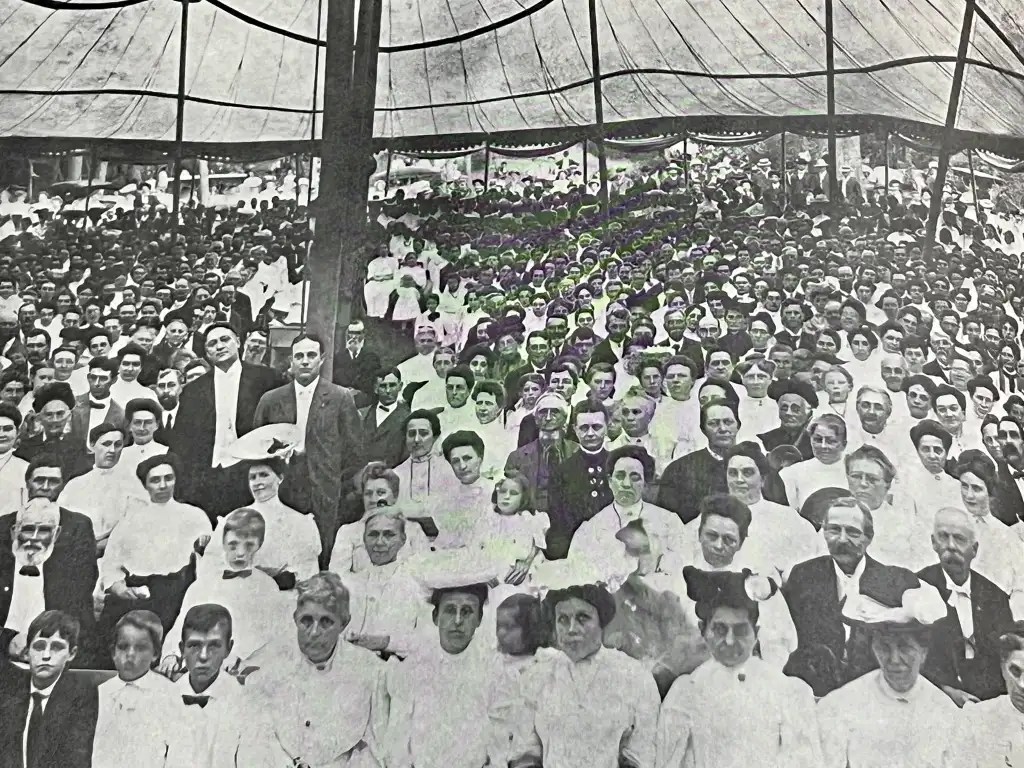
The Freeport tabernacle became, at that time, the largest such structure Sunday had used. Thousands streamed in nightly to hear his fast-talking, energetic sermons that combined homespun stories, baseball metaphors, and unflinching moral appeals. He denounced sin with the fervor of a prophet and the flair of a showman, and the people of Freeport couldn’t get enough. The revival stirred the city so thoroughly that even local skeptics had to admit its impact.
Aftermath and Legacy
The meetings formally ended on Sunday, June 3. Though exact figures for total conversions are not available in your data, the revival left a lasting impression. Just a month later, Sunday was preaching in Prophetstown, Illinois (Freeport Journal-Standard, July 5), continuing his revival circuit—but the spiritual spark he had ignited in Freeport still lingered.
The 1906 campaign marked a pivotal moment in Sunday’s early evangelistic career. Freeport, known for its beer and pretzels, had experienced a spiritual shake-up. Though some converts would later drift away—as often happens after revival—the consensus, even among critics, was that Sunday’s visit had made Freeport a better, more sober, more spiritually awakened city.
By Kraig McNutt
In the spring of 1906, the city of Freeport, Illinois—nicknamed by some as the “town of beer and pretzels”—became the unlikely stage for one of the most memorable revivals in early 20th-century American evangelicalism. It was led by none other than Rev. William Ashley “Billy” Sunday, the baseball-star-turned-evangelist whose fiery sermons and athletic stage presence would eventually captivate audiences across the country. But in Freeport, his gospel campaign left an impression still remembered more than a century later.
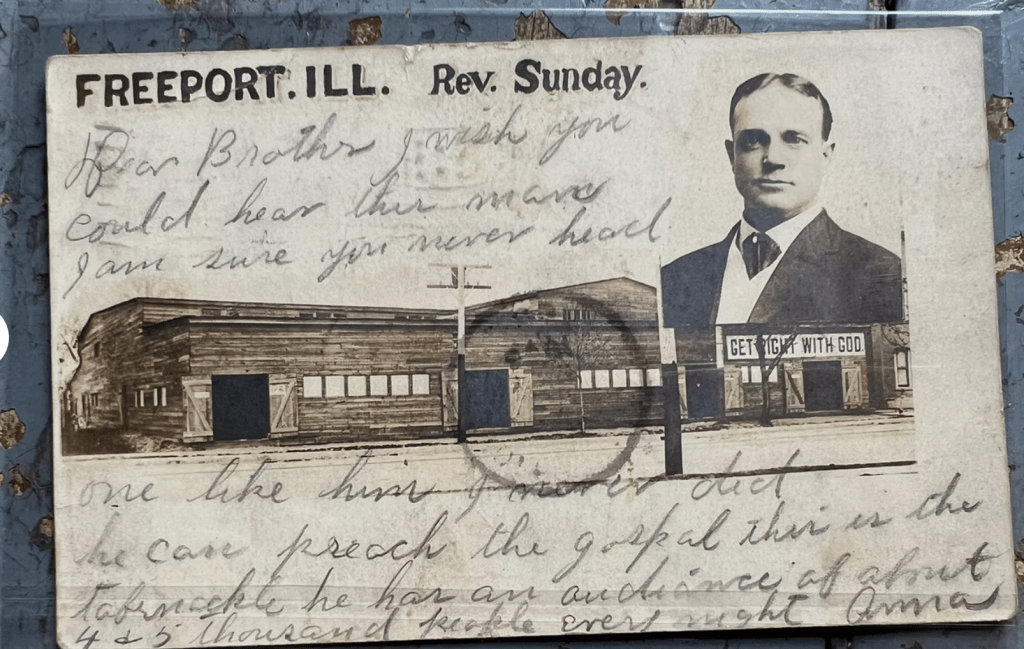
On January 25, The Freeport Journal-Standard announced plans for a wooden tabernacle to be built at the corner of Jackson and Walnut Streets—a temporary structure, 90 by 120 feet, with seating for 2,000. The project, including lumber, lighting, and labor, came with a hefty price tag of nearly $7,000, a bold investment for a campaign that hadn’t even begun.
But the momentum was building. By February, reports described a “revival wave sweeping the state” (Freeport Daily Bulletin, February 17), with Sunday’s campaign seen as the crest of that spiritual tide. Sunday had just completed a campaign in Princeton, Illinois, where 1,890 people—over one-third of the town’s population—had responded to his call for conversion.
Anticipation spread quickly in Freeport. On March 26, area churches agreed not to hold their own meetings during the revival, uniting in support of the citywide effort. By April 4, the Hamlyn Brothers had completed the tabernacle—just in time.
The meetings began on April 28 and were originally scheduled to conclude May 11. But it didn’t take long before city leaders and church officials realized something extraordinary was happening. The campaign was extended through June 3.
Night after night, thousands packed into the tabernacle to hear Sunday thunder against sin and call the city to repentance. By May 22, just eleven days after the originally scheduled end date, 490 conversions had been recorded. Local papers declared the Freeport tabernacle the largest Sunday had ever used at that point in his ministry.
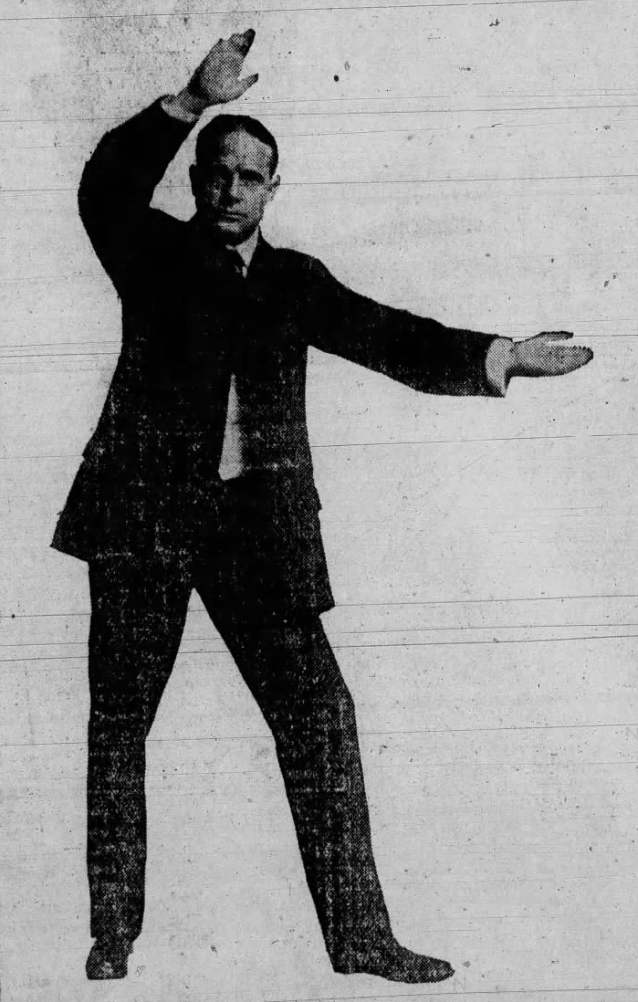
He preached with unmatched energy—sometimes leaping onto the pulpit or running across the stage—and wielded everyday language that even the most skeptical workingman could understand. Sunday brought the gospel to life with baseball metaphors, streetwise illustrations, and all the force of a man who believed eternity was at stake.
The campaign officially ended on Sunday, June 3. Though complete statistics remain elusive, the revival had clearly left its mark. One local newspaper would later reflect that Sunday’s campaign had done “more good than we thought it would” and credited it with producing “better citizens, law-abiding and self-respecting men.”
The same article pointed out that even those who didn’t remain in the church long after the revival had still taken a meaningful step: they had responded, they had come forward, they had heard. “A step in the right direction,” it noted, “builds character.”
Sunday himself moved on to Prophetstown by early July (Freeport Journal-Standard, July 5), but in Freeport, something remained. The revival had galvanized the churches, stirred the consciences of many, and sparked conversations about faith, morality, and public life that would reverberate for months to come.
The Freeport campaign was not the end of Billy Sunday’s evangelistic fire for the year—far from it. Fresh off the sawdust trail in northern Illinois, Sunday continued his whirlwind revival circuit, reaching small towns and stirring hearts across the Midwest and beyond.
Just a month after concluding in Freeport, Sunday preached in Prophetstown, Illinois, in July 1906, continuing to draw crowds eager for his message of repentance and salvation. By fall, he had moved westward to Salida, Colorado, where an unexpected snowstorm destroyed his revival tent. That loss became a turning point in his method: from that point forward, Sunday transitioned away from using large tents and instead began constructing permanent wooden tabernacles—just like the one used in Freeport.
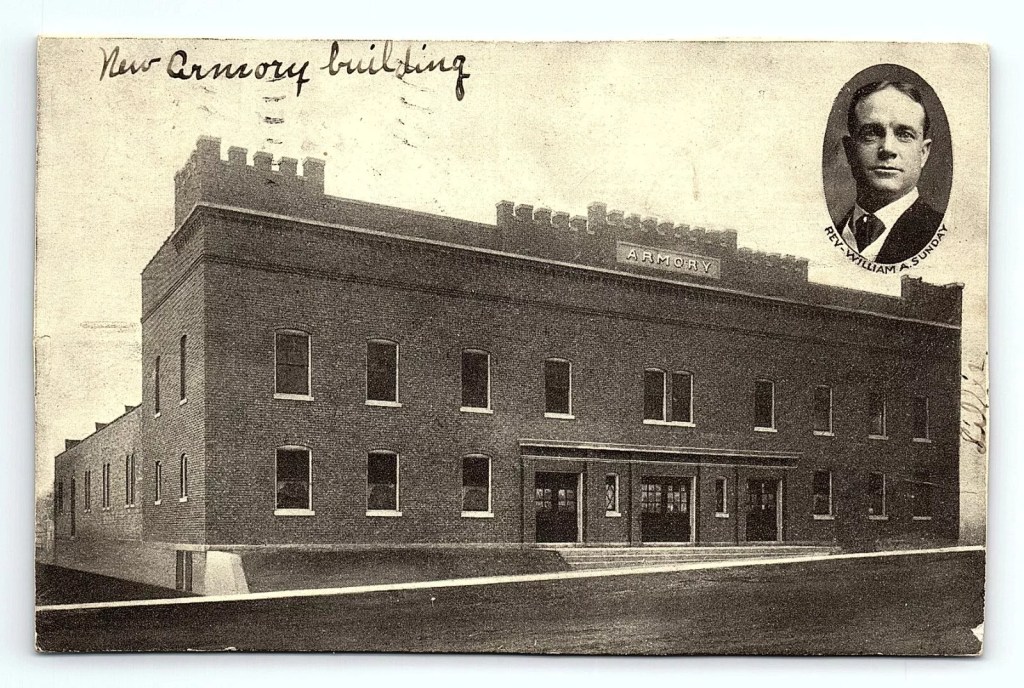
But it was Kewanee, Illinois, in late October through early December of 1906, that demonstrated just how rapidly his influence was growing. Holding a five-week revival in the newly built National Guard Armory, Sunday drew crowds of 2,000 to 4,000 each night, with a staggering 200,000 total attendees reported. So many people flocked to hear him that some had to be turned away at the doors.
Each campaign added to Sunday’s legend, but in many ways, Freeport stood as the hinge moment—a city that proved how a local revival could shake not just individuals but an entire community. And as Sunday’s trail moved on from town to town, the echoes of his voice still lingered in the tabernacle on Jackson and Walnut, where for a few electric weeks in the spring of 1906, revival fire had burned hot in the town of beer and pretzels.
Billy Sunday’s Freeport revival was, in many ways, a preview of what was to come. He would go on to preach to millions, become the most prominent evangelist of his era, and leave behind a complex legacy that combined bold preaching with theatrical flair. But in the spring of 1906, before national headlines, before the surge of prohibition politics and radio broadcasts, he stood in a sawdust-covered tabernacle in northern Illinois and offered one simple message: “Choose you this day whom ye will serve.”
 Evangelist Billy Sunday (1862-1935)