Top 10 Things to Know About Billy Sunday’s Burlington, Iowa Campaign (1905)

By Kraig McNutt

Image: Ames History Museum

1. The Revival Shook the City

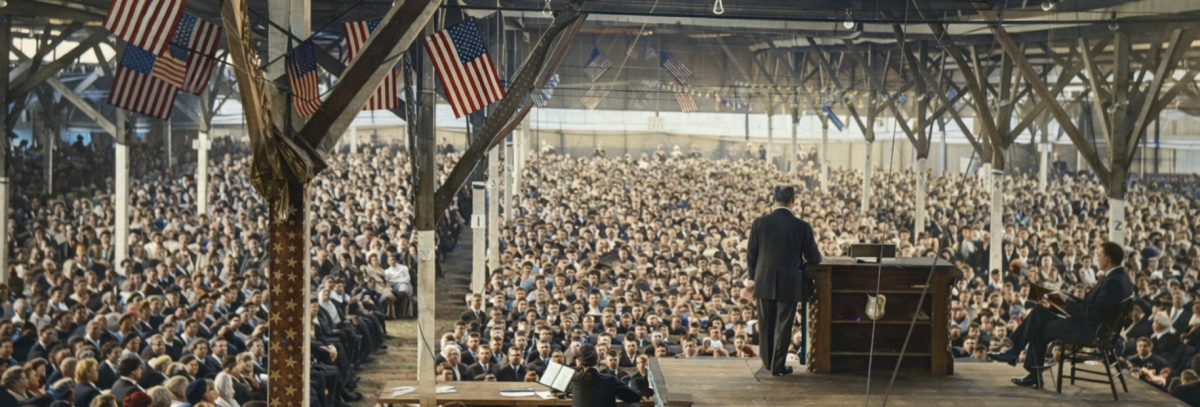
—Literally From November 9 to December 17, 1905, Billy Sunday preached daily to crowds of 6,000–10,000 in a massive wooden tabernacle. On the final night, 7,000 packed the building, with 5,000 more turned away.

2. Sunday Preached Himself to Collapse

On December 18, Sunday collapsed in front of 4,000 people, fainting from exhaustion after weeks of near-constant preaching. Newspapers feared for his life. He had been preaching “day and night for months” with little rest.

3. 2,500 Converts Publicly Responded

By the end of the campaign, 2,484 people had “hit the trail”, coming forward in response to Sunday’s bold calls for repentance. Men’s meetings alone drew thousands, with hundreds responding in a single afternoon.

4. $4,000 Raised in Free-Will Offerings

The people of Burlington gave Sunday over $4,000, a substantial sum for the time, reflecting both appreciation and the revival’s reach across economic lines.

5. The Mayor Ordered Saloons Closed on Sundays

The revival’s influence extended beyond the pulpit. Mayor Caster issued a public order to close all saloons on Sundays, a clear response to Sunday’s fiery sermons against the liquor trade.

6. A Civic Reform League Was Born

Sunday’s preaching catalyzed long-term impact: 150 citizens formed the Civic Reform League to continue fighting for moral reform and social change after the campaign ended.

7. His Style Divided the Crowd

While many were inspired, others were offended. The Cedar Rapids Gazette praised his sincerity but criticized his “gutter language” and aggressive tone. Sunday, however, refused to hold back: “You say, ‘It’s nobody’s business what I do.’ Hear me—it’s everybody’s business what everybody does.”

8. His Sermons Were a Fusion of Gospel and Social Commentary

Sunday denounced profanity, spiritual apathy, poor parenting, and cultural decay with equal fire. His sermons were revival messages with a conscience, tackling both personal sin and systemic vice.

9. Sunday Preached to a City, Not Just a Crowd

He reached every class—from maids to manufacturers, skeptics to civic leaders. His revival stirred the homes, workplaces, newspapers, and even local politics of Burlington.

10. Burlington Witnessed Both the Brilliance and the Breaking of a Revivalist

The Burlington campaign was a turning point in Sunday’s early career. It showed his remarkable reach, but also the cost of his calling. He preached with such intensity that it nearly ended his ministry—or his life.

Revival and Collapse: Billy Sunday’s Fiery Campaign in Burlington, Iowa (1905)

By Kraig McNutt

From the moment he arrived in Burlington, Iowa, in November 1905, Rev. William “Billy” Sunday brought with him more than a revival campaign—he brought a storm. For six intense weeks, Sunday preached to thousands daily, confronted sin with his trademark “hammer and tongs” style, and called the city to spiritual awakening.

But the campaign didn’t just stir souls. It nearly cost him his life.


A Town on Fire—Spiritually Speaking

Sunday’s campaign in Burlington ran from November 9 to December 17, 1905. In that span, he preached to crowds of 6,000 to 10,000 in a massive wooden tabernacle built for the occasion. The energy was electric. At one point, over 1,279 converts had been counted, and by the end of the campaign, the total reached 2,484.

The Muscatine Journal described Sunday’s preaching as if “swaying a storm-beaten ocean.” In a men’s meeting alone, 112 responded to the call, with many more turned away due to overcrowding.

But Sunday’s sermons weren’t just altar calls—they were cultural critiques. He lambasted spiritual apathy, criticized parental neglect, and took direct aim at profanity, indifference, and moral complacency. In one memorable line, he warned:

“You say, ‘It is nobody’s business what I do.’ But hear me—it is everybody’s business what everybody does.”

His sermons were equal parts gospel and social conscience.


Revival or Overkill?

Not everyone was thrilled. A Cedar Rapids Gazette editorial warned that while Sunday was sincere, his tone could be offensive and even vulgar. Some churchgoers felt he used “language of the gutter” and painted humanity as far too depraved. They admired his passion but questioned his method:

“Offensiveness and vulgarity may emanate from the pulpit as well as from any other source… but ‘Billy’ Sunday is sincere, and sincerity is a virtue that is not to be despised.”

It was this very sincerity—his relentless, full-throttle commitment—that finally broke him.


The Collapse Heard Across the Midwest

On Monday, December 18, 1905, as Sunday prepared to preach to yet another crowd of 4,000, he suddenly collapsed on stage, fainting in front of the shocked audience. Reports soon circulated that his life was in danger, and that weeks of nonstop preaching had led to total physical and nervous exhaustion.

The Dixon Evening Telegraph wrote:

“He had been preaching steadily day and night for months and during the preceding week had not slept.”

While Sunday recovered and eventually continued his national ministry, the Burlington collapse marked a critical moment—a reminder that even spiritual giants are still human.


A Lasting Impact on Burlington

Despite the toll on Sunday’s health, the Burlington campaign left deep footprints in the city. By the time the tabernacle closed:

  • 2,500 had publicly confessed Christ
  • $4,000 had been raised in free-will offerings
  • The mayor ordered all saloons closed on Sundays
  • A Civic Reform League with 150 members formed to continue the moral reform efforts sparked by Sunday’s preaching

According to The Grand Rapids Press, the final night saw 7,000 people crammed inside, with 5,000 more unable to get in. It was one of the most dramatic and consequential campaigns of Sunday’s early career.


Legacy: The Revival That Cost Everything

The Burlington campaign reveals the paradox of Billy Sunday’s revivalism:

  • His methods were polarizing—but effective.
  • His energy was boundless—but not limitless.
  • His message stirred the masses—but came at personal cost.

Still, Sunday “played ball” in the pulpit the way he had on the baseball field: heart first, full speed, no reserve.

And in December 1905, Burlington, Iowa, witnessed both the brilliance—and the breaking—of a man determined to bring America back to God.

Burlington, Iowa (November 9 to December 17, 1905)

​Billy Sunday conducted his revival campaign in Burlington, Iowa, from November 9 to December 17, 1905. He saw 2,484 conversions and generated $4,000 in collections. A newspaper article tells how he fell ill and his very life was deemed threatened during the Burlington campaign.

Reported That Evangelist Sunday Was Taken Ill During Meetings.

It is reported that Rev. “Billy” Sunday, who has hundreds of friends in Dixon, has broken down from overwork and nervous strain and is dangerously sick at Burlington, Iowa. Friends here have heard nothing of this but the following item is published in an exchange:

“Billy” Sunday, the famous baseball evangelist, broke down at a revival near Burlington, Iowa, Monday, and his death is feared. Sunday started to preach to a crowd of 4,000 people when he toppled over on the platform in a dead faint. He had been preaching steadily day and night for months and during the preceding week had not slept.”

  • Dixon Evening Telegraph. Mon, Dec 18, 1905 ·Page 5

Additional related newspaper coverage of the Burlington, Iowa (1905) campaign

REV. “BILLY” SUNDAY.

Burlington is now in the throes of a religious awakening, engineered by that eminent and popular ex-baseball player who now is known as Rev. William A. Sunday, but whose numerous friends still love to call “Billy” Sunday. Sunday has been preaching the old gospel in his own inimitable style for several years, and has drawn to him the friendships of a great many people of all denominations, while he has also offended many good people by his “hammer and tongs” style of argument. He has also many friends among the people outside of all churches, for there is one thing of which “Billy” Sunday cannot be justly accused, and that is insincerity. He preaches just like he played ball—puts his whole heart into the work; in other words, he “plays ball” in his present profession. That he has done and is doing great good cannot be successfully denied, and Burlington will probably be better, for a time at least, for his coming; but he has many friends who do not believe it is necessary to use the language of the gutter in condemning evil, nor that everybody is quite as bad as Mr. Sunday would sometimes have his hearers believe.

Offensiveness and vulgarity may emanate from the pulpit as well as from any other source. And it is barely possible that a religious cathartic may not prove as effective in the long run as a less drastic and more constructive remedy.

Again, those who labor just as hard, year in and year out, and just as faithfully, in the noble calling, at a salary generally less per annum than Mr. Sunday receives in a fortnight, may be doing a more permanent work. But “Billy” Sunday is sincere, and sincerity is a virtue that is not to be despised.

  • The Cedar Rapids Gazette. Mon, Nov 13, 1905 ·Page 4

GREAT REVIVAL.

Evangelist “Billy” Sunday Stirs Up Burlington—Large Crowds.

Burlington, Ia., Nov. 28—The revival services conducted by Rev. William A. Sunday have already grown to be a remarkable thing for Burlington. They have been going on for two weeks, and the evangelist is now speaking to an average of 6,000 people daily. Sunday afternoon he held his first men’s meeting and was greeted by fully 6,000 men, old and young. He swayed this remarkable audience for an hour and a half like a storm beaten ocean and at the close 112 men responded to the call for converts, and it is estimated that 50 were turned away because of the crush in front of the evangelist. Including this number there have been a total of 602 converts since last Thursday night.

  • The Muscatine Journal. Tue, Nov 28, 1905 ·Page 1

SOME “BILLY’ SUNDAYISMS.

From Burlington papers: The indifference of many in the church is keeping back the kingdom of God.

Some of you are constantly breathing out in doing good to others, but do no breathing in; seldom or never give yourselves any time with God.

If you have done your neighbor in jury, go to him and confess it, and ask his forgiveness.

The greatest barrier to the advancement of God’s Kingdom to-day is the indifference and apathy of so many of our church members.

No wonder so many of our children go to the bad; they get no guidance, no inspiration, no help for good in the home.

There are hundreds here to-night who are convinced that Jesus Christ is the son of God, but have not back- bone enough to come down the aisle and confess it.

The historical Jesus? You may repudiate him as the son of God, but you still have the historical Jesus, and you could no more write the history of the world and leave Jesus out than you could write the history of this country and leave out George Washington.

Profanity damns and curses any man who indulges in it.

What would the world be were there no restraining influence? You say “it is nobody’s business what I do.” Bu’ hear me, it is everybody’s business what everybody does.

There are certain men who scoff at religion and at preachers, but when they come face to face with death and the fearful consequences of their dis- solute lives they begin to fear and tremble.

  • Muscatine News-Tribune. Tue, Dec 05, 1905 ·Page 6

Ten thousand people sought to hear “Billy” Sunday preach at Burlington last Sunday, 6,000 succeeding. Converts in his revival services in that city to date number 1,279.

  • Quad-City Times. Wed, Dec 13, 1905 ·Page 2

Closed by “Billy” Sunday.

Burlington, Ia., Dec. 20.—The wave of reform in Burlington, growing out of William A. Sunday’s revival meetings, resulted in the formation of the Civic Reform league of 150 members, and the issuance last night by Mayor Caster of an order closing all saloons on Sunday.

  • The Grand Rapids Press. Wed, Dec 20, 1905 ·Page 9

2,500 Converts

Secured by Rev. Billy Sunday in Burlington

Burlington, Ia., Dec. 19.—The Rev. William A. Sunday has closed his series of evangelistic meetings here. There were 7,000 people packed into the tabernacle, with at least 5,000 outside unable to get in, last night. The results of the meetings are 2,500 converts. The people of Burlington have given him a free-will offering of over $4,000.

  • Marion News-Tribune. Wed, Dec 20, 1905 ·Page 9
Billy Sunday campaigns 1904-1905

Here’s a blog-ready narrative reflecting on the 1904–1905 campaign data from Billy Sunday’s early revivals:


Billy Sunday’s Early Impact: What the 1904–1905 Campaign Numbers Reveal

By Kraig McNutt

Before Billy Sunday became a national sensation—packing tabernacles in Philadelphia and Pittsburgh—he cut his evangelistic teeth in smaller Midwestern towns. The data from his 1904–1905 revival campaigns offers a fascinating glimpse into the early momentum of a man who would become America’s most celebrated evangelist of the early 20th century.

Here’s what the numbers reveal.


Small Towns, Big Spiritual Response

Many of the towns on Sunday’s early itinerary were small agricultural or industrial communities scattered across Iowa, Illinois, Minnesota, and Colorado. Places like Exira, Iowa and Audubon, Iowa boasted modest populations—yet hundreds came forward to respond to Sunday’s message.

  • Centerville, Iowa (1905): 900 conversions
  • Sterling, Illinois (1904): 1,678 conversions
  • Macomb, Illinois (1905): 1,880 conversions
  • Dixon, Illinois (1905): 1,875 conversions

These numbers are especially impressive when viewed through the lens of population density. In many cases, Sunday was reaching 10–20% or more of the town’s residents. His message wasn’t simply heard—it reshaped the spiritual landscape of entire communities.


Collections: A Window into Support and Sustainability

While conversion data was consistently recorded, collections (monetary offerings) were only occasionally noted:

  • Centerville, Iowa: $1,500
  • Keokuk, Iowa: $2,200
  • Dixon, Illinois: $2,000
  • Macomb, Illinois: $3,100

These figures indicate that even in smaller towns, there was strong financial support for revival efforts. The money likely covered the costs of tabernacle construction, music, printed materials, and Sunday’s own ministry team.

These generous gifts also reflect the deep gratitude communities felt for the spiritual impact they experienced.


Consistent Fruit Across the Heartland

Across 22 cities recorded between 1904 and 1905, Sunday saw tens of thousands make public professions of faith. The median number of conversions hovers around 900–1,000 per town. For a relatively unknown evangelist in his early 40s, this marks a period of accelerating credibility and growing influence.

It was this consistency—town after town, soul after soul—that built the foundation for Billy Sunday’s national platform just a few years later.


A Revival Rooted in the Midwest

It’s no accident that Sunday’s early years focused on Iowa, Illinois, and Minnesota—regions that mirrored his own upbringing and values. These were towns where the church was central, alcohol was a public enemy, and personal salvation was not just a religious idea, but a community matter.

Sunday’s fiery oratory, moral clarity, and theatrical flair found fertile ground in these heartland soils.


Final Thought: The Humble Beginnings of a National Voice

The revival fires Billy Sunday lit in places like Bedford, Harlan, and Canon City were more than regional events—they were launchpads. These early campaigns showed that revival could still grip a town, change hearts, and reorder lives.

In 1904 and 1905, he wasn’t yet preaching to hundreds of thousands—but he was proving that he could.

And history shows—he would.


Enjoying this kind of historical insight? Subscribe to the blog or check out more posts at EvangelistBillySunday.com


Source: The Spectacular Career, p. 126.

CityConversionsCollections
Marshall, Minn.600
Sterling, Ill.1678
Rockford, Ill.1000
Elgin, Ill.800
Carthage, Ill.650
Pontiac, Ill.1100
Jefferson, Iowa900
Bedford, Iowa600
Seymour, Iowa600
Centerville, Iowa9001500.0
Corydon, Iowa500
Audubon, Iowa500
Atlantic, Iowa600
Harlan, Iowa400
Exira, Iowa400
Keokuk, Iowa10002200.0
Redwood Falls, Minn.600
Mason City, Iowa1000
Dixon, Ill.18752000.0
Canon City, Colo.950
Macomb, Ill.18803100.0
Canton, Ill.1120