Here’s a blog-ready narrative reflecting on the 1904–1905 campaign data from Billy Sunday’s early revivals:
Billy Sunday’s Early Impact: What the 1904–1905 Campaign Numbers Reveal
By Kraig McNutt
Before Billy Sunday became a national sensation—packing tabernacles in Philadelphia and Pittsburgh—he cut his evangelistic teeth in smaller Midwestern towns. The data from his 1904–1905 revival campaigns offers a fascinating glimpse into the early momentum of a man who would become America’s most celebrated evangelist of the early 20th century.
Here’s what the numbers reveal.
Small Towns, Big Spiritual Response
Many of the towns on Sunday’s early itinerary were small agricultural or industrial communities scattered across Iowa, Illinois, Minnesota, and Colorado. Places like Exira, Iowa and Audubon, Iowa boasted modest populations—yet hundreds came forward to respond to Sunday’s message.
- Centerville, Iowa (1905): 900 conversions
- Sterling, Illinois (1904): 1,678 conversions
- Macomb, Illinois (1905): 1,880 conversions
- Dixon, Illinois (1905): 1,875 conversions
These numbers are especially impressive when viewed through the lens of population density. In many cases, Sunday was reaching 10–20% or more of the town’s residents. His message wasn’t simply heard—it reshaped the spiritual landscape of entire communities.
Collections: A Window into Support and Sustainability
While conversion data was consistently recorded, collections (monetary offerings) were only occasionally noted:
- Centerville, Iowa: $1,500
- Keokuk, Iowa: $2,200
- Dixon, Illinois: $2,000
- Macomb, Illinois: $3,100
These figures indicate that even in smaller towns, there was strong financial support for revival efforts. The money likely covered the costs of tabernacle construction, music, printed materials, and Sunday’s own ministry team.
These generous gifts also reflect the deep gratitude communities felt for the spiritual impact they experienced.
Consistent Fruit Across the Heartland
Across 22 cities recorded between 1904 and 1905, Sunday saw tens of thousands make public professions of faith. The median number of conversions hovers around 900–1,000 per town. For a relatively unknown evangelist in his early 40s, this marks a period of accelerating credibility and growing influence.
It was this consistency—town after town, soul after soul—that built the foundation for Billy Sunday’s national platform just a few years later.
A Revival Rooted in the Midwest
It’s no accident that Sunday’s early years focused on Iowa, Illinois, and Minnesota—regions that mirrored his own upbringing and values. These were towns where the church was central, alcohol was a public enemy, and personal salvation was not just a religious idea, but a community matter.
Sunday’s fiery oratory, moral clarity, and theatrical flair found fertile ground in these heartland soils.
Final Thought: The Humble Beginnings of a National Voice
The revival fires Billy Sunday lit in places like Bedford, Harlan, and Canon City were more than regional events—they were launchpads. These early campaigns showed that revival could still grip a town, change hearts, and reorder lives.
In 1904 and 1905, he wasn’t yet preaching to hundreds of thousands—but he was proving that he could.
And history shows—he would.
Enjoying this kind of historical insight? Subscribe to the blog or check out more posts at EvangelistBillySunday.com
Source: The Spectacular Career, p. 126.
| City | Conversions | Collections |
| Marshall, Minn. | 600 | |
| Sterling, Ill. | 1678 | |
| Rockford, Ill. | 1000 | |
| Elgin, Ill. | 800 | |
| Carthage, Ill. | 650 | |
| Pontiac, Ill. | 1100 | |
| Jefferson, Iowa | 900 | |
| Bedford, Iowa | 600 | |
| Seymour, Iowa | 600 | |
| Centerville, Iowa | 900 | 1500.0 |
| Corydon, Iowa | 500 | |
| Audubon, Iowa | 500 | |
| Atlantic, Iowa | 600 | |
| Harlan, Iowa | 400 | |
| Exira, Iowa | 400 | |
| Keokuk, Iowa | 1000 | 2200.0 |
| Redwood Falls, Minn. | 600 | |
| Mason City, Iowa | 1000 | |
| Dixon, Ill. | 1875 | 2000.0 |
| Canon City, Colo. | 950 | |
| Macomb, Ill. | 1880 | 3100.0 |
| Canton, Ill. | 1120 |
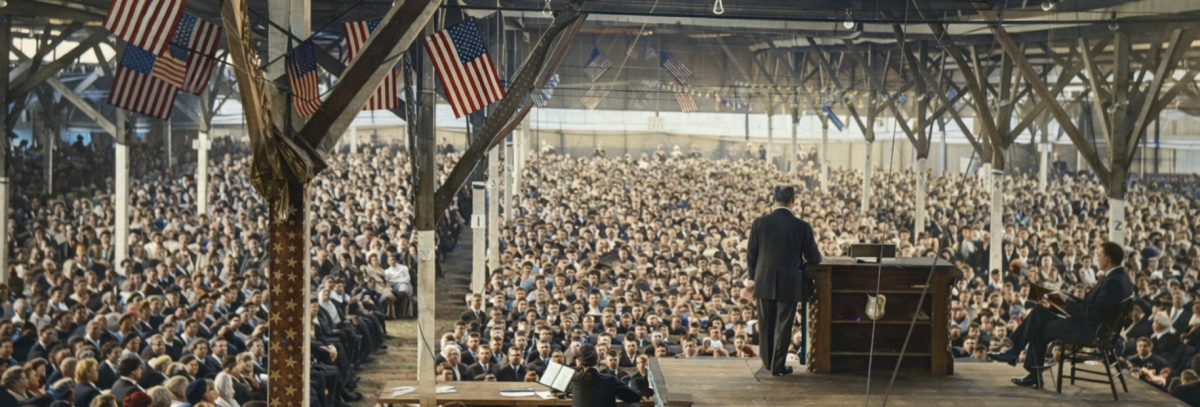
 Evangelist Billy Sunday (1862-1935)