Former professional baseball player-turned urban evangelist. Follow this daily blog that chronicles the life and ministry of revivalist preacher William Ashley "Billy" Sunday (1862-1935)
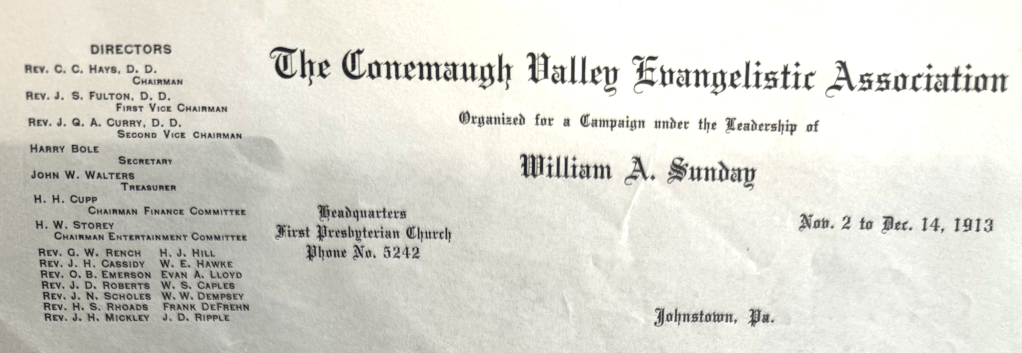
The logistics behind each revival campaign Billy held was simply massive. Here is an example of letterhead pertaining to his Johnstown, PA campaign (November 2, to December 14, 1913.
His letterhead usually indicated the key local personnel who were part of the Committee, the name of the organization formed to promote the revival, the name of a local host church serving as the revival headquarters, and the date of the event.
Permission to use artifact granted by the Morgan Library, Billy Sunday Archives, Grace College.
Here is First Presbyterian Church, Johnstown, PA (picture credit from their web site)
During the height of his ministry-career (1905-1920) Billy Sunday was more popular than Mark Twain or William Jennings Bryan. He even turned down an offer for $1,000,000 for a contract with “moving pictures.” He was a friend to multiple U.S. Presidents and dignitaries. One can only imagine whom he and Helen entertained in their living room below.
“Dr. Sunday (Westminster College had just conferred an honorary doctorate upon Sunday) knows his Bible which is the true body of divinity in theological lore. Mr. Sunday has devoted his life to the supreme task of world evangelization for which the Bible is the great charter.
He is, therefore, both in scholarship and practical effort entitled to the degree. Just as a Doctor of Medicine is supposed to know the Science of Medicine and practice the art of healing, so a Doctor of Divinity who know the truth about God and practices the art of saving 1s entitled to the degree. In many institutions it is customary to bestow the honorary degree of Doctor of Divinity upon those who are men noted for their knowledge of “the traditions of the scribes and pharisees” than for knowledge and practical use of the Bible itself.”
Sincerely yours,
R.M. Russell to T.T. Frankenberg (Columbus, Ohio) August 30, 1913
Artifact credit: Morgan Library, Grace College
The recipient of this letter, Theodore Thomas Frankenberg, was no casual correspondent. A Columbus-based journalist and author, Frankenberg was in the midst of gathering materials for what would become the first popular biography of the evangelist, Billy Sunday: The Man and His Message (published in 1914). Letters like Russell’s provided him with both anecdotal color and institutional validation—evidence that Sunday was not just a charismatic revivalist but a figure respected by the academic establishment.
This exchange captures an important cultural moment. Westminster’s degree signaled a rare bridging of worlds: a Presbyterian college recognizing a frontier-style evangelist whose power lay not in polished scholarship but in the raw urgency of his preaching. To Sunday’s critics, the degree may have looked like a concession to populism. To his supporters, it was overdue acknowledgment that the man who knew his Bible best and preached it most widely deserved the honor more than those “scribes and Pharisees” who merely debated it in lecture halls.
In the end, Frankenberg’s biography helped cement Sunday’s reputation, weaving together stories, letters, and testimonies like this one. And tucked inside that narrative is the 1913 moment when Westminster College draped Billy Sunday in academic robes, placing him—at least symbolically—among the doctors of divinity.
“Winona people are beginning to know something of Mrs Sunday’s gifts and abilities, as they never have before understood them. She works with unusual tact, and gives evidence of thinking every subject through before action is taken. Personally, I appreciate such a counsellor more than I can express. I feel satisfied that her spirit has touched the heart of every Commissioner of the General Assembly; and this has resulted in inspiring their confidence in Winona’s present, and enlarged their vision of the great future this Institution faces.”
Letter from J.C. Breckenridge, General Secretary, Winona Assembly and Bible Conference. May 24, 1921. Addressed to Billy Sunday. Morgan Library. Billy Sunday Archives.




 Evangelist Billy Sunday (1862-1935)