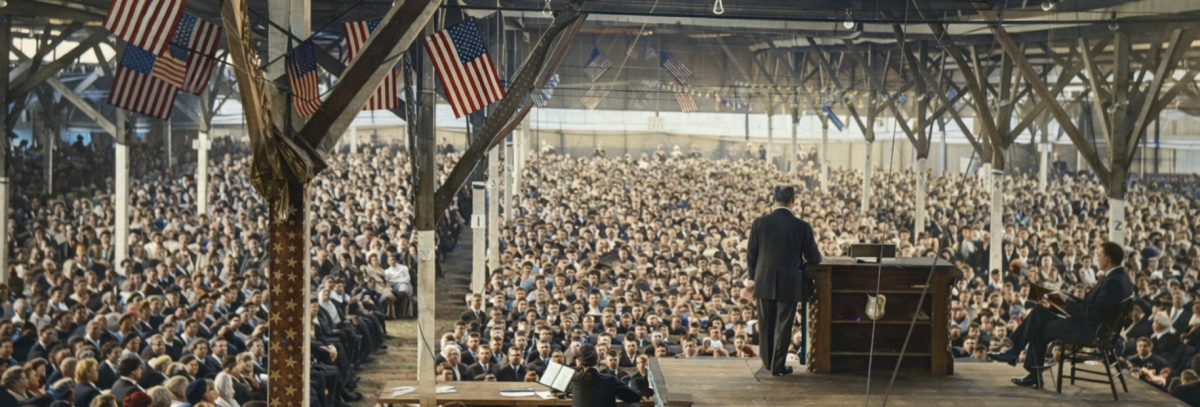
When the revival campaign of Billy Sunday reached Kansas City in 1916, observers could easily assume that the evangelist’s enormous crowds and national reputation had appeared overnight. But a reflective article in the The Kansas City Star reminded readers that Sunday’s success had actually grown slowly and deliberately over many years.
The paper explained that there was nothing sudden or “mushroom-like” about the rise of the Sunday revivals.
“There is nothing ‘mushroom’ in the growth of the Billy Sunday meetings.”
Instead, the evangelist’s methods and audience steadily developed over time. In the early years, when Sunday first began holding revival meetings, his audiences often found little that seemed unusual.
“Early audiences found nothing spectacular in the sermons of the revivalist.”
Those early campaigns were also modest in scale. At first, Sunday and his team believed that smaller communities were the natural limit of their work.
“We used to think that the town of ten thousand population was our limit.”
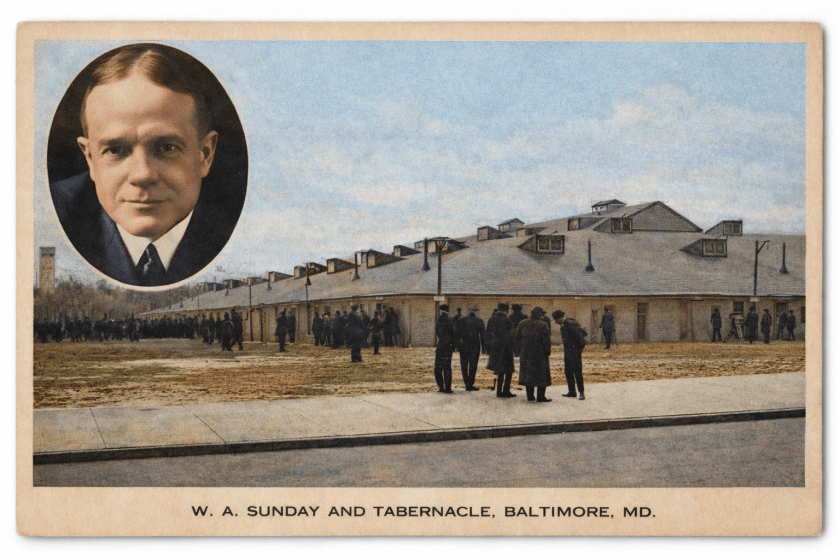
As the years passed, however, confidence grew. The team gradually moved into larger towns and then into major cities. The article recalled how Sunday’s organization expanded step by step—building larger tabernacles and reaching larger crowds with each campaign.
“All the time we were gradually adding to our party and building larger tabernacles.”
By 1916, the scale had changed dramatically. Cities once thought far beyond reach were now the focus of massive campaigns.
“Here we are and New York City is in sight with a tabernacle seating twenty-five thousand.”
The article also emphasized that Sunday’s preaching style had developed its own distinctive character. His revival methods were not borrowed directly from older traditions but shaped by his own personality and experience.
The writer noted that Sunday had “thrown out the life line in a fashion distinctly unique.”
Another aspect of his ministry that caught the attention of reporters was the structure of the campaigns themselves. A typical revival lasted about a month, with the message unfolding gradually over time.
In the early weeks, Sunday often avoided direct appeals for conversion, instead using stories and humor to gain the attention of his audience. Only later did the preaching intensify.
By the third week, the article explained, Sunday would devote his sermons to confronting sin and pressing listeners toward repentance. The final week focused on urging people to make a decision.
Even the physical setting reflected Sunday’s distinctive approach. Unlike some revivalists, he rejected the traditional “mourner’s bench” used in earlier revival meetings. Instead, converts were invited to come forward and sit in chairs while he spoke with them personally.
The article also noted that Sunday was not closely tied to any one denomination. While he often expressed appreciation for various churches, his ministry remained broadly interdenominational.
By the time Kansas City hosted the campaign in 1916, Billy Sunday had become one of the most recognizable religious figures in America. Yet the newspaper’s reflection reminded readers that the movement had not been built in a single moment.
It had grown—campaign by campaign, city by city, and year by year.
And in the process, Billy Sunday had created a revival method that was unmistakably his own.
 Evangelist Billy Sunday (1862-1935)