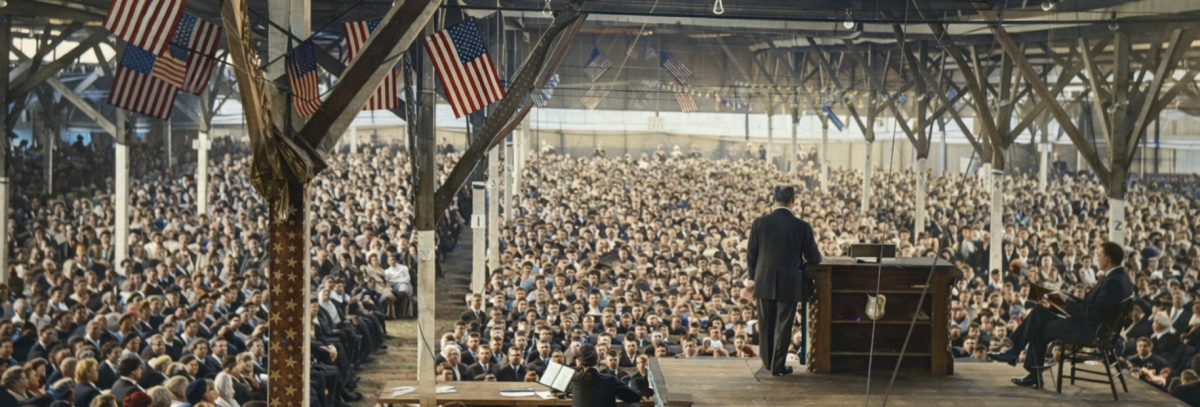
During the 1916 revival campaign of Billy Sunday in Kansas City, one of the most striking moments came when the evangelist’s wife, Helen Amelia Thompson Sunday—known widely as “Ma Sunday”—took the pulpit herself.
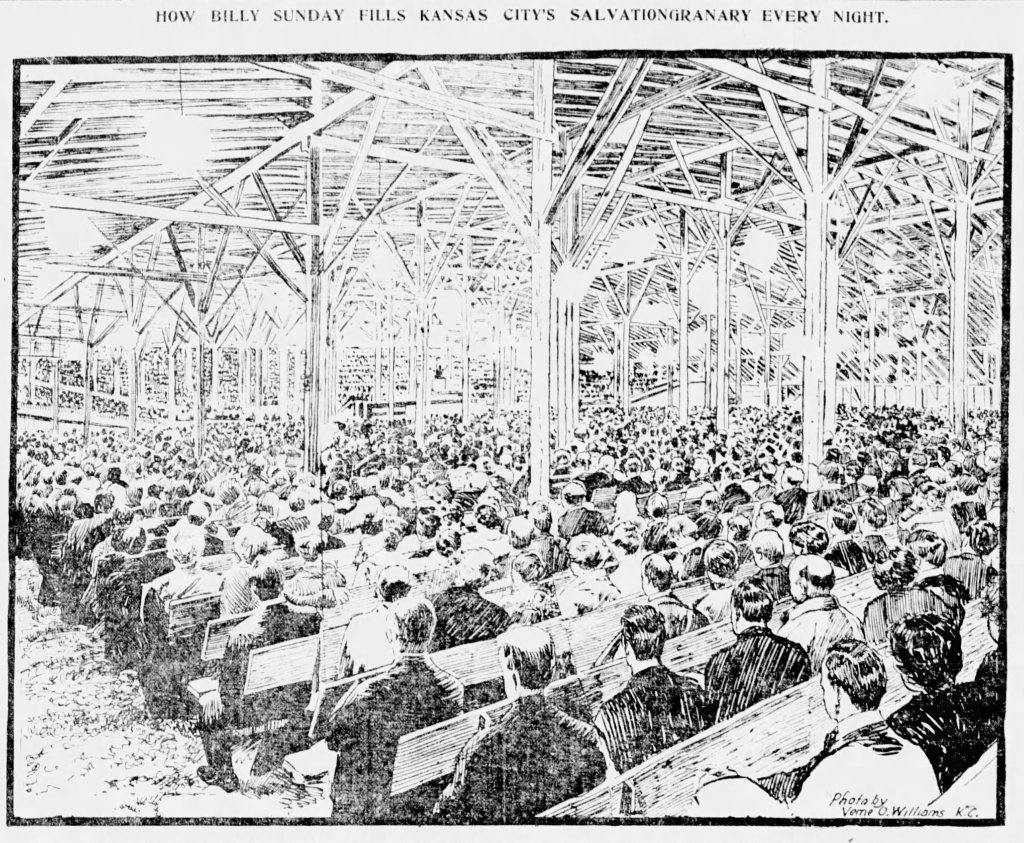
A report in the The Kansas City Star described her address as unmistakably in the style of her famous husband: energetic, blunt, and deeply challenging to church members.
The newspaper noted that Kansas City audiences had not heard her preach before, but the reaction was immediate. Speaking rapidly and with confidence, she quoted Scripture freely, used expressive gestures, and even thumped the pulpit for emphasis.
By the end of her half-hour address, the reporter observed, “she was perspiring freely,” a familiar description for anyone who had watched Billy Sunday preach.
Her message was aimed squarely at professing Christians, not skeptics or outsiders. She criticized believers whose lives contradicted their testimony.
“The professed Christian who forgets his vows every time a joy ride is offered… is a liar—she said liar—every time testimonials are called for.”
Like her husband, Ma Sunday believed revival depended not only on converting sinners but also on awakening the church. In her view, too many Christians expected evangelists to do the spiritual work while they remained passive.
“Don’t you think that we are going to carry the load and let you sit back and say, ‘I hope you have a good meeting.’”
Instead, she challenged church members to take personal responsibility for the spread of the gospel. Her message emphasized the role of ordinary believers as witnesses for Christ.
She even offered a striking calculation:
“If every church member would win one person to God a year in twenty-five years the world would be saved.”
But she also warned that careless Christian living could damage the church’s influence.
“The church member who proves himself a liar every time he testifies is more harm than good to the church.”
At one point she posed a simple question to the audience: how many people were praying for others? Only a few hands rose. Yet when she asked how many were professed Christians, nearly every hand went up. The contrast, she implied, revealed the problem.
Another theme in her address was the temptation of worldly distractions. She criticized believers who treated recreation as more important than spiritual discipline.
“Lots of Christians forget every time they have a chance to go joy riding.”
Her solution was straightforward: prayer and active participation in the revival effort.
“Get a prayer list… I don’t mean to show around and talk about, but to pray for.”
She also defended the unusual style of her husband’s ministry. Critics often accused Billy Sunday of being theatrical or unconventional. Ma Sunday reminded her listeners that religious leaders throughout the Bible had often acted outside ordinary expectations.
“The Pharisees tried to trip up Jesus for doing things out of the ordinary… Mr. Sunday has lots of authority for doing things out of the ordinary.”
Her address illustrated an important aspect of the Sunday revival campaigns: they were family efforts. While Billy Sunday delivered the dramatic evening sermons, Ma Sunday frequently reinforced the message by speaking directly to believers about prayer, personal responsibility, and spiritual integrity.
In Kansas City that spring of 1916, the newspaper report made one thing clear. The revival was not powered by one voice alone.
Ma Sunday had her own message—and she delivered it with the same urgency and conviction that had made the Sunday campaigns famous across America.
The Kansas City Star. May 9, 1916:4.

 Evangelist Billy Sunday (1862-1935)