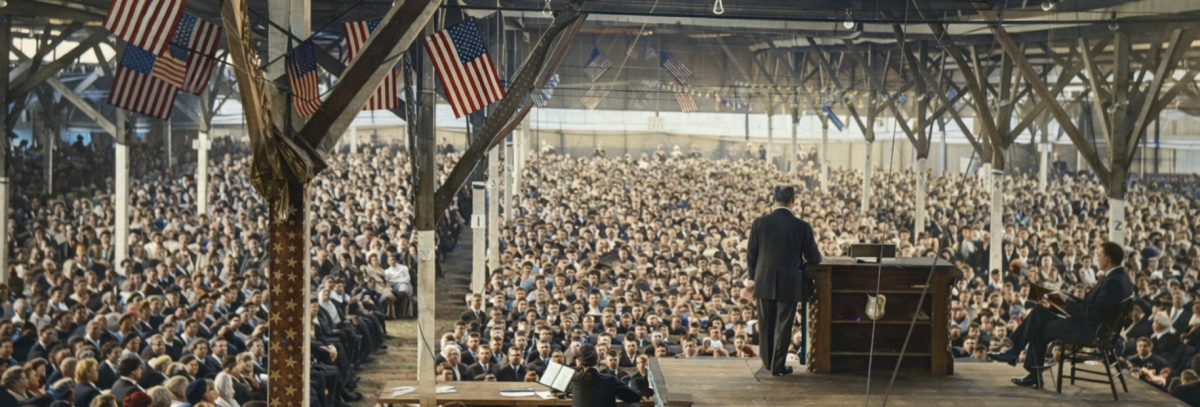
When Billy Sunday preached in Kansas City during his 1916 revival campaign, his sermons often struck directly at the spiritual condition of the church itself. One message, reported by the The Kansas City Star, carried a sharp and revealing title: “Why the Church Is Weak.”
Sunday did not begin by blaming society, politics, or culture. Instead, he argued that the church’s weakness came from within.
“The sermon by Billy Sunday this afternoon had for its subject this verse from Judges xvi, 20: ‘He wist not that the spirit of the Lord had departed from him.’”
Drawing from the story of Samson, Sunday warned that the modern church could lose its spiritual power without even realizing it. In his view, the problem was not a lack of organization, buildings, or membership.
“Nothing in the world can substitute for the spirit of God.”
For Sunday, the church had become timid. Instead of confronting sin, it had grown cautious and respectable. He charged that many congregations had traded spiritual authority for social approval.
“The church is afraid of men and women; we are to be in the world, but not of the world.”
The evangelist insisted that the church had gradually surrendered its moral courage. Leaders often hesitated to rebuke wrongdoing among their members, even when it was obvious.
“Leading church members lead in nothing but card parties and society functions.”
To Sunday, such compromises drained the church of its influence. A church that tolerated worldliness could no longer confront it.
He argued that the true strength of Christianity had never been found in numbers or wealth. The early church, he reminded his audience, possessed little of either.
“God’s church has not increased correspondingly in power as it has in numbers… it has decreased in spiritual power.”
Sunday contrasted the modern church with the first believers described in the book of Acts. They had no impressive buildings, no social prestige, and little money. Yet they possessed something far greater—spiritual conviction.
“There was a time when the church had more members than she has today; there never was a time when she had more money than she has today… but there was a time when she had more spiritual power than she has today.”
Another cause of weakness, Sunday argued, was the church’s tendency to accommodate fashionable society. Rather than confronting sin, some congregations had become comfortable with it.
“That is why many a preacher is a failure today; he is a compromiser.”
Sunday spoke especially bluntly about moral compromise among church members. When churches tolerated behavior they should have challenged, they undermined their own witness.
“We have lost our power because we have compromised.”
But the evangelist did not end his message with criticism. He pointed his listeners toward the remedy: a return to genuine spiritual life. The church needed renewed faith, repentance, and courage.
He concluded with a simple but urgent appeal. If the church wanted to regain its strength, it needed to return to prayer and dependence upon God.
“If there’s anything the church of God needs it is to climb the stairs and get in an upper room.”
In the packed tabernacle that afternoon, Sunday’s message was unmistakable. The problem facing the church was not outside pressure or hostile culture. It was the quiet erosion of conviction within.
And until the church rediscovered the spiritual power that marked its earliest days, Sunday warned, its influence would continue to fade.
 Evangelist Billy Sunday (1862-1935)