When Billy Sunday arrived in Kansas City during his 1916 revival campaign, reporters tried to explain what made his preaching so electrifying. One article in the The Kansas City Star offered an unusual perspective. Rather than describing Sunday simply as a preacher, the writer analyzed him as something closer to a dramatic performer.
The article was titled “Billy Sunday as an Actor,” and it attempted to dissect the evangelist’s method from a theatrical standpoint. What the reporter saw was not merely a sermon but a kind of living drama unfolding on the sawdust platform.
According to the writer, Sunday had the ability to bring invisible scenes vividly to life:
“Mr. Sunday, erect and eloquent, is addressing some jury which is corporeally invisible, but which instantly lives before the eyes.”
In other words, Sunday’s sermons created mental pictures so vivid that listeners could almost see the courtroom of heaven forming before them. The preacher might begin by placing his audience before the bar of divine judgment, describing the sinner standing before God.
But the sermon did not stay in one place for long. Sunday constantly shifted roles, turning the message into a dramatic sequence of scenes. One moment he might portray a bartender leaning over a counter; the next he was the drunken customer staggering through the gutter.
The article described these rapid transitions with striking clarity:
“Then he becomes a barkeeper… And in another instant he is the drunkard—‘a dirty rum guzzler’—cringing, broken, swaying to the gutter.”
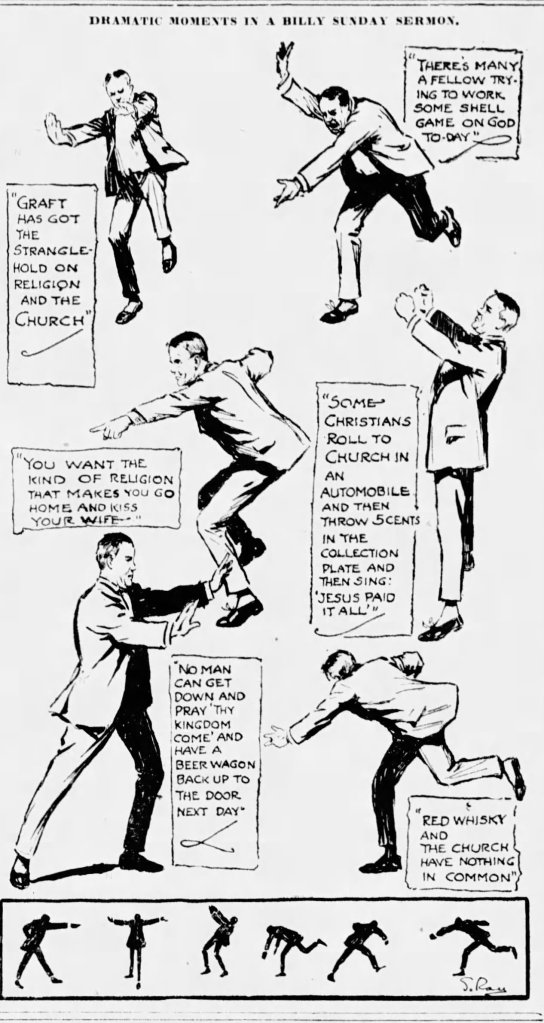
Through pantomime, gestures, and changes in voice, Sunday acted out moral situations that his audience immediately recognized.
The reporter concluded that Sunday’s preaching relied heavily on what he called melodrama. But the word was not meant as criticism so much as explanation. Melodrama, the article observed, was easy for ordinary people to understand because it dealt in clear moral conflict.
“Melodrama has nothing to do with character and is easy to understand,” the writer noted. “It is the drama of situation.”
That description captures something essential about Billy Sunday’s preaching. His sermons did not revolve around abstract theological debates. Instead, they focused on recognizable human stories: the drunkard, the wandering son, the sinner facing judgment.
Another feature the reporter noticed was Sunday’s physical intensity. The evangelist rarely stood still. He ran, leaped, stamped his foot, pointed accusingly, and pounded the pulpit for emphasis. The effect, the article suggested, was almost like watching an athlete or dancer.
One colorful comparison even likened him to the famed ballet performer Vaslav Nijinsky—an extraordinary metaphor for a revival preacher.
Perhaps the most perceptive observation in the article concerned the simplicity of Sunday’s language. The reporter noted that his words were blunt, Anglo-Saxon, and forceful:
“Short, pungent… Saxon derivatives of English… packed full of powerful stimulus.”
This plainspoken style, filled with vivid phrases and sharp imagery, helped Sunday communicate with audiences drawn from every social class.
In the end, the Kansas City writer recognized something that many critics missed. Billy Sunday’s sermons were not merely lectures about religion. They were dramatic moral confrontations, staged in front of thousands of listeners each night.
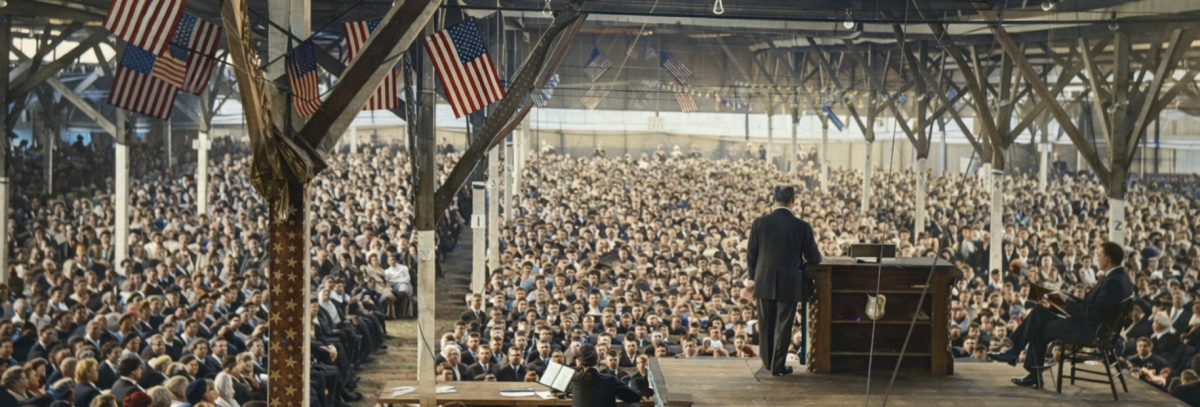
On the bare platform of a temporary tabernacle, without scenery or props, Sunday created entire scenes through voice, motion, and imagination. His preaching was not simply heard—it was seen and felt.
And that, the reporter concluded, was the secret of his remarkable power over a crowd.
Adapted from: The Kansas City Star. May 4, 1916:2.
 Evangelist Billy Sunday (1862-1935)