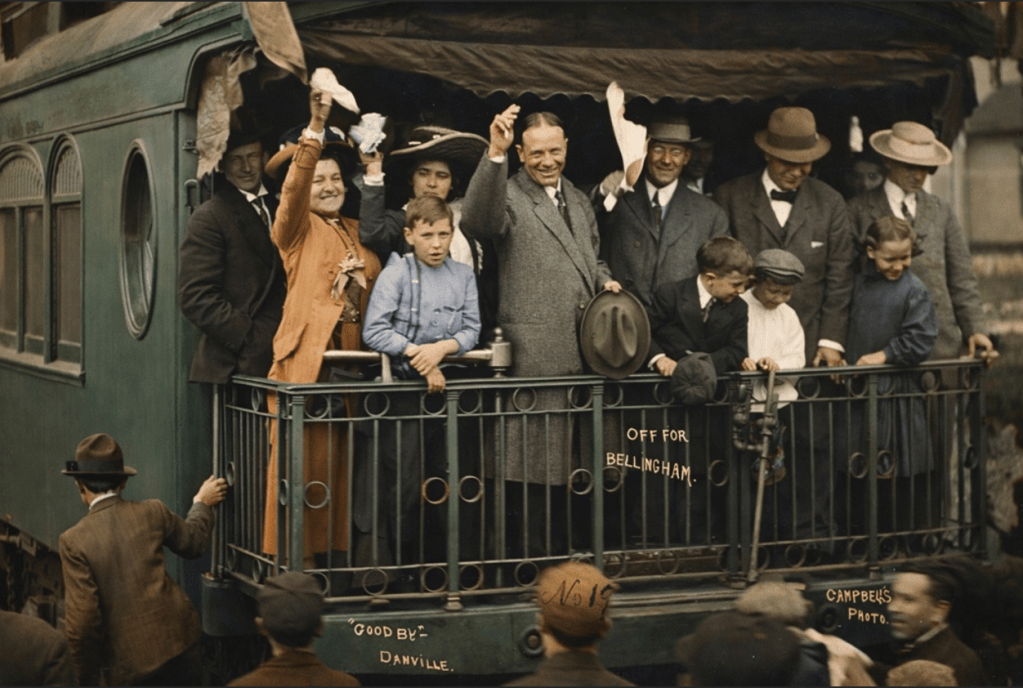
Bellingham aboard a train.
When Billy Sunday arrived in Bellingham, Washington, in the spring of 1910, the city knew something significant was about to happen.
His campaign formally began on April 17, 1910, and was scheduled to run for six weeks through May 29. Even before the opening service, anticipation was high. On April 16, The Bellingham Herald placed the coming revival on the front page, signaling that this was not just another religious meeting but a major civic event.
From the start, the campaign drew extensive attention. Local and regional newspapers covered Sunday’s meetings with unusual depth and frequency. By May 2, The Seattle Star was featuring the revival prominently on its own front page, evidence that Sunday’s influence extended far beyond Bellingham into the broader Pacific Northwest.
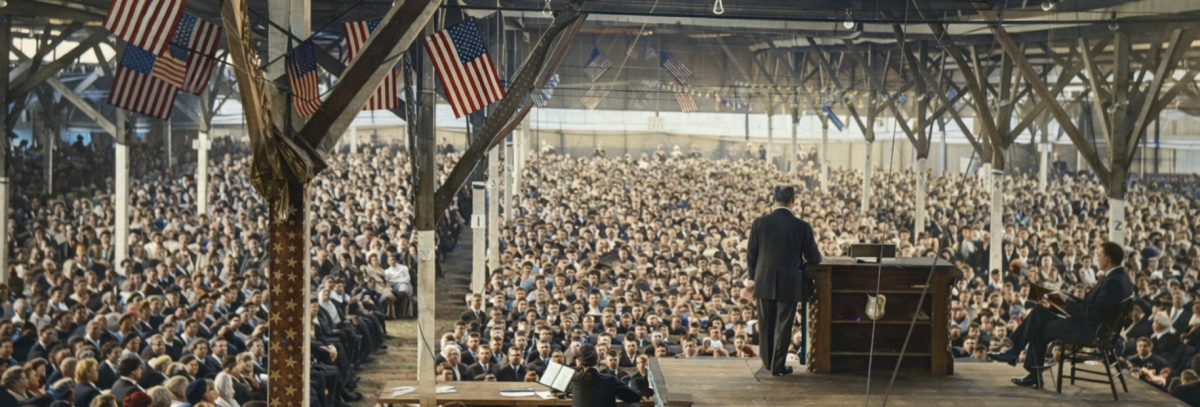
One of the most remarkable days came on Sunday, May 1. That evening, approximately 15,000 people crowded into the tabernacle and surrounding grounds to hear Sunday preach. The turnout was stunning for a city of Bellingham’s size at the time. Collections that day totaled $3,201.10, a substantial sum in 1910, reflecting both the generosity of the crowd and the financial scale of Sunday’s campaigns. That same service also recorded 140 conversions, showing that this was not merely spectacle but a movement that claimed measurable spiritual results.
Interest in Sunday’s work went beyond daily newspaper reports. On May 8, The Bellingham Herald devoted magazine-style coverage to the revival, suggesting that the meetings had become a defining moment in the city’s public life rather than a passing event.
Perhaps the most revealing glimpse into Sunday himself came from an interview published in The Daily Herald of Everett on May 18 under the title “Billy Sunday: His Methods, His Ideas and His Work.” In it, Sunday rejected the idea that his success came from showmanship or gimmicks. He explained his approach in characteristically plain terms:
“I haven’t any tricks. I’m just an old-fashioned preacher. I tell people in plain words the simple truth, that they are lost in sin and need salvation. I just preach the Bible – that’s all.”
That statement captures the heart of his appeal in Bellingham. He did not present himself as a social reformer, a political activist, or a religious entertainer. He came as a straightforward revival preacher who believed that the Bible, clearly proclaimed, could still change lives.
By the time the campaign concluded on May 29, Bellingham had experienced six weeks of intense preaching, packed crowds, and sustained public attention. For many residents, these meetings likely became a defining memory of the year 1910—a season when their city was temporarily at the center of a national religious movement.
The Bellingham campaign illustrates why Billy Sunday was such a powerful figure in early twentieth-century America. He could command enormous crowds, attract front-page coverage, inspire generous giving, and still insist that his effectiveness rested not on method but on message. In Bellingham, as in so many other cities, Sunday left behind not just statistics, but stories of a community stirred by revival.

 Evangelist Billy Sunday (1862-1935)