Former professional baseball player-turned urban evangelist. Follow this daily blog that chronicles the life and ministry of revivalist preacher William Ashley "Billy" Sunday (1862-1935)
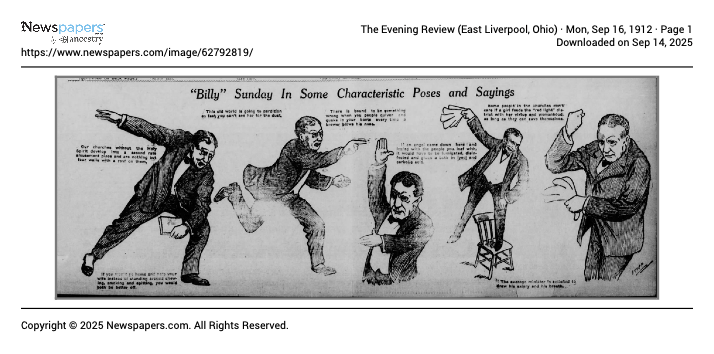
That is Billy Sunday in action—a human dynamo working for the cause of religion. No one could listen to the evangelist, yesterday, without absorbing some of his wonderful energy as he sent it out in great dynamic waves through the huge tabernacle. The air of the big structure was saturated with it.
Billy Sunday literally pumps religious enthusiasm into people. And no matter how much of it he pours out, the supply seems inexhaustible. It is almost incredible that one man could have such a lot of vim and vinegar stored up in his one little body and his brain.
Billy Sunday believes in a Christianity that does things, that is carried out into the lives of people, that accomplishes results, that “delivers the goods.” This is the core of his evangelism. This is why he is so vitriolic in his denunciation of the Christian who sits back and is satisfied with announcing that he believes in the Lord but does nothing for the Lord.
Nothing in oratory could be more impressive or effective than the evangelist’s word painting of histrionic scenes, especially those of the battlefield, and the application of some striking incident to the life and work of the soldier in the Christian army. It is the very essence and soul of eloquence.
The audiences that met yesterday to hear Sunday’s first three sermons, would have been most encouragingly large on the pleasantest of days. On a rainy day such as it was, they may well be regarded as remarkable, and as most auspicious.
The following account (excerpted) is in the Morgan Library Billy Sunday Archives.
“Life and Labors of William A. Sunday”
[Billy’s own view of his first sermon.]
“I diagnosed the sins and difficulties of people as existing in the gray matter. I figured I had to show people. You ought to have heard my [first] sermon. It was a hummer. I had stacks of books all around me. There were words that would make the jaws of a Greek professor squeak for a week. When I sprung it, it went off like a firecracker and busted in the middle. I figured that I was going to the old sinful world to its knees and yet nothing happened. Then I loaded my old muzzle loading gun with ipecac , buttermilk, rough on rats, rock salt and whatever else came handy and the gang has been ducking and the feathers flying ever since. I was wrong. It was the heart and not the gray matter that was wrong.
“In 1891 Sunday left baseball to become secretary of religious work at the Chicago Y.M.C.A. After three years he became advance man for J.Wilbur Chapman, also holding meetings in connection with the campaigns. About Jan.1,1896 Chapman returned to the pastorate and simultaneously Sunday received his first call [editor: this is not correct] as an evangelist. This meeting was held at Garner, Iowa and dates the beginning of this mans remarkable career.”
[Billy as a man of prayer.]
In regard to the personality of the man I would say first that he is fundamentally a man of prayer. Let the mistaken critic of Sunday rid himself at once of the notion that his meetings are merely big displays of the powers of advertising and organized enthusiasm and the product of a man who is called “a great salesman”. The life of the man and the activities of a campaign are shot through and through with prayer. In every place where he holds a meeting he chooses a secluded spot from whence he storms heaven. This place becomes a Bethel to him. In prayer he is natural. His prayers are not long but to the point and usually open with “and now Jesus” from whence he proceeds in his peculiar manner to pray for all the matters pertaining to the success of the meetings. Without prayer he believes he would be as Samson shorn of his strength. He makes no decision or takes no step without first taking the matter to the Lord.
[Billy’s passion for souls?”
He has an intense passion for souls. Here is a man who carries the people of a community upon his heart and is ready to give his very life and strength and energy in order to see them saved. He will continue day after day, preaching twice and three times only to see men turn to God.
[Billy’s power of perception?]
Mr. Sunday is endowed with a remarkable power of perception. Passing through a building he sees things that readily lend themselves for sermon stuff. His remarkable memory is brought into evidence in his sermons as he pours forth anecdote, history, statistics and quotations from literature with remarkable rapidity. He is equipped with a clear eye that takes in the entire tabernacle into its scope and gives him a remarkable advantage over his audience.
[Billy’s executive ability?]
We must here mention the executive ability of the man. He has the happy faculty of surrounding himself with co-workers who are very efficient and it is to the credit of Mr. Sunday that the personnel of his staff is the same today that it was in 1916 with the possible exception of the tabernacle building as my memory fails me on this point. Space will not permit us to discuss the form of organization in a campaign except the fact that towns from 5 to 20 miles from the seat of activity are touched through the organized spirit of prayer that emanates from the campaign.
[Billy’s imagination?]
His imagination enables him to make the commonplace radiant with beauty. He uses no Greek or Latin but the plainest and most expressive language. He calls things by their right name and often his words burn and blister. It is doubtful if there is any living preacher who can pour out such a stream of red-hot and sizzling adjectives to show his scorn and contempt for sin. There are moments when he makes you think of the way Jesus denounced the scribes and Pharisees.
[Billy’s use of slang?]
We must give a little space to the matter of slang. It is futile to attempt to apologize in behalf of Mr. Sunday as he would not welcome such an apology. It is his point of contact. He calls it, “corn bread and potatoes”. Asked to tone down his preaching in this regard he replied to a committee of ministers that, “If I preached like you do I would have about as many people to preach to as you do.” Slang is defined as language in the making and unconventional speech. Study carefully the Bible characters whom God has used. How many are there of the stereotyped kind? It was the rams horn rather than the silver trumpet that led Joshua’s army to victory. Samson thinned the army of the alien with the jaw-bone of an ass. David used a sling and Shamgar an ox goad and we are also reminded that the Master himself “taught not as the scribes”.
[Billy’s use of illustrations?]
. . . his style is direct and expressive. His sermons teem with illustrations that illustrate. He combs the ends of the earth for material for his sermons and his ready references to science, history, literature and other branches both delight and stagger the hearer. Sentiment, pathos, logic, word pictures, impersonation etc are all used to drive home truth.
Before another issue of the Times-Leader reaches its readers, Rev. Billy Sunday and his co-workers will have left. This community has been stirred up as never before. We desire at this time to reproduce an editorial of the Ohio State Journal published at Columbus, when Mr. Sunday conducted a campaign just previous to his visit here:
“As a result of his mission in Columbus, we should say there is a stronger moral sense in this community than there ever was before; and now the pressing question is, how to preserve it, how to make it vital in civic, religious and business life. He has made of religion a thoroughly practical matter, and has made the people feel it to be that way; and now it becomes the duty of every one who loves his neighbor and his city to put into practice in his own life the high lessons of duty, and honor, and faith, which Rev. Sunday has been preaching to us for the past seven weeks.”
That’s the correct summing up of the entire situation. Sunday has recruited the soldiers. The responsibilities and duties rest with those who remain here.
Source: Wilkes-Barre Times Leader. Sat, Apr 12, 1913 ·Page 6
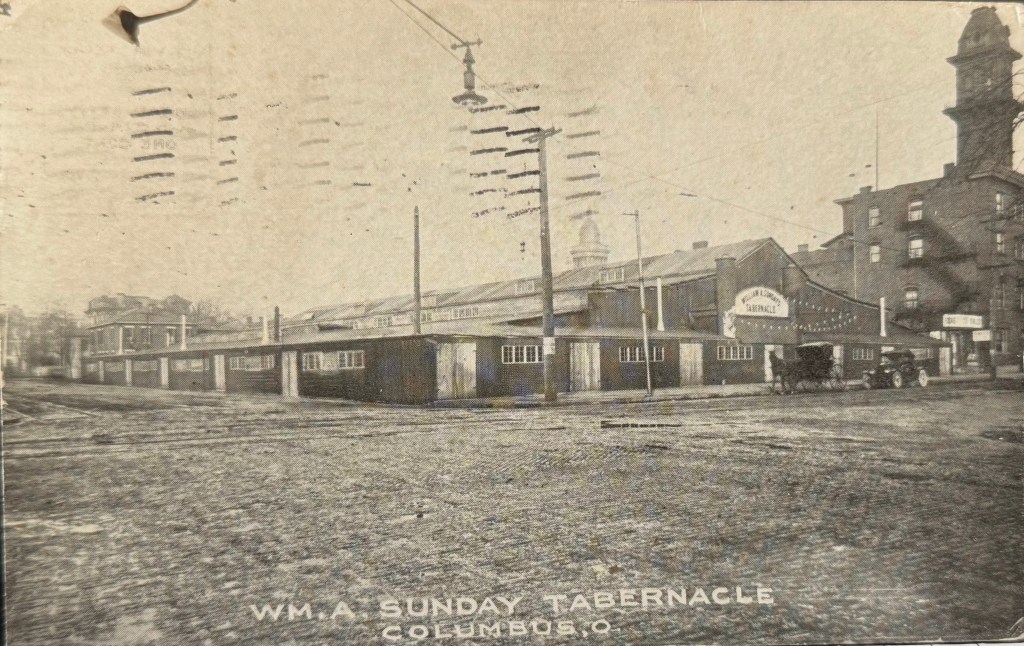
The Columbus, Ohio Billy Sunday Tabernacle. Author’s Collection.
The following information* was addressed to the Wilkes-Barre Editor in 1913, probably just before the February revival. It was likely drafted by Billy himself or someone else close to him from his campaign team. The revival at Wilkes-Barre took place February 22 (23), thru April 13th, 1913.
Image made by J. Inbody, Elkhart, Indiana. Author’s collection. From a 1915 postmarked postcard.
“He [Billy] has skimmed the literature of the English race for information and illustrations, and has a slang vocabulary that is simply astounding. He uses his knowledge with such telling effect that those who come to scoff remain to pray. His earnestness, his transparent honesty, carries his hearers with him, and his slang is all forgotten in his clarion call for repentance; his denunciation of all that is bad, vile and wicked, and in his praise of God, home and country.
“The old school of evangelists were of the itinerant class, moving rapidly through the country, their evangelism seemed sudden in its effects, and I am afraid somewhat evanescent in its results. It is just here that Sunday’s campaign gives promise of more lasting good. His coming has been carefully prepared for, and his meeting place is undenominational and unconventional in character. His is a movement conducted with great business acumen and sound common sense. He trains the ministers and church workers in such a way as to make them capable of caring for the harvest when it comes. Like a good farmer, he prunes the fruit trees with vigor, cuts out all the dead wood and sprays well to get rid of moths, beetles, and such like, so that when the new fruit shall ripen it will be sound and good. Mr. Sunday is a man with a great faith. He prays for the blessing, he prepares for the blessing, and he is sure of getting it. It is therefore no surprise to him when it comes.”
*Original artifact is in the Billy Sunday Archives at the Morgan Library, Grace College.
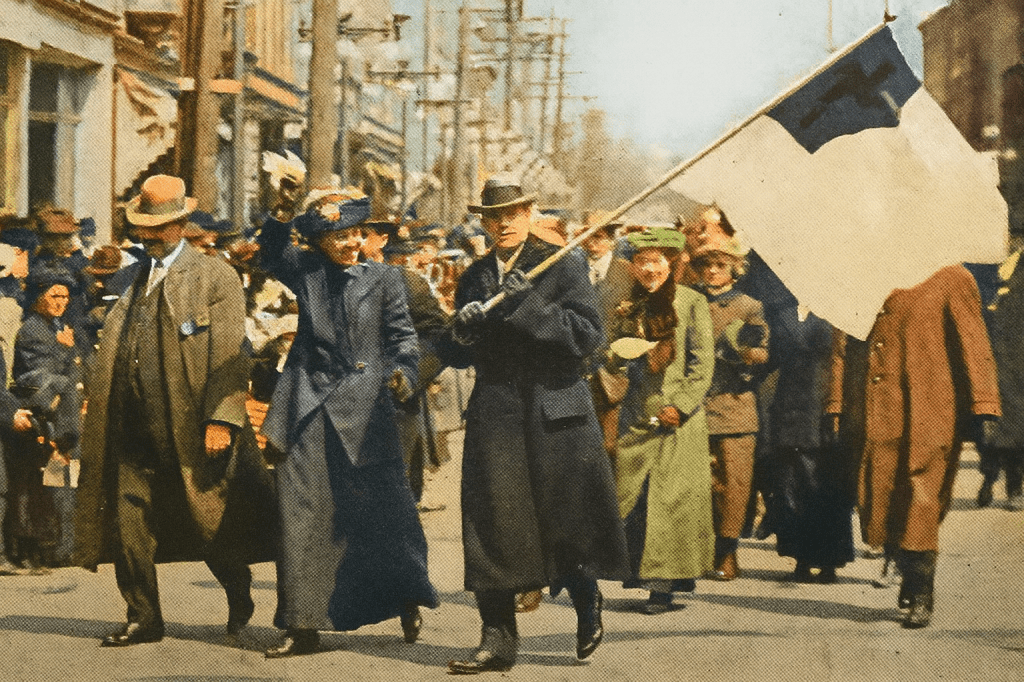
Billy Sunday, and wife Helen, lead a procession of around 20,000 people in a Sunday School parade at Wilkes-Barre. Colorized by the author.
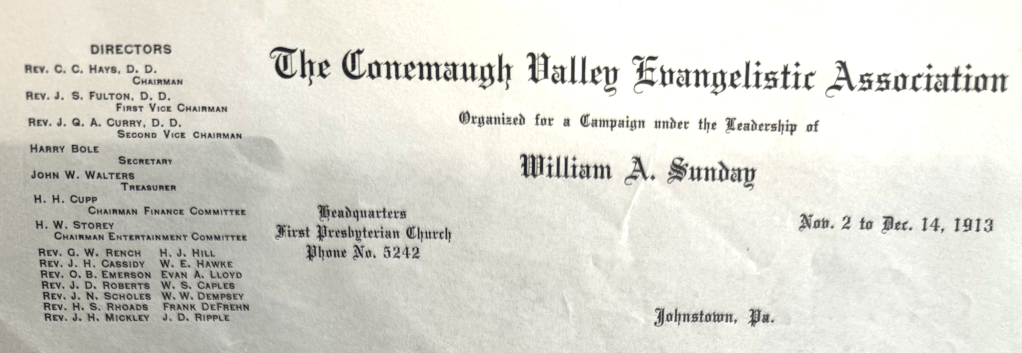
The logistics behind each revival campaign Billy held was simply massive. Here is an example of letterhead pertaining to his Johnstown, PA campaign (November 2, to December 14, 1913.
His letterhead usually indicated the key local personnel who were part of the Committee, the name of the organization formed to promote the revival, the name of a local host church serving as the revival headquarters, and the date of the event.
Permission to use artifact granted by the Morgan Library, Billy Sunday Archives, Grace College.
Here is First Presbyterian Church, Johnstown, PA (picture credit from their web site)
During the height of his ministry-career (1905-1920) Billy Sunday was more popular than Mark Twain or William Jennings Bryan. He even turned down an offer for $1,000,000 for a contract with “moving pictures.” He was a friend to multiple U.S. Presidents and dignitaries. One can only imagine whom he and Helen entertained in their living room below.

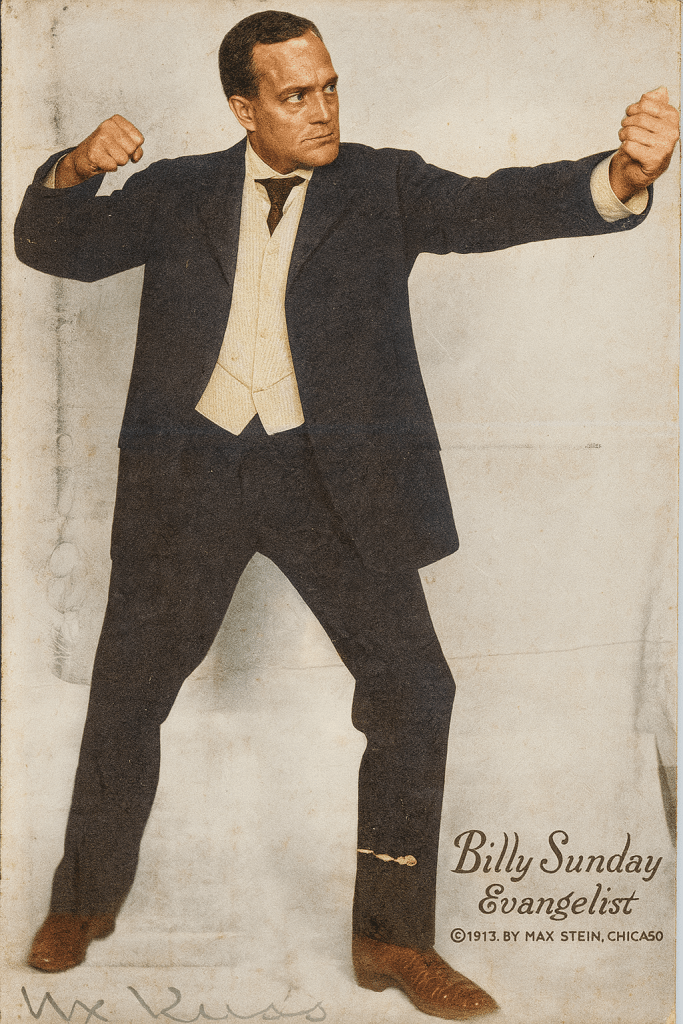




 Evangelist Billy Sunday (1862-1935)