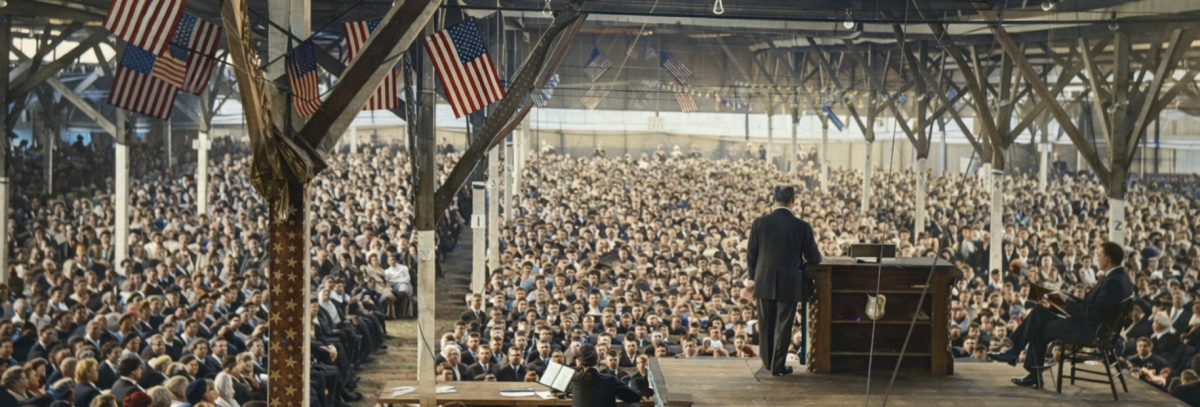
When Billy Sunday came to New Castle, Pennsylvania, in the fall of 1910, the city quickly discovered that it was not ready for what was about to happen.
The campaign opened on September 18, 1910, and from the very first service it was clear that the tabernacle—built to hold 7,500 people—was not nearly large enough. According to the New Castle Herald (Sept. 19, 1910), crowds overflowed the structure on opening day, spilling into the streets and surrounding grounds. What had been intended as a major civic event immediately became something larger: a public phenomenon.
For six weeks, New Castle lived inside a revival. Night after night, thousands gathered to hear Sunday preach in his unmistakable style—direct, forceful, unsparing, and deeply earnest. Newspapers across western Pennsylvania followed the meetings closely, treating the campaign as front-page news rather than mere church business.
By the time the final service concluded on October 30, the numbers were staggering.
In total, $12,500 was collected during the campaign, as reported by the Warren Times Mirror on November 3, 1910. But far more striking were the spiritual results reported by local churches: 6,383 recorded conversions, including 1,050 decisions on the final evening alone.
The New Castle Herald captured the meaning of those numbers in a powerful editorial reflection on October 31:
“Just think of 6,383 souls being added to the churches of this city and county. This means one out of every six persons residing in this city. It means a very much larger proportion in reality, for these 6,383 are all of age to think and to accept for themselves the doctrines of Christianity. In the light of this, the money given yesterday to the evangelist seems a trivial sum, when compared with the good he has done.”
That statement goes to the heart of why New Castle mattered in Sunday’s career. This was not simply a revival that filled a building or generated headlines. It reshaped congregations across an entire region. Local churches suddenly found themselves filled with new members, new energy, and new responsibility for discipleship.
The New Castle campaign also illustrates why Billy Sunday became such a defining figure in early twentieth-century America. In an era before radio, television, or social media, he could command massive crowds purely through reputation, word of mouth, and the sheer force of his preaching. Cities did not merely host Sunday; they were changed by him.
More than a century later, the New Castle revival stands as one of Sunday’s most dramatic successes. For six weeks in 1910, a steel-town community experienced a spiritual earthquake—one that newspapers, pastors, and ordinary citizens remembered long after the tabernacle was torn down.
For historians of revival, New Castle offers a vivid case study in how Sunday’s campaigns worked: huge crowds, intense emotion, measurable results, and lasting impact on local churches.
For the people of New Castle, it was simply the season when their city met Billy Sunday—and was never quite the same again.
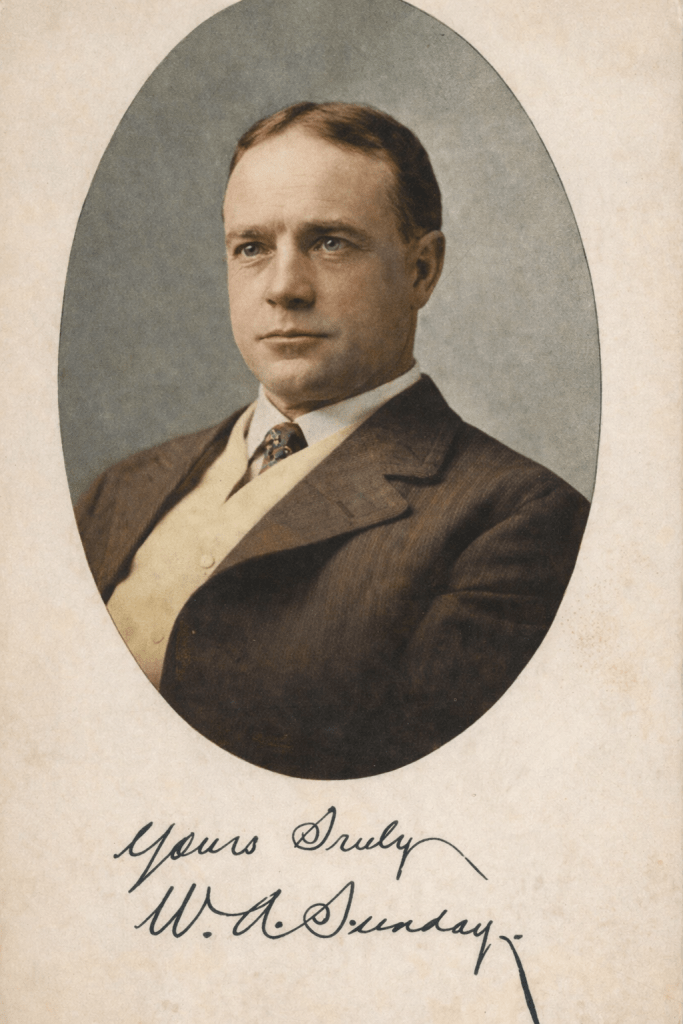
 Evangelist Billy Sunday (1862-1935)