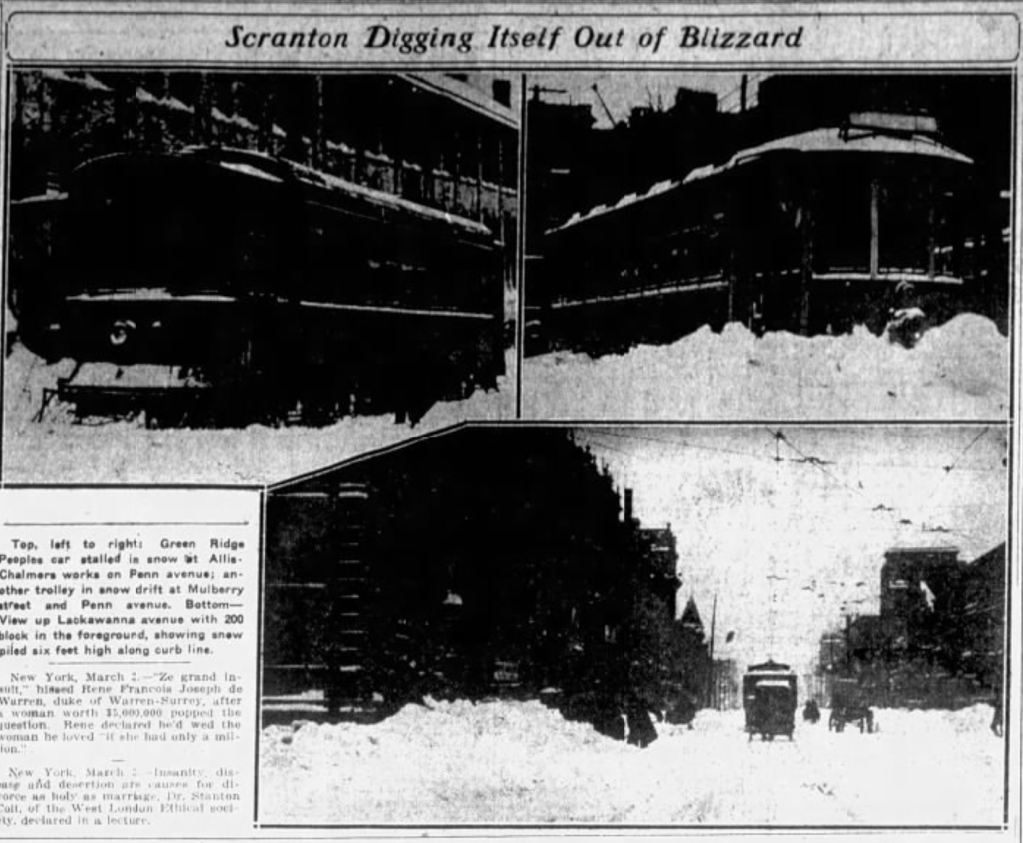
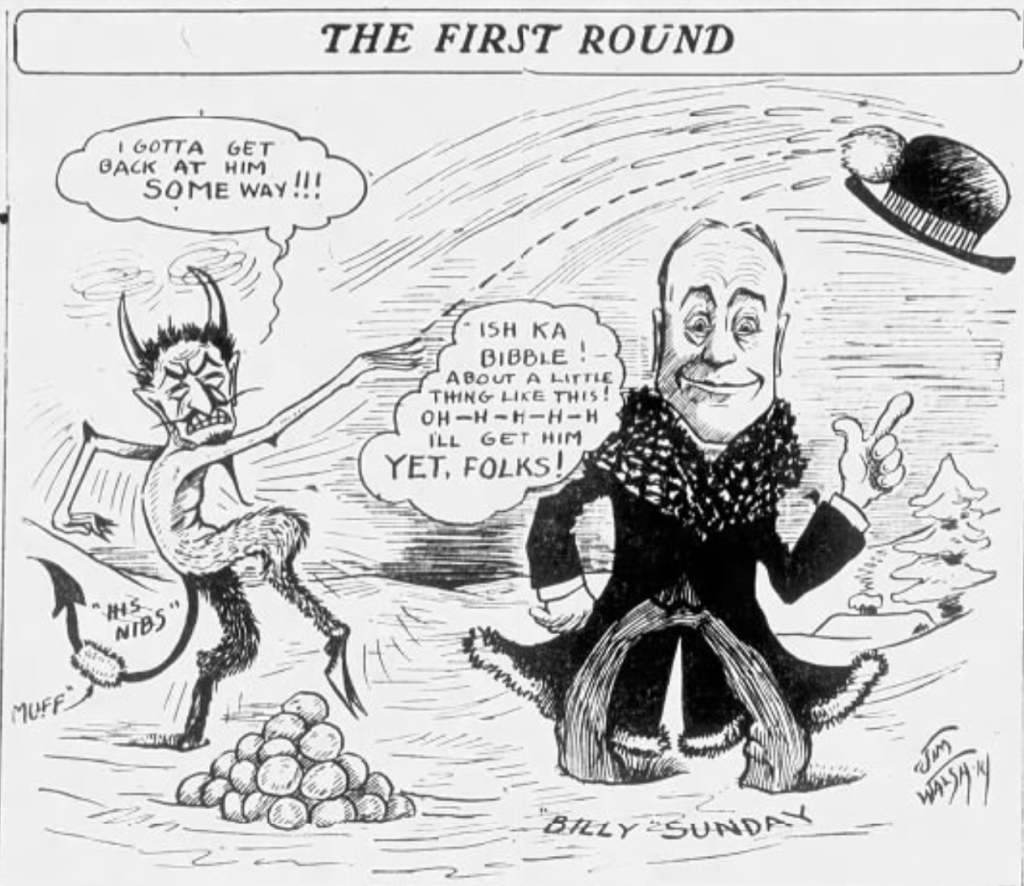
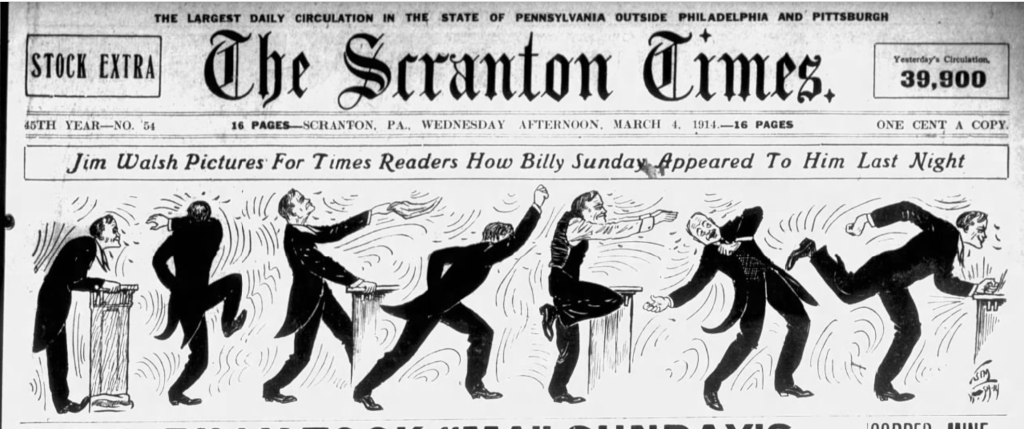
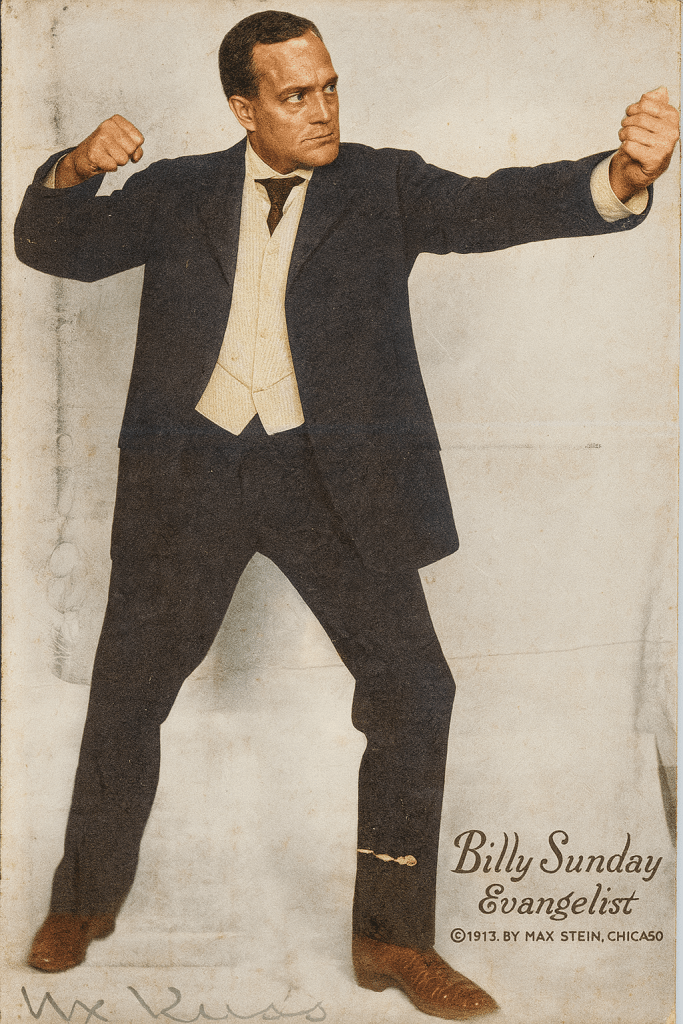
Opening day for the Scranton, PA (1914) revival was met with a massive snow storm

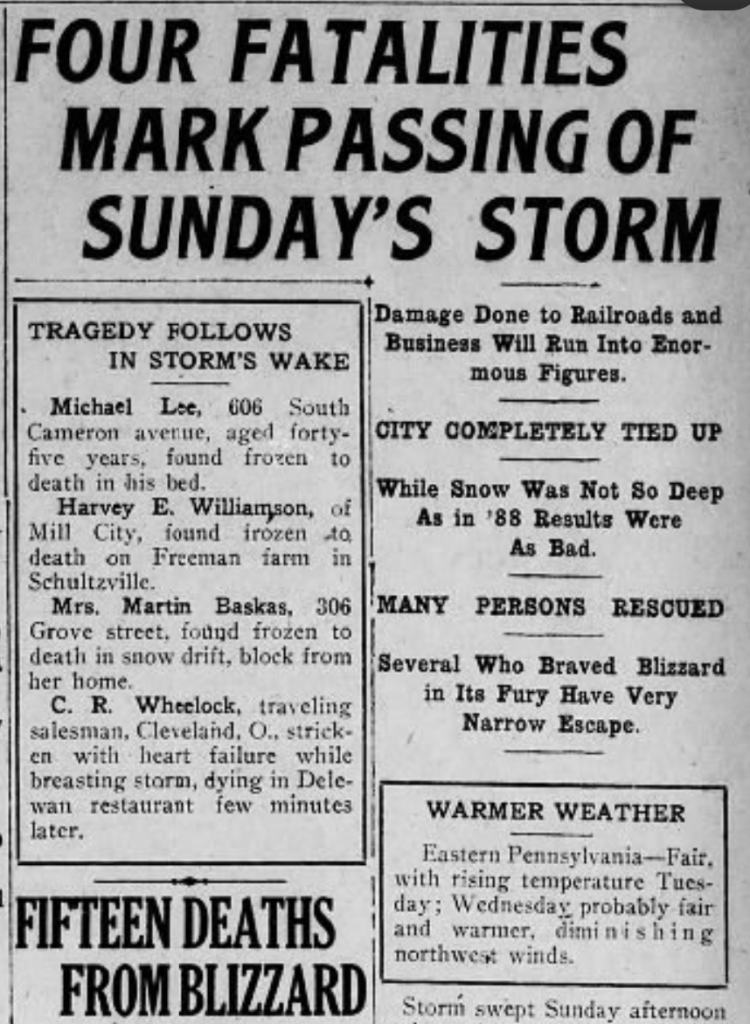
Despite one of the worst storms in recent memory for Scrantonites (March 1, 1914), 4,000 people showed up at the tabernacle, Unfortunately, about 1,500 could not get home. Over 100 trains were delayed or stopped running.

On the evening of March 1, 1914, a fierce winter storm swept into Scranton, Pennsylvania, just as evangelist Billy Sunday opened his long-anticipated revival campaign. Snow began falling heavily and, by night’s end, roughly 14 inches blanketed the city. Winds howled at nearly 45 miles per hour, rattling the enormous wooden tabernacle built for the meetings and at times drowning out Sunday’s booming voice.

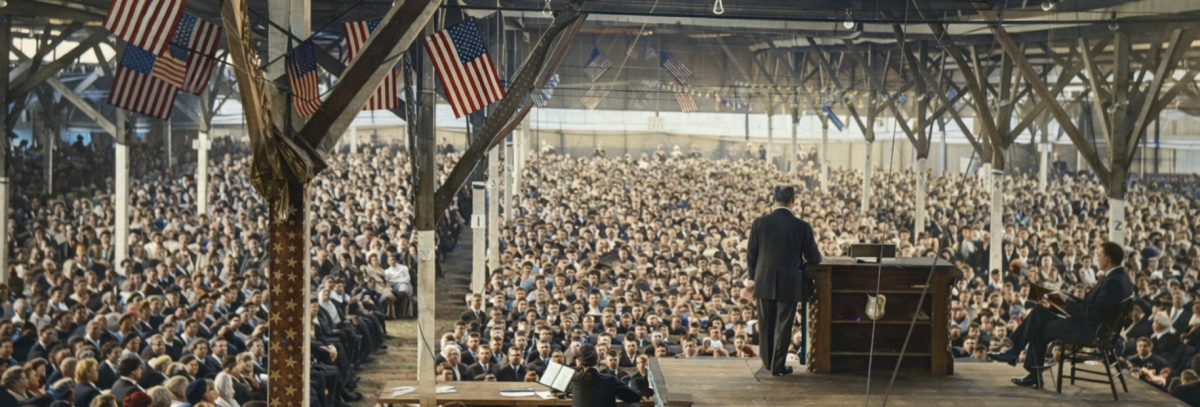
Outside, the storm piled drifts as high as ten feet, choking off roads and halting the streetcars that normally ferried worshipers home. Inside the tabernacle, about 2,500 attendees quickly realized they were stranded. With travel impossible, they settled in for the night, huddling around pot-bellied stoves, brewing coffee, sharing whatever food they had carried, and making the best of their unexpected vigil.

Times-Republican, Tue, Mar 03, 1914 ·Page 1

By the next morning, Scranton lay silent under a white barricade. Billy Sunday canceled Monday’s services so people could rest and dig out. Local volunteers soon arrived with wagons and supplies, helping the weary congregation back to their homes.

The episode became known as the “Billy Sunday Snowstorm,” a dramatic blend of nature’s power and religious fervor that locals remembered for years as the night a revival meeting turned into an impromptu winter encampment.

The Pittsburgh Press (Pittsburgh, Pennsylvania) · Mon, Mar 2, 1914 · Page 1.

“Read good books,” urged Billy Sunday.

In October 1906 Billy preached to a crowd of roughly 800 people in Salida, Colorado, at First Presbyterian Church. During his message he exhorted the crowd…..

Read good books and keep good company. Every gambler and drunkard became so by imitating the gang he went with. Good books and good companions are to character what water is to the fruit trees, the grasses and the vegetables in this beautiful valley.

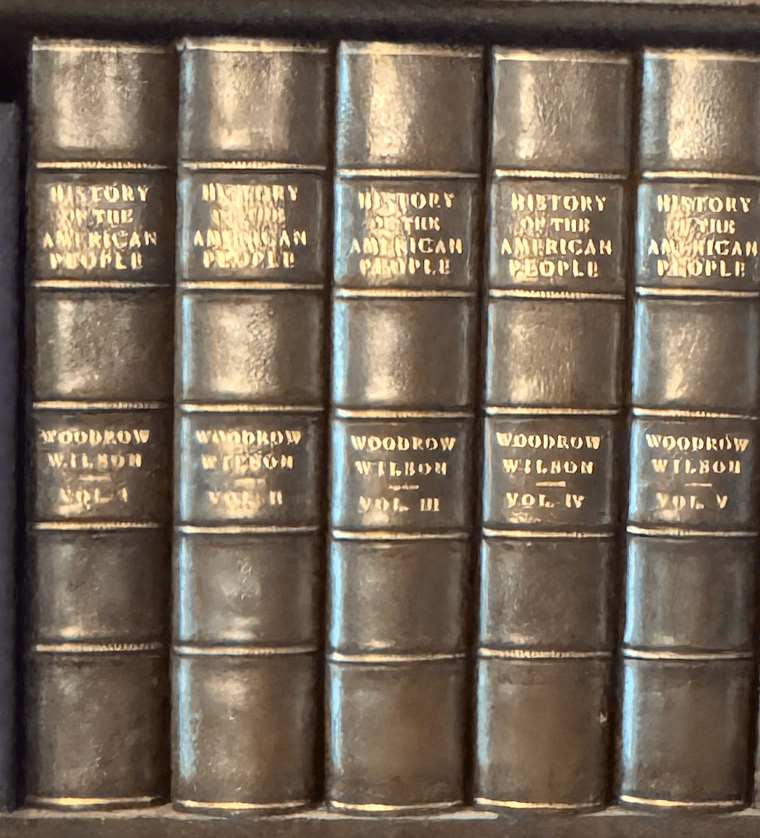
There are a few hundred books in the present Winona Lake home that Billy lived in for the last 30 years of his ministry. On the shelf, one can find A History of the American People, by Wodrow Wilson in the first edition (1902).

While Sunday’s authority came from Scripture, A History of the American People offered a grand, moral narrative of the United States that fit seamlessly with his revivalistic call: a chosen nation needing repentance and reform to fulfill its destiny. Wilson’s combination of national mission, moral urgency, and literary flair reinforced Sunday’s belief that evangelism and patriotism were inseparable in early-20th-century America.

Morgan Library at Grace College (Winona Lake) has several cards or notes in which Sunday and Wilson communicated together. They seemed to have liked each other.

Circa 1890s notebook belonging to Billy

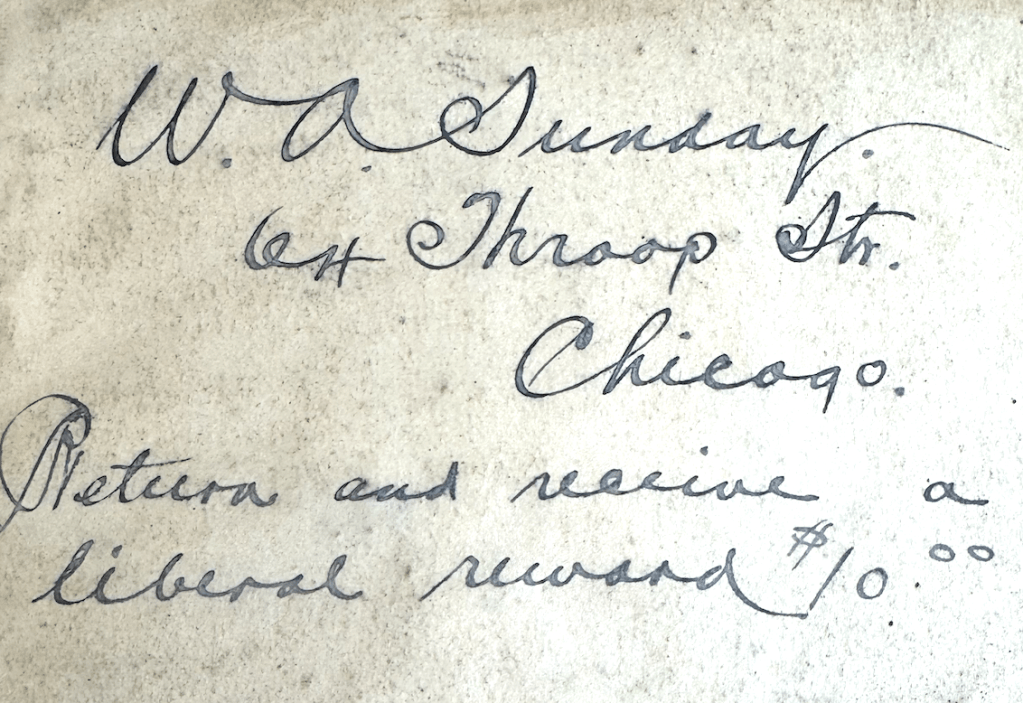
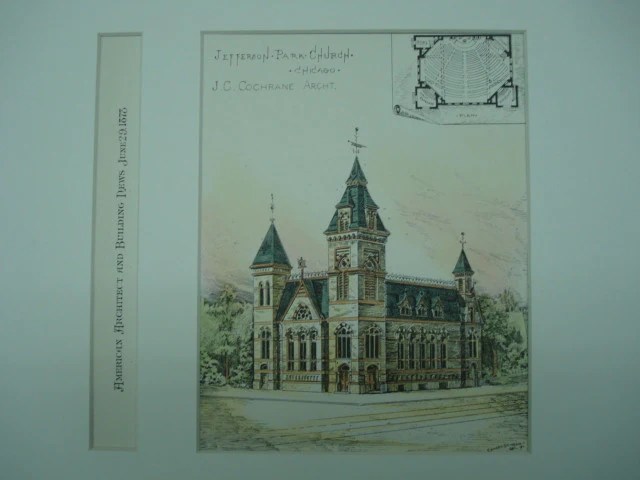
Morgan Library at Grace College has a wonderful artifact that appears to be a notebook with various (mostly) handwritten notes, undoubetdly by Billy himself, that resemble the raw materials and resources Billy used in his earliest ministry days, perhaps as early as the 1890s. It is chalked full with handwritten notes, stats, illustrations, and what appears to be outlines for messages. It is personally inscribed by W.A. Sunday with an address of 64 Throop St. Chicago. The address is interesting because across the street from the home (now gone) is Jefferson Park Church (see Bruns:47).

This Google Earth views shows the site of the previous Park Jefferson Church (8-story red building today). 64 Throop would have been right across today, where a long distribution or warehouse sits today.

“Striking Out” Satan (February 18, 1889) Chicago Tribune.

“STRIKING OUT” SATAN.

BILLY SUNDAY, THE NOTED BALL TOSSER, TURNS EVANGELIST.

The Famous Centre-Fielder Addresses a Large Crowd at Farwell Hall – He Didn’t Even Allow the “Father of Sin” to Reach First Base – Advising His Hearers to Watch Their “Error Columns” – Forty-eight Converts Made.

Centre Fielder Billy Sunday made a three-base hit at Farwell Hall last night. There is no other way of expressing the success that accompanied his first appearance in Chicago as an evangelist.

Young men who dodged the boys distributing pamphlets at the door of the hall were confronted with these words blazing in scarlet letters on the big bulletin board:

“William A. Sunday, the base-ball player.”

And about 500 of them who didn’t know much about Billy’s talents as an evangelist, but could remember him galloping to second base with his cap in his hand, went inside. They heard a rattling fifteen minutes’ talk.

Mr. Sunday, who has grown a red mustache since his marriage, appeared in a becoming black suit and looked a little shy. It was his first public appearance here as an evangelist. In private he had often tried to do quiet work among the ball players, but, after dulling his weapons on the adamantine surface of “Silver” Flint’s moral character, he gave up the task, and for several winters has been preparing for a public trial of his skill in saving souls.

His talk last night was the most successful of the year. He aimed straight at the young men in front of him, giving them the truth in plain, earnest language, and when he finished forty-eight youths raised their hands to show that they had been converted. Sunday looked as pleased as a man who has stolen third.

AT THE BAT.

His talk was from the text: “Is the Young Man Safe?”

“Is he safe?” said Mr. Sunday. “Do you think he is safe, boys – do you think he is safe? I answer no. This is a big city. It is full of temptations. No young man is safe in it without Christ. With Him there is security. Without Him – O! think of the pitfalls and iniquity that drag young men down to sin and death.”

The little ball player walked across the stage with the springing gait of an athlete, and turned suddenly on his audience: “There are a great many questions of vast importance to us as individuals and as a Nation—questions that call for men of keen intellect and for thought—such questions as the tariff and labor. Vast and important as these are, they sink to oblivion when compared to the question of your soul’s future home. Ah! my boy, that is the big question. Christ calls across a chasm of 1,800 years: ‘Son, give me thine heart.’ Today the seat of war is confined to no one nation or battlefield. It rages all over this earth, on the Hudson, on the Mississippi, on the Nile, on the Danube. It is the battle against sin. Ever since Cain slew Abel in the Garden of Eden that battle has been raging, and it will rage so long as the earth stands. What side are you on?

“Think of the thousands that fall in the battle of life, no hope, no home, no heaven. Look at it right, boys. Satan doesn’t want to get a young man who after a while may dispute with him the realm of everlasting meanness. You bet he doesn’t. It is the generous young man, the warm-hearted young man, the ardent young man, the sociable young man who is in danger, my friends. He’s the fellow that Satan behind the bat wants to catch napping. He’s the chap that the Devil in the box wants to pull on with a snake curve. Hold your base. Wait for your ball.”

“WATCH THE ERROR COLUMN.”

Sunday was in earnest. He grew eloquent. “Say to yourself, O my friends, God helping me, I will take my Bible, light for all darkness, balm for all wounds, grand, glorious, the best book you ever owned. If you haven’t got a Bible now, my lads, get one. It will show you the paths of safety and warn you of the danger of the paths of sin: ‘Whoso putteth his trust in the Lord shall be safe.’

“Is there a voice within you saying: ‘What did you do that for? Why did you go there? What did you mean by that?’ Is there a memory in your soul that makes you tremble—is there such a memory, fellows? God only knows all our hearts. He is familiar with the catalogues of our sins. How many hits have you made and where do you stand in the error column?”

Mr. Sunday then led the audience in singing the hymn:

Safe in the arms of Jesus,

Safe from corroding care,

Safe from the world’s temptation,

Sin cannot harm me there.

Forty-eight persons acknowledged the effect of Mr. Sunday’s manly and earnest talk—the best showing made at a Farwell Hall Sunday night service in a year. After the regular meeting an experience meeting was held in the rear of the hall, where Mr. Sunday led in prayer and shook hands with the converts.

“I wish Anson were here,” he said. “What an evangelist the old man would make. No, I’m glad I didn’t take the long trip. I can do more good here bringing souls to Christ. I will play in Pittsburg next summer.”

“Say, how he did line old Satan’s delivery out of the lot,” said a young man at the door. “He hit the ball on the nose every time.”
A churchless community?

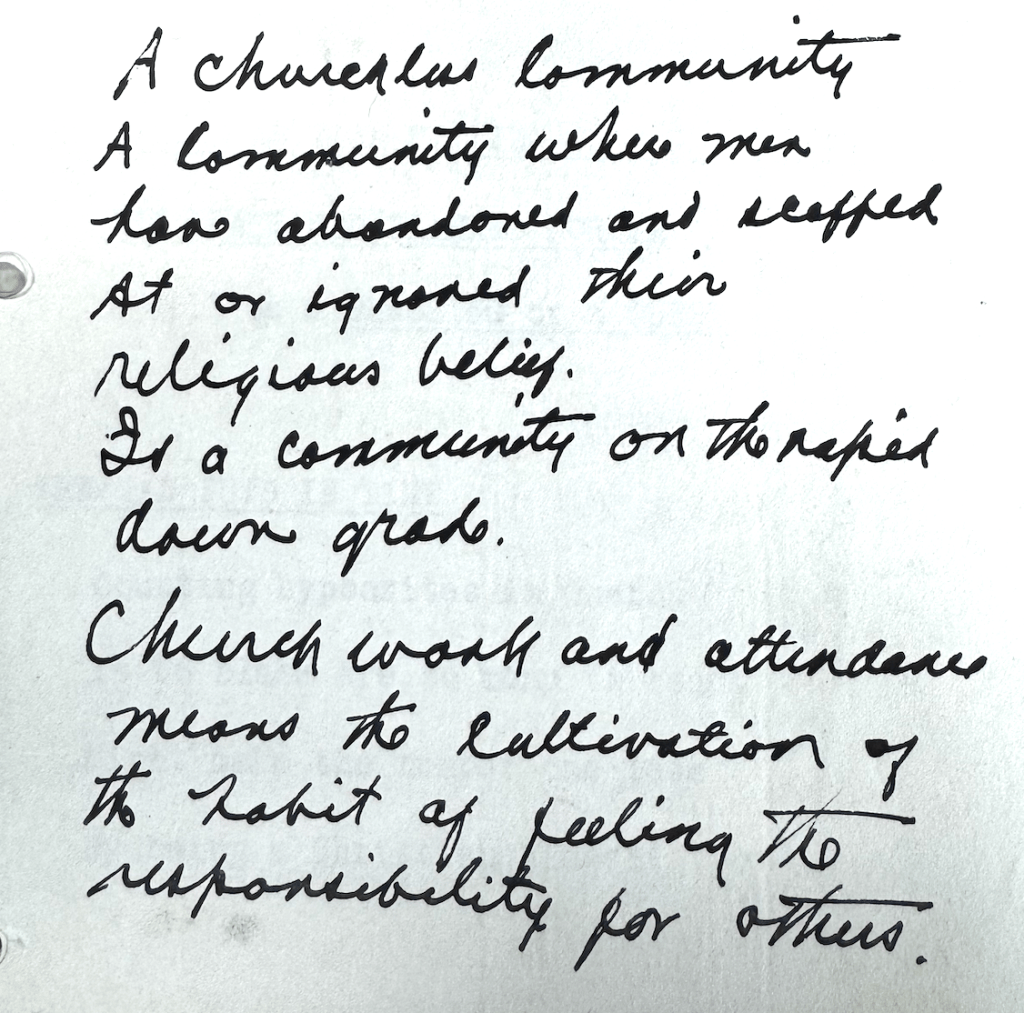
Here’s what Billy Sunday personally wrote in a sermon note about a churchless community.

“A churchless community is a community where men have abandoned and scoffed at or ignored their religious belief. It is a community on the rapid down grade. Church work and attendance means a cultivation of the habit of feeling the responsibility for others.” – not dated but likely 1934. Grace College. Morgan Library.

Philadelphia campaign. January 3 – March 20, 1915

Billy’s words to the people at Philadelphia, farewell:

“And this is only the beginning. The revival is a failure that comes to a close when the tabernacle is torn down; we have enlisted –not for a campaign—but for the war. “There remains much land yet to be possessed”. Not in many years has a large city been so generally permeated by the Spirit of God. But only in part has the harvest been gathered; the convicted should be converted; the lives of those who have taken their first step must be linked to the church of Christ; the young convert must be taught; These thousands of men “whose hearts God has touched” must be kept true by being kept

busy for the Master”. – Morgan Library

A Human Dynamo

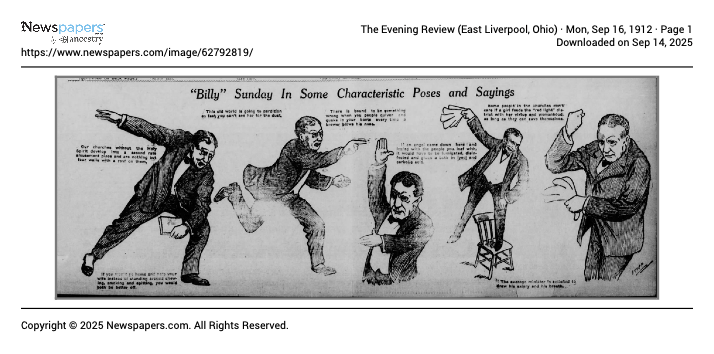
The Evening Review (East Liverpool, Ohio) · Mon, Sep 16, 1912 · Page 4

A Human Dynamo.

That is Billy Sunday in action—a human dynamo working for the cause of religion. No one could listen to the evangelist, yesterday, without absorbing some of his wonderful energy as he sent it out in great dynamic waves through the huge tabernacle. The air of the big structure was saturated with it.

Billy Sunday literally pumps religious enthusiasm into people. And no matter how much of it he pours out, the supply seems inexhaustible. It is almost incredible that one man could have such a lot of vim and vinegar stored up in his one little body and his brain.

Billy Sunday believes in a Christianity that does things, that is carried out into the lives of people, that accomplishes results, that “delivers the goods.” This is the core of his evangelism. This is why he is so vitriolic in his denunciation of the Christian who sits back and is satisfied with announcing that he believes in the Lord but does nothing for the Lord.

Nothing in oratory could be more impressive or effective than the evangelist’s word painting of histrionic scenes, especially those of the battlefield, and the application of some striking incident to the life and work of the soldier in the Christian army. It is the very essence and soul of eloquence.

The audiences that met yesterday to hear Sunday’s first three sermons, would have been most encouragingly large on the pleasantest of days. On a rainy day such as it was, they may well be regarded as remarkable, and as most auspicious.

A contemporary account of Billy Sunday (c 1921)?

The following account (excerpted) is in the Morgan Library Billy Sunday Archives.

“Life and Labors of William A. Sunday”

[Billy’s own view of his first sermon.]

“I diagnosed the sins and difficulties of people as existing in the gray matter. I figured I had to show people. You ought to have heard my [first] sermon. It was a hummer. I had stacks of books all around me. There were words that would make the jaws of a Greek professor squeak for a week. When I sprung it, it went off like a firecracker and busted in the middle. I figured that I was going to the old sinful world to its knees and yet nothing happened. Then I loaded my old muzzle loading gun with ipecac , buttermilk, rough on rats, rock salt and whatever else came handy and the gang has been ducking and the feathers flying ever since. I was wrong. It was the heart and not the gray matter that was wrong.

“In 1891 Sunday left baseball to become secretary of religious work at the Chicago Y.M.C.A. After three years he became advance man for J.Wilbur Chapman, also holding meetings in connection with the campaigns. About Jan.1,1896 Chapman returned to the pastorate and simultaneously Sunday received his first call [editor: this is not correct] as an evangelist. This meeting was held at Garner, Iowa and dates the beginning of this mans remarkable career.”

[Billy as a man of prayer.]

In regard to the personality of the man I would say first that he is fundamentally a man of prayer. Let the mistaken critic of Sunday rid himself at once of the notion that his meetings are merely big displays of the powers of advertising and organized enthusiasm and the product of a man who is called “a great salesman”. The life of the man and the activities of a campaign are shot through and through with prayer. In every place where he holds a meeting he chooses a secluded spot from whence he storms heaven. This place becomes a Bethel to him. In prayer he is natural. His prayers are not long but to the point and usually open with “and now Jesus” from whence he proceeds in his peculiar manner to pray for all the matters pertaining to the success of the meetings. Without prayer he believes he would be as Samson shorn of his strength. He makes no decision or takes no step without first taking the matter to the Lord.

[Billy’s passion for souls?”

He has an intense passion for souls. Here is a man who carries the people of a community upon his heart and is ready to give his very life and strength and energy in order to see them saved. He will continue day after day, preaching twice and three times only to see men turn to God.

[Billy’s power of perception?]

Mr. Sunday is endowed with a remarkable power of perception. Passing through a building he sees things that readily lend themselves for sermon stuff. His remarkable memory is brought into evidence in his sermons as he pours forth anecdote, history, statistics and quotations from literature with remarkable rapidity. He is equipped with a clear eye that takes in the entire tabernacle into its scope and gives him a remarkable advantage over his audience.

[Billy’s executive ability?]

We must here mention the executive ability of the man. He has the happy faculty of surrounding himself with co-workers who are very efficient and it is to the credit of Mr. Sunday that the personnel of his staff is the same today that it was in 1916 with the possible exception of the tabernacle building as my memory fails me on this point. Space will not permit us to discuss the form of organization in a campaign except the fact that towns from 5 to 20 miles from the seat of activity are touched through the organized spirit of prayer that emanates from the campaign.

[Billy’s imagination?]

His imagination enables him to make the commonplace radiant with beauty. He uses no Greek or Latin but the plainest and most expressive language. He calls things by their right name and often his words burn and blister. It is doubtful if there is any living preacher who can pour out such a stream of red-hot and sizzling adjectives to show his scorn and contempt for sin. There are moments when he makes you think of the way Jesus denounced the scribes and Pharisees.

[Billy’s use of slang?]

We must give a little space to the matter of slang. It is futile to attempt to apologize in behalf of Mr. Sunday as he would not welcome such an apology. It is his point of contact. He calls it, “corn bread and potatoes”. Asked to tone down his preaching in this regard he replied to a committee of ministers that, “If I preached like you do I would have about as many people to preach to as you do.” Slang is defined as language in the making and unconventional speech. Study carefully the Bible characters whom God has used. How many are there of the stereotyped kind? It was the rams horn rather than the silver trumpet that led Joshua’s army to victory. Samson thinned the army of the alien with the jaw-bone of an ass. David used a sling and Shamgar an ox goad and we are also reminded that the Master himself “taught not as the scribes”.

[Billy’s use of illustrations?]

. . . his style is direct and expressive. His sermons teem with illustrations that illustrate. He combs the ends of the earth for material for his sermons and his ready references to science, history, literature and other branches both delight and stagger the hearer. Sentiment, pathos, logic, word pictures, impersonation etc are all used to drive home truth.

What’s next, after a Sunday revival ends? C. 1913

END OF SUNDAY CAMPAIGN.

Before another issue of the Times-Leader reaches its readers, Rev. Billy Sunday and his co-workers will have left. This community has been stirred up as never before. We desire at this time to reproduce an editorial of the Ohio State Journal published at Columbus, when Mr. Sunday conducted a campaign just previous to his visit here:

“As a result of his mission in Columbus, we should say there is a stronger moral sense in this community than there ever was before; and now the pressing question is, how to preserve it, how to make it vital in civic, religious and business life. He has made of religion a thoroughly practical matter, and has made the people feel it to be that way; and now it becomes the duty of every one who loves his neighbor and his city to put into practice in his own life the high lessons of duty, and honor, and faith, which Rev. Sunday has been preaching to us for the past seven weeks.”

That’s the correct summing up of the entire situation. Sunday has recruited the soldiers. The responsibilities and duties rest with those who remain here.

Source: Wilkes-Barre Times Leader. Sat, Apr 12, 1913 ·Page 6

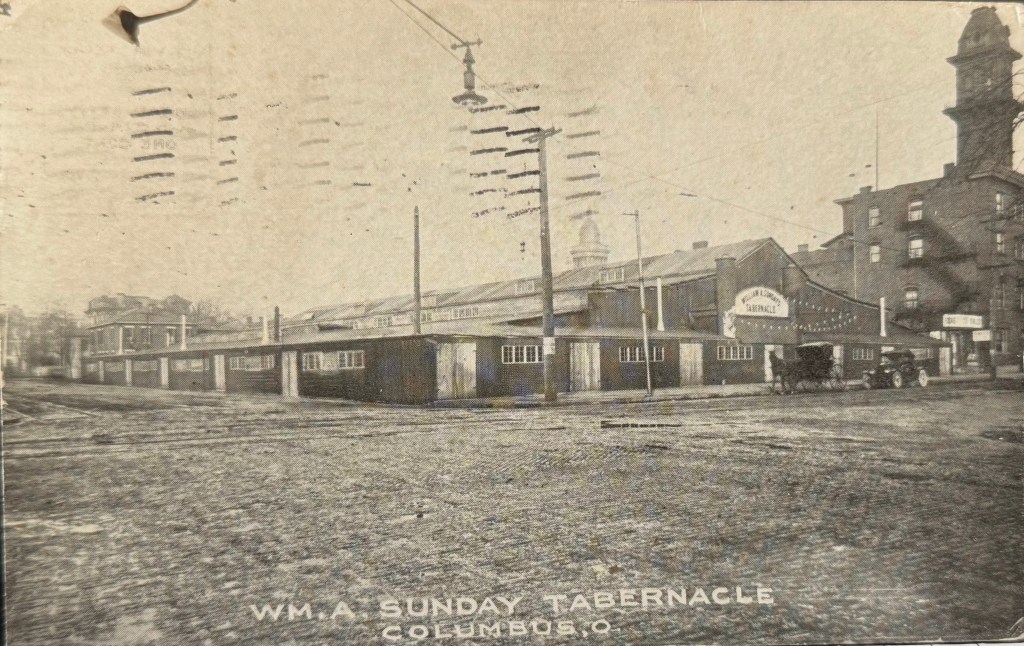
The Columbus, Ohio Billy Sunday Tabernacle. Author’s Collection.