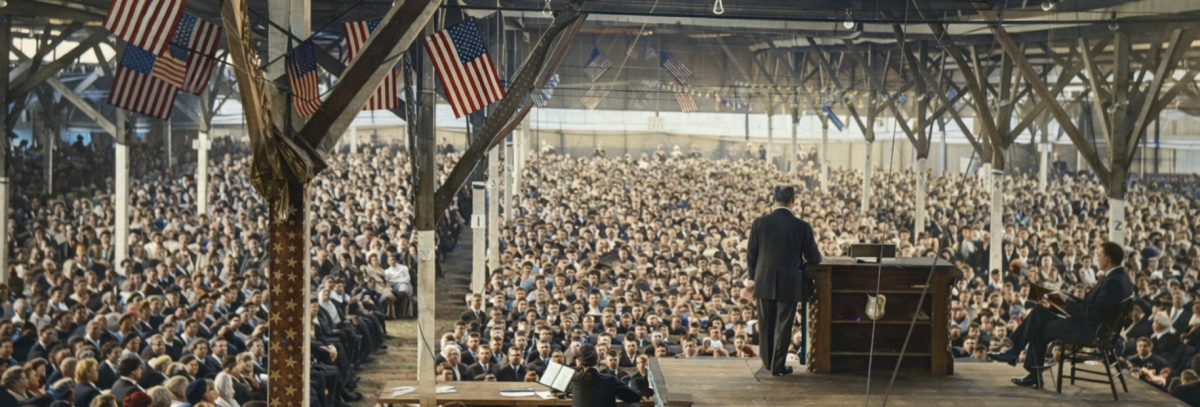
The Greatest Show You’ve Never Heard Of: Circuit Chautauqua and the Performance of America


If you lived in small-town America a century ago and heard that a massive tent was going up just outside of town, you knew exactly what was coming: the Chautauqua was back.
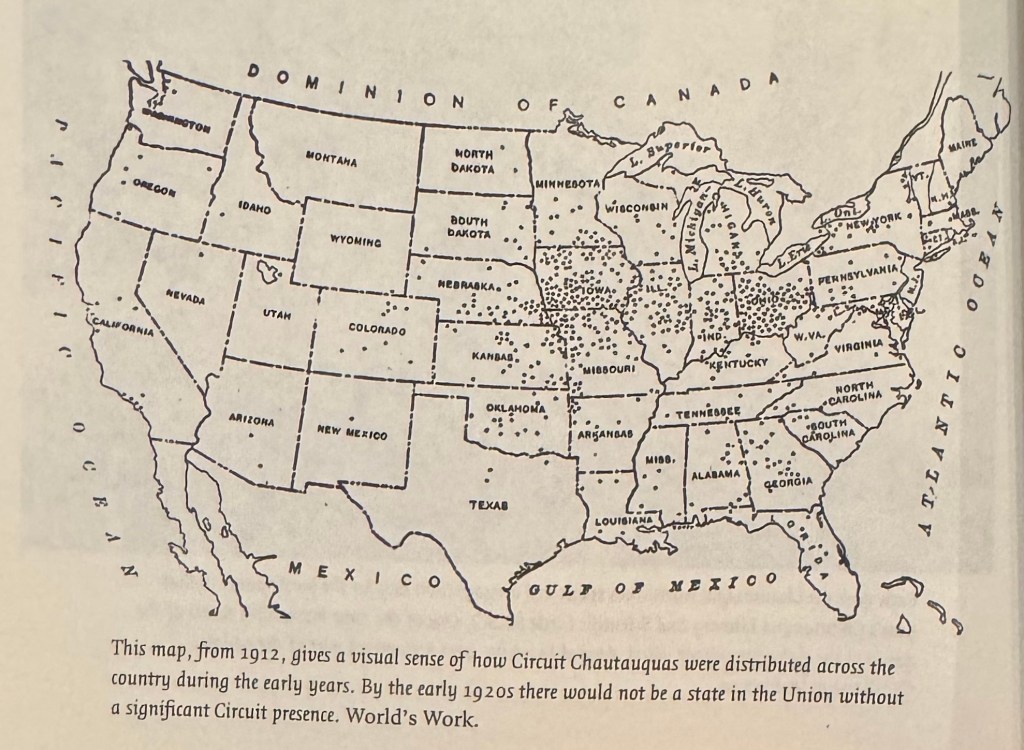
Canning, p. 26

But not just any Chautauqua. This was the circuit Chautauqua—a full-blown cultural caravan, rolling into communities like a blend of TED Talk, county fair, gospel revival, and Broadway road show. It was, as historian Charlotte Canning describes it, “the greatest aggregation of public performers the world has ever known.”

Forget the dusty image of civic lectures and sober-minded schoolteachers. Circuit Chautauquas were performance-driven experiences, intentionally designed to shape the American imagination. They were mobile festivals of ideas, music, drama, and moral vision—staged under a giant canvas tent, and scheduled with industrial precision across the country.

Canning helps us see these not merely as education-on-wheels, but as orchestrated acts of cultural storytelling. At their heart, circuit Chautauquas were about performing a kind of “Americanness”—a staged identity that included democracy, morality, individual responsibility, and civic pride. And these weren’t abstract ideas: they were embodied in actors, lecturers, and musicians who took the platform with everything from Shakespearean monologues to lectures on temperance and suffrage.

The Paradox? These events, often remembered as wholesome and nostalgic, were also deeply commercial. Promoters like Roy Ellison and Keith Vawter didn’t just want to elevate the public—they wanted to make a million. Yet that’s part of the genius: they succeeded in selling culture as spectacle, without cheapening either.

To Canning, the tent was a stage—not just for performers, but for the entire community to see itself. Who belonged? Who was excluded? What did it mean to be an American in 1910 or 1920? Every act—whether musical trio or biblical dramatist—answered those questions in subtle (and sometimes not-so-subtle) ways.
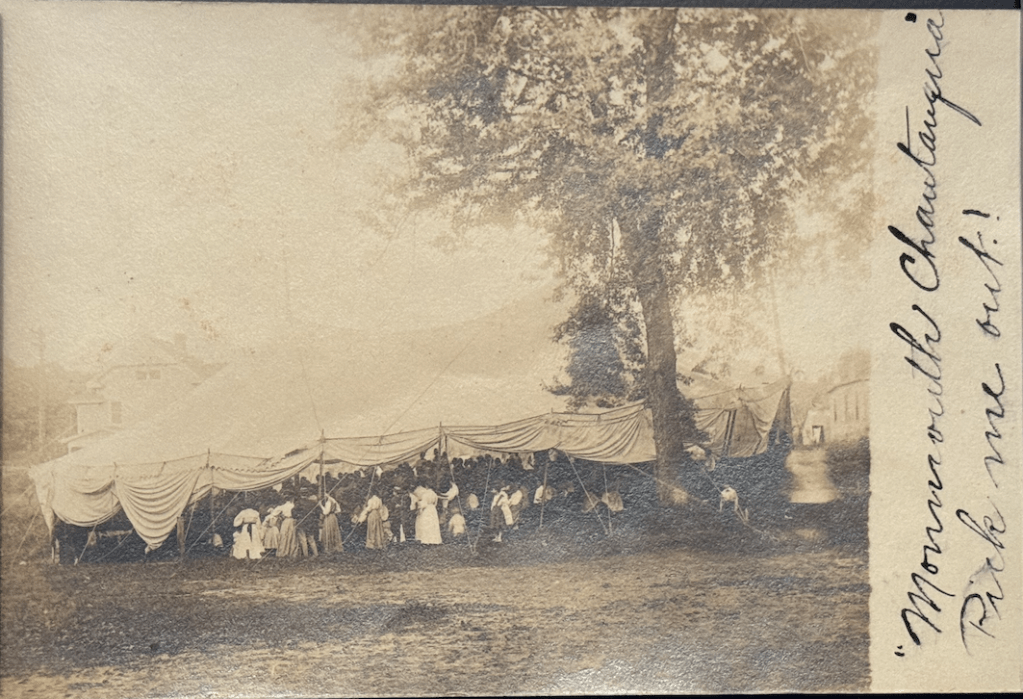
Monmouth, Illinois chautauqua, 1907 postcard. Author’s collection.
Billy spoke at Monmouth, August 17, 1906.

So the next time you think of rural America in the early 20th century, don’t just imagine plows and porches. Picture the circus-sized tent at the edge of town. The banners. The folding chairs. The packed crowd.

And inside that tent? America on stage.


Resource cited
Charlotte M. Canning. The Most American Thing in America: Circuit Chautauqua as Performance. 2005.
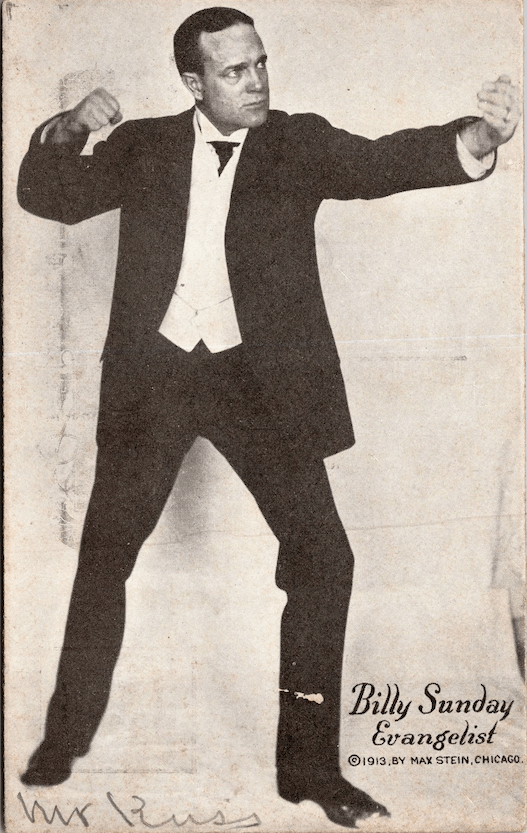
Sunday answered the ‘cultural cry’ of his age


Part 1: A Nation in Turmoil and Transition

How Industrialization, Urbanization, and Moral Upheaval Set the Stage for Revival

When Billy Sunday’s voice rang out across America’s wooden tabernacles, he wasn’t just preaching sermons—he was answering a cultural cry. From 1900 to the early 1920s, the United States was spinning in the whirlwind of transformation. Old institutions were cracking, new cities were rising, and the American soul was searching for an anchor. Into that spiritual vacuum stepped Sunday—a preacher who didn’t just understand the moment; he embodied it.

By the early 20th century, America was moving from farm to factory. In 1870, only 25% of the population lived in cities. By 1920, over 50% did. The dizzying shift from rural life to urban sprawl left many disoriented. Long-standing community structures—churches, front porches, family farms—were being replaced by crowded tenements, anonymous factory work, and the fast pace of modern life. People needed clarity, direction, and moral certainty.

Sunday gave it to them—loudly, plainly, and with baseball-player bravado.

The U.S. was also undergoing its greatest wave of immigration, with over 14 million new arrivals between 1900 and 1920. While these immigrants enriched the nation’s culture, they also stoked fears among native-born Protestants about identity, religion, and national character. Sunday’s revivals, though not overtly anti-immigrant, often appealed to a kind of nostalgic Protestant Americanism that comforted people who felt their world slipping away.

Meanwhile, the Industrial Revolution was rewriting the rules of labor and wealth. Robber barons rose; workers organized. Socialist ideas were gaining traction. Against this backdrop, Sunday didn’t call for revolution—he called for regeneration. He told workers to repent, not revolt. He urged bosses to clean up their lives, not just their payrolls. In an age when ideologies were competing to explain human brokenness, Sunday offered the most American answer imaginable: personal repentance and individual transformation.

And of course, moral reform movements were gaining steam—chiefly the push for Prohibition. The saloon had become a symbol of urban vice, immigrant excess, and male irresponsibility. Billy Sunday didn’t just preach against alcohol—he declared war on it. His famous line, “I’m against the saloon with all the power I’ve got,” wasn’t just rhetoric; it helped catalyze a national movement that led to the 18th Amendment.

So why did Billy Sunday rise when he did?

Because he stepped into a nation off balance, morally confused, spiritually hungry, and socially uprooted. He didn’t just ride the wave—he harnessed it. His sermons shouted what many Americans were whispering: that the old truths still mattered, that the Bible still had authority, and that one man’s conviction could still move a crowd.

In an age of massive upheaval, Billy Sunday stood like a lightning rod—conducting fear, hope, outrage, and repentance into one electrifying movement.