The following article appeared in The South Bend Tribune. November 7, 1935.
Sunday Heard by Big Crowds Here in 1913
Rev. William Ashley Sunday, who died suddenly Wednesday evening in the home of a friend in Rogers Park, a suburb of Chicago, conducted in South Bend in 1913 what probably was the greatest series of evangelistic meetings ever held in Indiana. His campaign began Sunday, April 27, and continued for seven weeks.
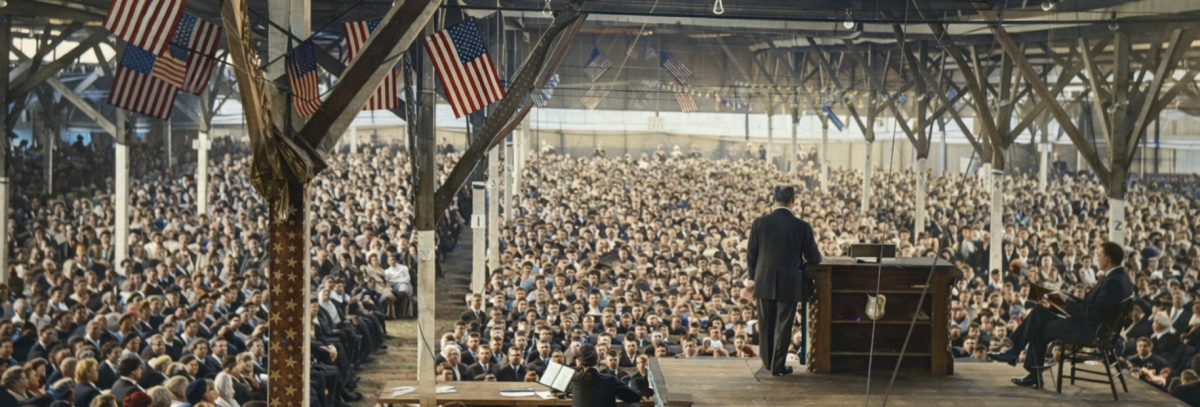
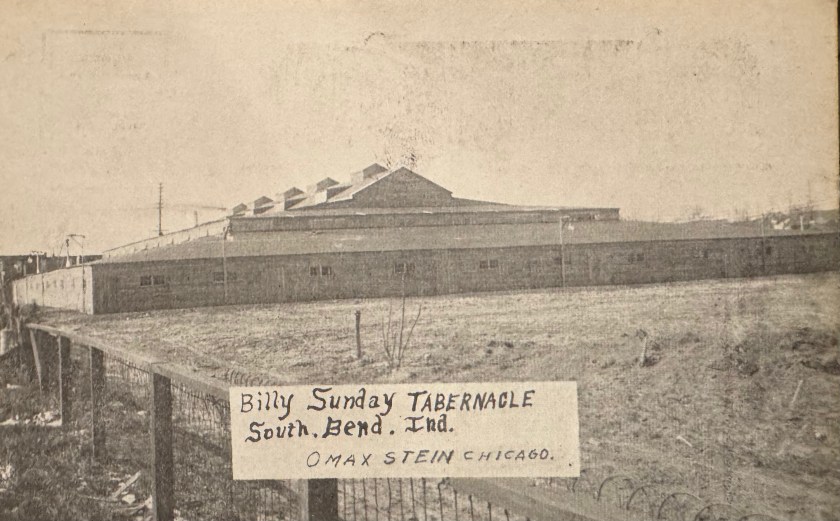
For two months before the famous Billy Sunday opened his meetings in South Bend workmen were engaged in the construction of one of the largest buildings ever erected in the city which became known as the tabernacle. It was built of wood on vacant land between Vistula avenue, now Lincoln Way East, and the St. Joseph river, with Monroe street on the north and South street on the south. The tabernacle had a seating capacity of about 10,000. Reservations were made for the largest musical organization ever assembled in the city, a chorus of more than 1,000 voices. The ground floor was covered with sawdust and fine shavings, making a soft, thick carpet and the outstanding celebrated sawdust trail.
4,000 at Dedication.
Mr. Sunday and his party were quartered in three houses at 515, 517 and 519 South Carroll street. His housekeeper, Mrs. J. W. Foults, of Cleveland, O., had charge of the households. The tabernacle was under the supervision of Fred Seitz, a close friend of the evangelist, who had charge of his tabernacles in the various places where services were held.
The tabernacle was dedicated on Sunday evening, April 20, more than 4,000 persons presenting many denominations in South Bend and elsewhere being present. Rev. Dr. Henry L. Davis, pastor of the First M. E. church, chairman of the tabernacle building committee, presided. He then introduced to E. C. Miller, chairman of the executive committee for the St. Joseph County Evangelistic association, which was largely instrumental in bringing Mr. Sunday to the city. Mr. Miller told of the purpose for which the tabernacle was built. The invocation was by Rev. Peter Moredyke, pastor of the First Reformed church, now out of existence.
Rev. C. V. Mull, pastor of the United Brethren church, led the responsive reading. The scripture lesson was read by Rev. J. C. Tomes, pastor of the Christian Church, of Mishawaka. Rev. Thomas W. Powell, pastor of the Quincy Baptist church, preached, his subject being “Divine Urgency.” Rev. A. C. Ormond, pastor of the Presbyterian church in Mishawaka, spoke on “God’s Victories,” praising Mr. Sunday’s work and saying that if Christian people could operate 40,000 souls in South Bend and Mishawaka could be saved. The benediction was by Rev. Dr. C. A. Lippincott, pastor of the First Presbyterian church.
Nursery Provided.
Marvin Campbell, chairman of the finance committee, announced that in addition to this the association would pay half of the salaries of Mr. Sunday’s co-workers. Mr. Sunday was not to receive anything until the last Sunday of the services when the entire collection was to go to him. Rev. C. A. Decker, pastor of the First Baptist church, told of preparations for handling the big crowds.
A nursery where parents left their children while the parents attended the meetings was situated near the tabernacle and was in charge of Miss Babcock, head of the city’s kindergarten training schools. Children under five years of age were not allowed to attend the services.
Before the tabernacle was completed South Bend business men began the erection of large and small billboards near the entrances to the tabernacle. This aroused the indignation of religious people to a point of battle and vigorous protests were made against the signs.
Nearly 20,000 Listen.
Members of the Sunday party arrived in South Bend previous to
The_South_Bend_Tribune_1935_11_07_1
SUNDAY SPOKE IN CITY IN 1913
Continued from Page One.
Saturday, April 26, and prepared for the great Sunday opening. Mr. and Mrs. Sunday arrived Saturday afternoon and the evangelistic services began the following day. The great evangelist’s first utterances were made before an enormous gathering. Hour after hour on the opening day nearly 20,000 upturned faces watched and listened in the great tabernacle. The morning crowd was estimated at 7,000, the afternoon at 4,000 and the evening at 8,000. Favorable weather, leaders of the movement believed, would have swelled the crowd to nearly 25,000. The morning collection amounted to $184, the afternoon to $70.28 and the night to $167.93, making a total for the day of $425.51. From the first meeting to the last seven weeks later Mr. Sunday had great crowds.
The great evangelist’s services closed on Sunday, June 15. On that day the collection amounted to approximately $10,000. The collection was given to Mr. Sunday. The total of collections for the seven weeks was $24,227.98, the total attendance was 600,050 and the total conversions 6,389. The taking of the offering for Mr. Sunday was one of the features of the closing day of his great campaign. A number of persons in South Bend and Mishawaka contributed $100 each. The largest individual contribution was $200 given by Samuel Murdock, of Lafayette, Ind., a well known and devout Catholic and one of the owners of the Chicago, South Bend & Northern Indiana railway of South Bend.
After Rev. Mr. Sunday completed his services and left the city the great frame tabernacle was torn down and the lumber was removed. The site is now covered by some of the best residences in South Bend and is known as Edgewater place.
The_South_Bend_Tribune_1935_11_07_2

 Evangelist Billy Sunday (1862-1935)