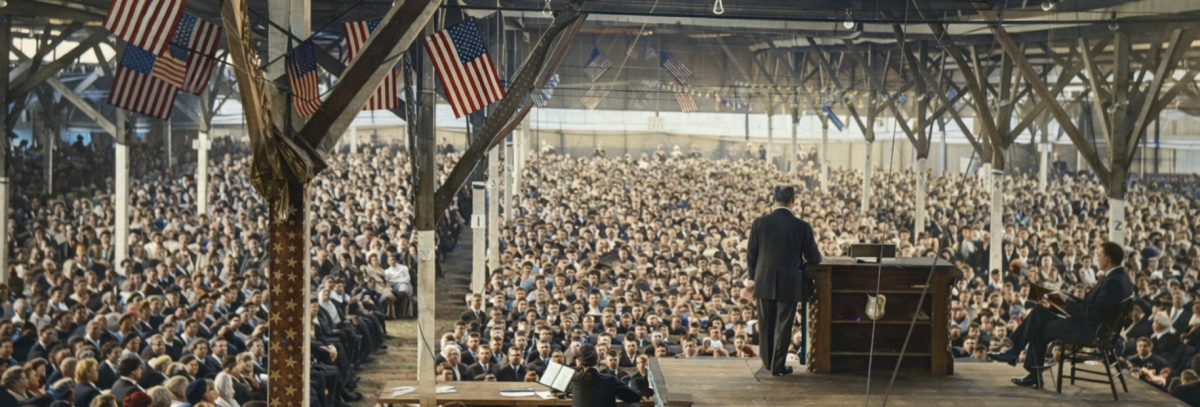
From Spectacular Career (198-201)
Mr. Sunday’s literary activities are carried on for the most part at Winona and sometimes at his fruit ranch in Oregon. The exacting demands on his time during a campaign admit of very little new work. At Winona it is his favorite method to take his Bible and spend the long days beneath the trees reading. This he calls resting and with the single exception of preaching to a responsive audience, is his favorite occupation. He is also fond of books relating to evangelistic and kindred work.
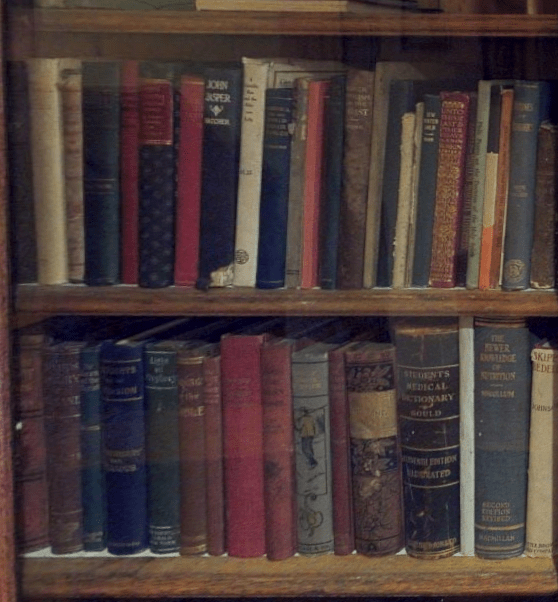
— “There are some books I like to read” he says, “I consider the Bible the best of them all. I also think the lives of Peter Cartwright, Charles G. Finney and John G. Paton are among the greatest of all books. Finney converted the owner of the New York mills at Utica, New York, and since he campaigned there, the mills have not been in the hands of non-Christian men.
He never goes into the pulpit with more than an outline before him. His extraordinary memory permits him to quote lengthy passages verbatim, but on this he does not rely for effect.
In comparing his sermons for use Mr. Sunday begins by noting various quotations and anecdotes which will illustrate the theme he wishes to handle. Notations of these are made on all sorts of scraps of paper and are then turned over to his secretary who shapes them into memoranda. Gradually the sermon takes form in the preacher’s mind and then with a great sheaf of notes in his hand he whips the whole into something like the form in which it will be used. Seldom if ever, however, are even his famous sermons preached twice exactly alike. He never goes into the pulpit with more than an outline before him. His extraordinary memory permits him to quote lengthy passages verbatim, but on this he does not rely for effect. It is in the infusion of intense personal enthusiasm that the most remarkable results from his discourses come.
In his earlier days Mr. Sunday made no effort to copyright any of his writings. What he considered unwarranted liberties with the text, however, later prompted him to do so, and in a little more than three years he copyrighted no less than 31 of his discourses.
The records of the Library of Congress show the following titles, copyrights of which are in his name:
Amusements.
And he said tomorrow.
Atonement.
Backsliders.
Behold, I stand at the door and knock.
Get on the water wagon.
Great reward.
Home.
Hope.
How shall we escape?
How to succeed.
If any man will.
If ye love me, keep my commandments.
Incarnation.
Is it well with thee?
Judgment.
Little plain talks—Character.
Moral leper.
Nathan and David.
No man cared for my soul.
Not far from the Kingdom.
Nuts for skeptics to crack.
Power of motherhood.
Question of the ages.
Samson.
Three great questions.
Three groups.
Twenty-third Psalm.
Unpardonable sin.
What must I do to be saved?
What shall the end be?
Title to one other copyright stands in the name of Mr. Sunday, this is for a book entitled “Life and Labors of Rev. Wm. A. (Billy) Sunday, the Great Modern Evangelist; With Selected Sermons.” It was copyrighted in the year 1908 by S. T. Herman and E. E. Poole; of Decatur, Illinois, and published by a printing establishment in Chicago.
The only feature of the book, which properly can be considered a life, are four pages of introduction. In the first paragraph of this introduction there are no less than five errors in fact, other portions of the meager outline are more or less at variance with actual conditions, although there is nothing to indicate any greater offense than carelessness.
The bulk of the 360 pages is taken up with reproductions of sermons. The readers of the book, if there be any, would have recognized whole pages of familiar expressions which he had heard in the tabernacle. The evangelist, however, more intimately familiar with the construction of all his works, finds that a number of his sermons were ruthlessly joined together and the entire continuity of thought disturbed.
Mr. Sunday, therefore, made it his business, at a considerable outlay in cash, to secure both the copy-right and the plates of the book, which he destroyed and effectively prevented any further issue. Copies are extremely rare and indeed none are known to exist outside of the Library of Congress. Thus ended the only previous attempt to put in book form the doings of the evangelist.

 Evangelist Billy Sunday (1862-1935)