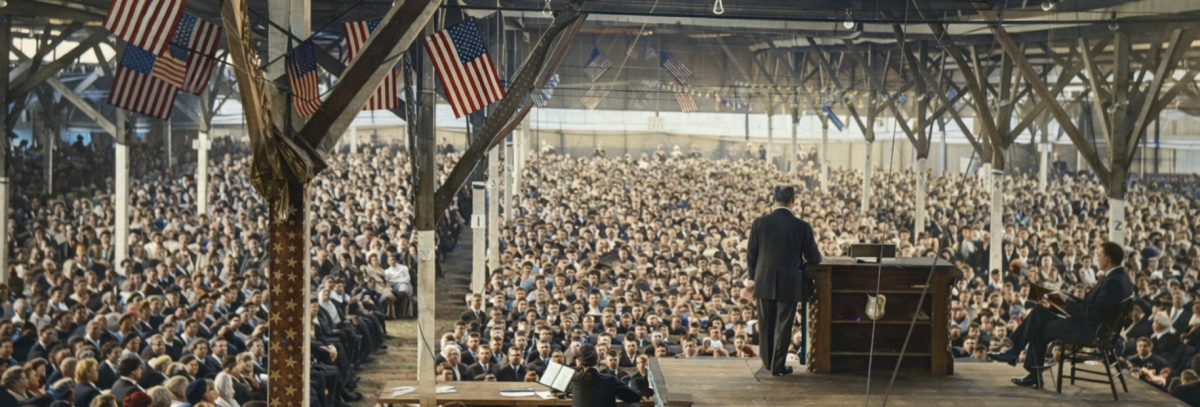
What did Billy Sunday’s 1918 campaign mean to Chicago?

The Muscatine Journal. Tue, May 21, 1918 ·Page 3

WHAT BILLY SUNDAY MEANT.

“Billy” Sunday has come and gone. His mission is a matter of history. What did it signify? Some of the facts of the great revival are indicated in figures. The famous “trail” of the tabernacle for example was touched by nearly 50,000 pairs of feet seeking Mr. Sunday.

Chicago Daily News, no copyright.

The combined audiences at all the Sunday meetings are again reckoned at something like 1,200,000. Plainly a very considerable section of Chicago listened to the Sunday message. No politician, nor even a statesman, ever enjoyed such a hearing.

The novelty in the evangelist’s preachments arose from his unique personality. The doctrines preached by the Rev. William A. Sunday were essentially much the same as those the Chicago of another generation heard from the Rev. Dwight Moody. They were the same to be heard today in the four hundred-odd churches which were represented by the Sunday campaign.

The homely virtues, individual rectitude in business, personal morality in domestic life—these were the essentials. The code preached by “Billy” Sunday was familiar to his congregations. It is characteristically American. The “thou shalts” and “thou shalt nots” are the precepts and the prohibitions of the United States.

Mr. Sunday gave a new emphasis to a creed learned by most of his hearers in infancy. Like all successful missionaries in the home field, he affirmed persuasively what his converts believed, but did not consistently practice.

Many of those who renewed their religious pledges in the tabernacle will be better citizens. Chicago like Billy Sunday. His sincerity and disinterestedness made a good impression.

Every one wishes him success in his next public work.—Chicago Herald- Examiner.

For more information:

The Wheaton College Archives. The Chicago Campaign, 1918.

When did Billy Sunday host an evangelistic campaign in Chicago?

Billy Sunday’s 1918 revival campaign in Chicago, held from March 10 to May 20, was one of his most ambitious and high-profile efforts. It occurred during a pivotal moment in American history, as the nation grappled with World War I, the temperance movement, and the looming influenza pandemic.

The Billy Sunday Tabernacle, Chicago. 1918. Bill Sunday (left), Homer Rodeheaver (right).
Public domain.

Campaign Overview

The campaign was strategically timed to bolster support for Prohibition in Chicago, a city known for its vibrant nightlife and strong opposition to temperance reforms. Sunday, a fervent advocate for the ban on alcohol, delivered his fiery sermon “Get on the Water Wagon,” in which he vividly denounced the liquor industry. He likened the “booze interests” to a “rattlesnake that wriggled its miserable carcass out of hell,” vowing to fight them relentlessly—even “on ice” if hell froze over.

Despite his passionate rhetoric and widespread attention, Sunday’s efforts did not yield the desired political outcome. Chicago voters rejected a local Prohibition initiative during the campaign, a defeat famously referenced in Frank Sinatra’s song “Chicago (That Toddlin’ Town)” with the line: “The town that Billy Sunday could not shut down.”

Attendance and Impact

The campaign drew substantial crowds, with estimates suggesting that over 650,000 people attended the meetings over the course of seven weeks.

Sunday’s dynamic preaching style and the campaign’s extensive organization contributed to its broad reach and influence.

Legacy

Although the immediate goal of enacting local Prohibition in Chicago was not achieved, the campaign underscored Sunday’s significant role in the national temperance movement. His efforts contributed to the broader momentum that led to the ratification of the Eighteenth Amendment in 1919, establishing Prohibition across the United States. The Chicago campaign remains a notable example of Sunday’s impact on American society during a transformative era.