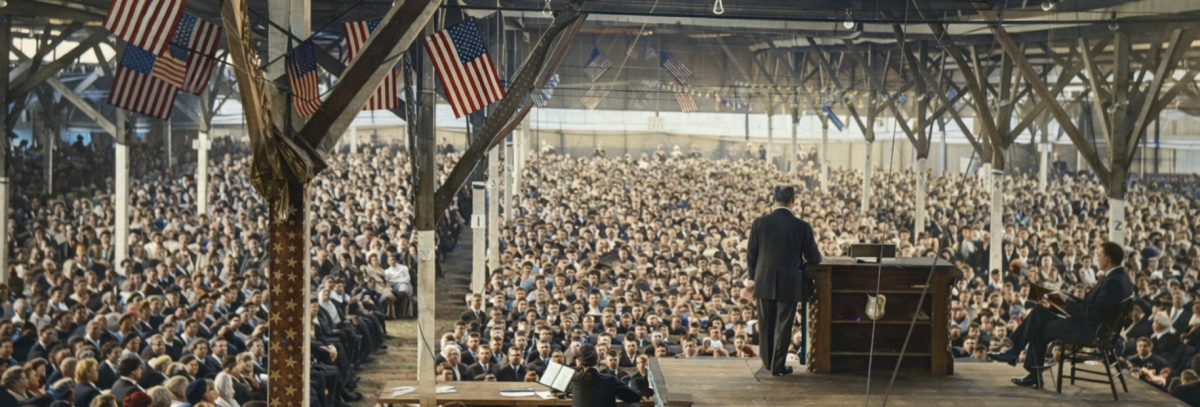
In 1922, Billy Sunday stepped into a new technological frontier by preaching over the “wireless”—what we now call radio. At the time, this was cutting-edge communication. The term “wireless” referred to the transmission of audio over electromagnetic waves, without the use of physical wires or cables. In just a few years, this technology had moved from military and maritime use into the public sphere, and by 1922, commercial radio broadcasting was beginning to take off across the United States.
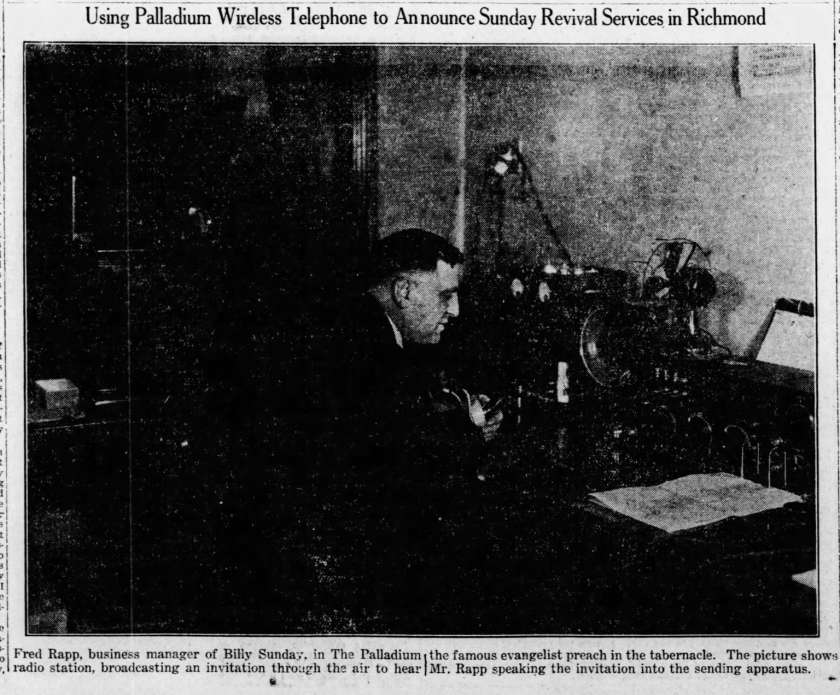
The form of radio Sunday used was known as AM, or amplitude modulation. This early method involved taking the sound of a person’s voice—captured by a microphone—and superimposing it onto a high-frequency radio wave using a modulator and vacuum tube amplifier. That modulated signal was then broadcast through an antenna and picked up by receivers—early crystal sets or tube radios—scattered in homes and offices around the region. It was basic by today’s standards, but revolutionary in its day.
In practical terms, this meant that Sunday’s sermons, once confined to large wooden tabernacles or revival tents, could now reach thousands of listeners in real time over great distances. His voice might have been carried by pioneering stations such as WJZ in Newark or WEAF in New York, allowing people who had never set foot in one of his campaigns to hear his preaching live.
This was no small development. At the start of 1922, fewer than 50 licensed radio stations existed in the U.S.; by the end of that year, over 500 were on the air. The nation was gripped by what some called “radio fever,” and Billy Sunday—ever the showman and communicator—was quick to embrace it.
For Sunday, radio was not just a novelty. It was a powerful extension of his mission. He had long understood the role of mass media in spreading his message, leveraging newspapers and advertising better than any evangelist of his time. Radio became the next logical step, and his use of it helped set the stage for a new generation of radio preachers and religious broadcasters, including names like Charles Fuller and Aimee Semple McPherson.
Sunday’s move into the airwaves marked a turning point—not only in his ministry but in the story of American religious life. It was one of the earliest moments where evangelical preaching and modern technology met in a way that would change both forever.
BILLY ENJOYS FIRST PROGRAM BY RADIO; LISTENS IN HIS ROOM
Billy Sunday has been converted— to wireless.
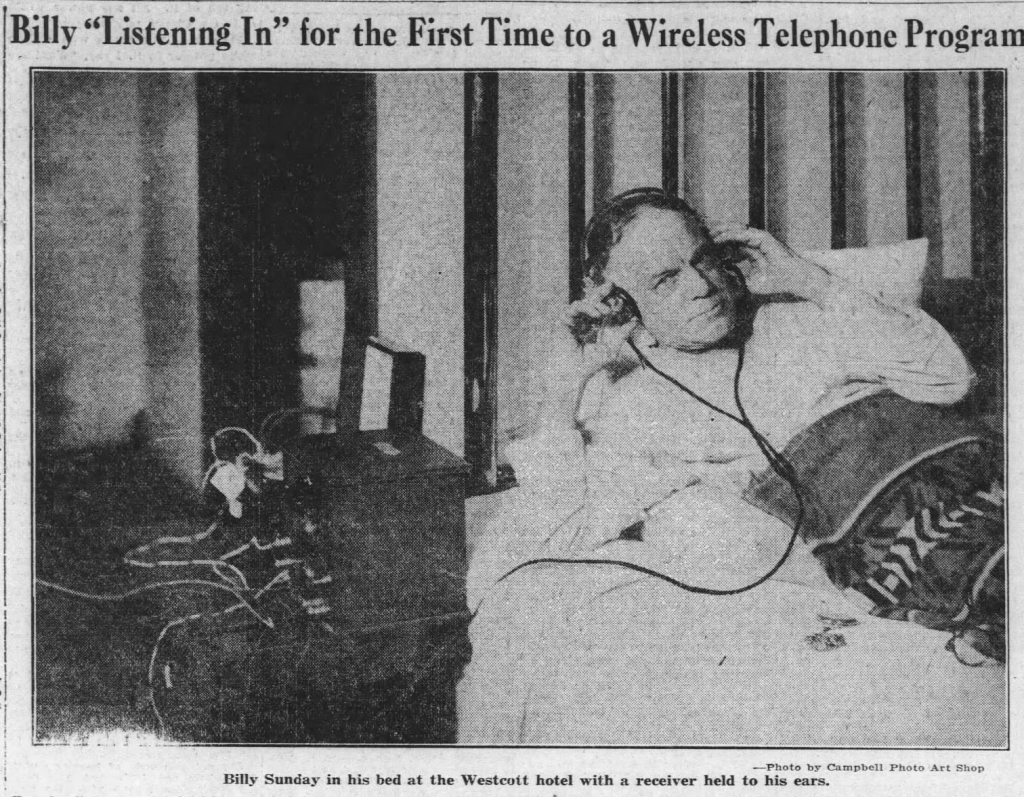
For the first time in the history of the evangelistic party, a concert was given by members over a wireless telephone Wednesday night, and after listening in on a set that had been installed in his room, Mr. Sunday requested the operators, Messrs. Paul Showalter and Harold Cutler, to return after his evening sermon and allow him another chance to listen. The special program of the evening was given in The Palladium wireless room. The bulbs of the receiving set in Mr. Sunday’s room burned until 10:30 o’clock while local and out-of-town stations were turned in.
At Mr. Sunday’s request also, the set was left in place all day Thursday to allow him to hear the noon and evening programs of The Palladium. Arrangements will be made to furnish him a set for the entire time he is in Richmond. With a set installed, the former baseball player expects to follow the fortunes of the different teams as they are shown in the daily broadcasts of baseball scores and to get other sport news ‘hot off the bat.’
Complete success for the special program, in spite of unusually adverse weather conditions, was reported by listeners. ‘Fine.’ ‘Best program you have given yet,’ ‘unusually clear and distinct,’ were some of the phrases used in praise of the vocal and instrumental concert. Some difficulties were met in broadcasting music from the original performers as this is the first time it has been attempted by the Richmond station, but the results aroused a quickly expressed delight at all the stations listening.
First Radio Performance.
Although Mr. Rodeheaver has been with the revivalist for 12 years, Mr. Peterson for five, Miss Kinney for six, Mr. Matthews for eight and Mrs. Asher for 11 years, this was also the first occasion that any of the party had made a ‘radio appearance.’ Yet there was no trace of ‘radio fright’—akin to stage fright—common to those accustomed to public appearances when they are first asked to talk or sing into an inanimate transmitter for the benefit of an invisible audience.
Gathering in the Palladium wireless telephone room promptly at 6:30, the program began on schedule time and was heard by the regular listeners to the Palladium evening program. In many cases, out-of-town amateurs invited neighbors and friends to listen and entertained them with the special concert.
A photograph was taken of the singers in the radio room during the program.
The duet, ‘The Old Rugged Cross,’ sung by Mrs. Asher and Mr. Rodeheaver, seemed to find especial favor with some listeners. Mrs. Maude Winder, 413 North Thirteenth street, who is active in the Billy Sunday organization, had the opportunity of listening over a set operated by her husband, Joseph Winder, president of the
(Continued on Page Twelve.)
BILLY IS
(Continued from Page One.)
Richmond wireless amateurs’ organization and expressed deep appreciation Thursday morning. The final song was her favorite. “The last song was beautiful,” she said, “but we listened to and enjoyed the whole program from beginning to end. The instrumental solos were fine also.”
Trio Number Choice.
The trio which sang negro spirituals was the choice of R. G. Bruce, teacher in the Boston school, who listened over Walter Rife’s set. “That was the best of all, it was exceptionally good,” he said, “but the trombone solo was beautiful also. It was very clear and the words of the songs were wonderfully plain as well.”
Mr. Rife, an amateur of Boston, was host to Mr. Bruce and to a group of his neighbors whom he had invited for the special program. Unable to attend the services at Richmond, these Boston citizens still enjoyed the benefit of all but Mr. Sunday’s sermon. Mr. Rife reported a very clear and distinct transmission for the Palladium telephone, which he was unable to obtain with other stations that night.
A report was telephoned in by Park Snider of Connersville, one of the prominent amateurs and a radio dealer, immediately after the program. “Your telephone came in very loud here,” he said, in spite of some bad interference through which the program was received.
Loud In Praises
A group listening at the station of C. O. Snyder in West Richmond, was loud in praises of the program. Two of the listeners for whom this was the first experience with wireless, expressed amazement at the excellent quality and the loudness of the voices of the singers. “It’s just as though they were in the room,” said one.
David R. Pottenger, a real estate dealer, who was one of the new listeners at Mr. Snyder’s set, was especially interested in the program and expressed surprise at the perfect manner in which voices and music could be transmitted.
Another informal radio party was held at the store of Leslie Hart, radio dealer, on Main street. Many other amateurs of Richmond listened to the program and gave efficient and valuable assistance in their suggestions and prompt reports at the beginning of the program.
Express Gratification
Gratification was expressed by local listeners for the opportunity to hear the special program, as except for the few that were able to hear Wednesday night on account of the bad weather conditions which made transmission difficult. Only a few stations could be tuned in by Rife at Boston, with none as loud as the Palladium station. Rike-Kumler’s station at Dayton was heard by C. O. Snyder and other amateurs after the Palladium program, but was reported very weak locally, although usually it comes in very loud. This station was heard also by Billy Sunday at the hotel after the close of the special program.
As stated above, Billy Sunday was one of the most interested listeners, this being the first occasion on which he had had any experience with wireless, or had a chance to hear his party over the wireless, although he has travelled with them from Duluth south to Tampa and from New York to California.
Solo, duet, trio, vocal numbers and solo piano and trombone numbers were given by the Sunday party.
Palladium-Item. Thu, Apr 27, 1922 · Page 1
https://www.newspapers.com/image/246718382/
Richmond Palladium Item. April 29. 1922
Members of Sunday’s Party All Set to Give Their First Wireless Concert
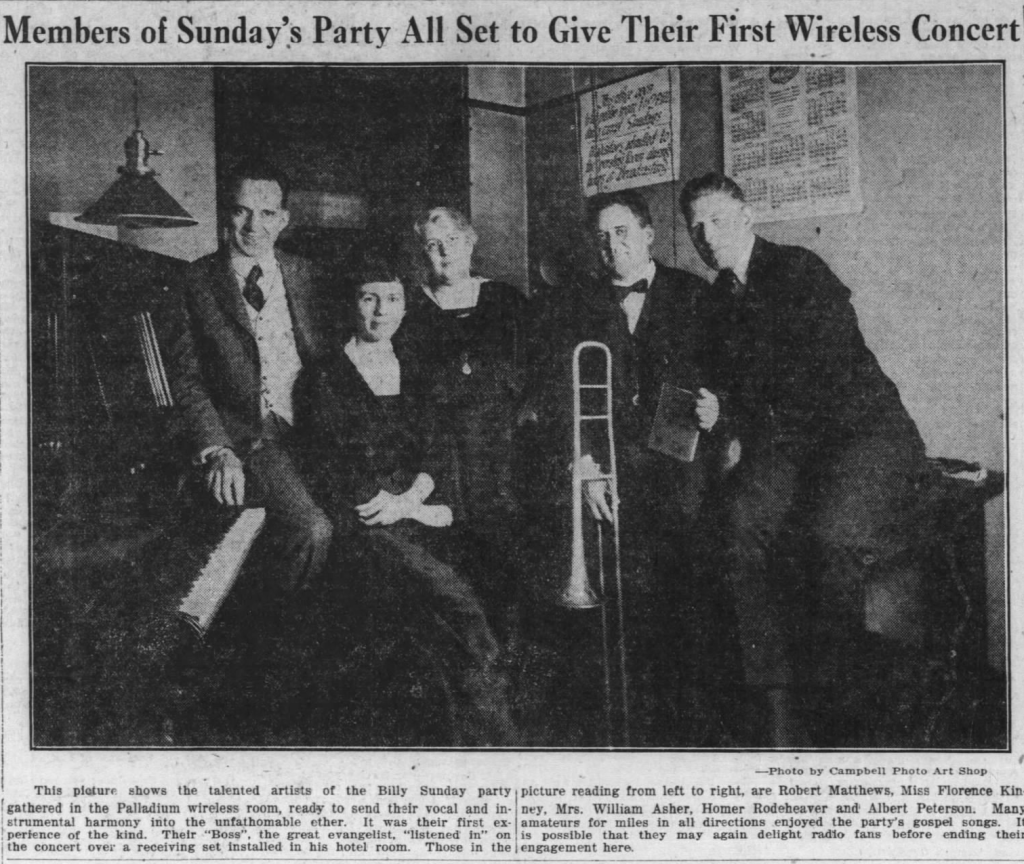
This picture shows the talented artists of the Billy Sunday party gathered in the Palladium wireless room, ready to send their vocal and instrumental harmony into the unfathomable ether. It was their first experience of the kind. ‘Their ‘Boss’, the great evangelist, ‘listened in’ on the concert over a receiving set installed in his hotel room. Those in the picture reading from left to right, are Robert Matthews, Miss Florence Kinney, Mrs. William Asher, Homer Rodeheaver and Albert Peterson. Many amateurs for miles in all directions enjoyed the party’s gospel songs. It is possible that they may again delight radio fans before ending their engagement here.
—Photo by Campbell Photo Art Shop

 Evangelist Billy Sunday (1862-1935)