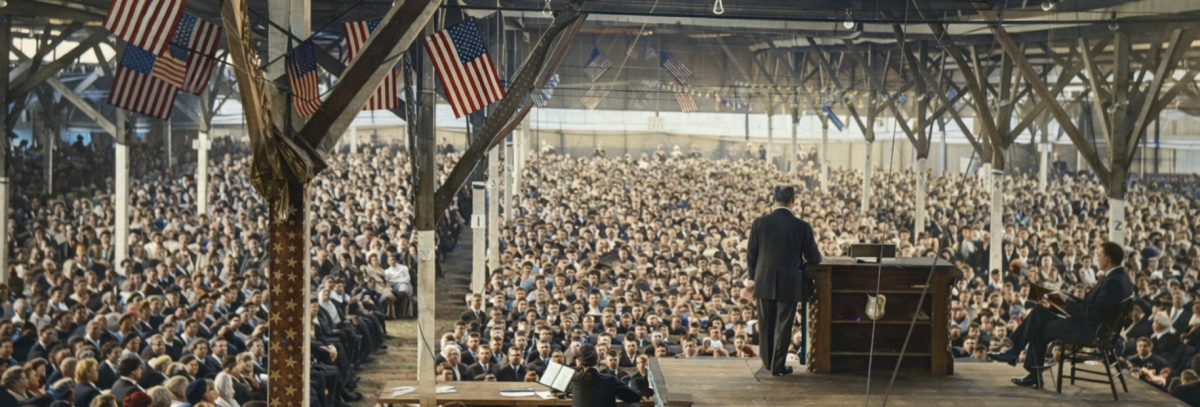
Notable Incident: Ku Klux Klan Appearance
On May 14, 1922, during one of the revival meetings, twelve robed and masked members of the Ku Klux Klan entered the tabernacle, marched down the center aisle.
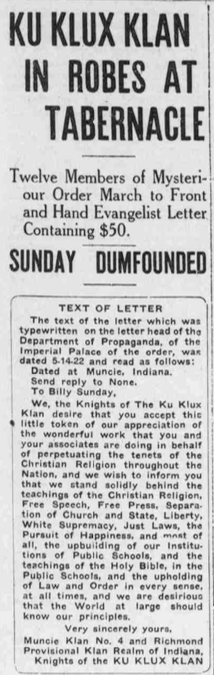
KU KLUX KLAN IN ROBES AT TABERNACLE
Twelve Members of Mysterious Order March to Front and Hand Evangelist Letter Containing $50.
SUNDAY DUMFOUNDED
TEXT OF LETTER
The text of the letter which was typewritten on the letter head of the Department of Propaganda, of the Imperial Palace of the order, was dated 5-14-22 and read as follows:
Dated at Muncie, Indiana.
Send reply to None.
To Billy Sunday.
We, the Knights of The Ku Klux Klan desire that you accept this little token of our appreciation of your wonderful work in the interest of the American people and for perpetuating the tenets of the Christian Religion throughout the Nation, and we wish you to know that we stand solidly behind the teachings of the Christian Religion, Free Speech, Free Press, and Separation of Church and State.
While supremacy, Just Laws, the Pursuit of Happiness, Liberty, and Justice, the Public School, and the thoughts of the Boy Scout in the teachings of the Bible, and in the love of the flag of our country, and in the word of every sense, that we, and we alone, should stand for these large and wholesome principles.
Very sincerely yours,
Muncie Klan No. 4 and Richmond Provincial Klan Realm of Indiana, Knights of the KU KLUX KLAN
Five thousand men and women sat spellbound in the tabernacle Sunday night while 12 masked members of the Ku Klux Klan, unopposed and fearless- ly, interrupted the service long enough to hand the Rev. W. A. Sunday an envelope containing a message of commendation and $50 in bills.
Their mission executed, their identity successfully cloaked, the twelve men marched out of the tabernacle, entered automobiles and disappeared as silently and quickly as they had made their entrance.
Members of the Sunday party had been informed of the proposed visit, however, so that some of them were prepared for the Klansmen, one of the chief ushers said.
While no clue to the identity of the men could be found, a man whose name could not be learned was found in the front of the tabernacle after the meeting, commenting on the amount of publicity which the spectacular entry would get, and asking how soon the Associated Press would get the news.
Not First Experience
This is not the first experience of Mr. Sunday with the Ku Klux Klan.
The klan has made a present to Mr. Sunday in every city he has been in during the last year, said Bob Matthews secretary to Mr. Sunday. Even the Klan in Sioux City did the same thing.
At Charleston four members of the Klan appeared, and presented Mr. Sun- day a similar communication, inclosing $200, while at Spartanburg, S. C., the Klan presented Mr. Sunday with $50.
An attempt of the reporters at the Charleston meeting to follow the Klan members and find out who they were was frustrated, the secretary said. There seemed to be an agreement among the ushers at the meeting that no one was to follow the men, and when the reporters started there seemed to be conspiracy to have them waylaid.
First Appearance
It was the first time in the history of Richmond that the Ku Klux Klan had appeared in public, according to Mr. Sunday, although he said the Klansmen were known to have met there.
The letter which they gave to Mr. Sunday bore the address of the United Klan No. 4 and Richmond Provincial Klan.
Just as Billy Sunday was beginning his sermon the twelve white clad men, wearing high pointed head gears, draped in robes that came to their feet, with flowing wide sleeves and white masks, were seen marching silently down the aisle, single file.
Sunday paused in the middle of his announcement, and stared down at them, while a hush fell over the audience, as the 12 figures lined up before the platform, and two of them mounted to the platform.
Suppressed giggles and hysterical snickers broke the stillness faintly, but for the most part, the audience was awed into immobility, except on the edges where men and women stood on chairs and benches to see what was going on.
At a grunt of command, the only sound made by the group during the entire visit, and in unison with their leader, the men lined up facing Sunday, while the other two, at the same unspoken command, turned and walked to the platform and presented the letter containing the money.
The men and women on the stairs parted for the ghost like men, whose audible footfalls could not be heard, their costumes revealing only blue eyes and black leather shoes.
It was not known what Mr. Sunday said until the visitors had marched out and the tabernacle had settled down. Then he turned and faced the audience and said firmly, “I am not afraid of anybody. I have had my car and automobiles and driver attacked, but I am not afraid. I will stand to be checked on my work.”
Sunday ceased to speak, while the men filed from the tabernacle. “I am not a member of the Ku Klux Klan, of the Masons, of the Odd Fellows, or any other secret order, but I’ve learned more about them to night than I ever knew before.
“So I guess if you behave yourself they won’t bother you,” Sunday said.
“A Hint to Others”
“Now you Masons, Odd Fellows, or any of you other fellows, if you want to give something to Winona you just come ahead,” Mr. Sunday said after he announced that the letter contained $50 in bills, which he said would be used to pay the expenses of the Winona Lake tabernacle.
“The $50 comes from the Muncie branch,” Mr. Sunday started to say in telling of the money in the envelope, when Fred Rupp interrupted to say that Richmond was also mentioned.
Fumbling with the letter for a moment, Sunday reread the closing words and corrected himself: “It comes also from the provisional Richmond klan.” After a little pause Sunday added to the audience: “Well, you seemed to sit right; they didn’t take you.” Denouncing the liberal wing of the Baptist church which is forcing a contest within that denomination, Mr. Sunday called them the “God-forsaken liberal wing,” and declared that “they ought to be in Hell.”
Denounces Liberalism.
“It’s the liberal bunch that don’t like me, and I don’t want their backing. The Baptists were the last bulwark of orthodoxy,” he said, “and now they’ve got a fight on their hands.” “There never was a greater God-forsaken liberal wing of the church, that seeks ethical death of Christ. Its the
Near the end of the sermon, but before the audience arose, Sunday called on those that wanted to make a public confession of Christ to walk down in front.
“I want to see your faces as you come,” he said. “I don’t know how you feel about it, but I want to see you come.”
“I haven’t asked for that a long time,” he added, “but I had a feeling that maybe some of you fellows would come that way.”
For a time no one moved, but a slight movement in the rear of the audience was seen. Mr. Sunday made mention of it.
“There were ten here now,” About the time it looked as if there would be plenty of room for Mr. Sunday to come down and take their hands.
63 Come Forward
After the audience stood, and the personal workers had scattered among them, more gathered at the front until 63 “trail hitters” had come forward as signed pledges of belief in Christ. The opening prayer was offered by Rev. E. Gage of the Third Methodist church, while the meeting was closed by prayer by Louis Jones, minister of the South Eighth Street Friends meeting.
The collection, as at the other meetings of the day, was taken for the Bible School, Chautauqua, and other summer meetings held at Winona Lake, Indiana.
Afternoon Service
Coatless, perspiring until he removed his collar and necktie, Billy Sunday called on the packed tabernacle Sunday afternoon to give their lives to Christ, and from an audience of 6,000, more than 300 persons came forward to shake his hand, while several hundred signed cards pledging themselves to accept Jesus Christ as their personal savior.
It was an audience composed almost entirely of out-of-town people. On a show of hands it had seemed as if there were no Richmond people present, but a rising demonstration of Richmond and of visitors showed that only a fifth were local residents.
The huge crowd gathered early, by noon the tabernacle was filled and the music began. Just before the sermon Mr. Rodeheaver called for the show of hands to account for the local poor fifth of the audience.
Calls for City
As the huge out-of-town audience stood, cries of “Richmond” Richmond” came from the ministerial section, and Mr. Rodeheaver called for the local people to stand. They were the poor fifth of the audience.
The great tabernacle of Richmond, they say, has stayed Mr. Sunday’s people could not have had the great success they have had without it. All the more, when you realize that all the people in the audience are not Richmond people, but they are the people who regularly do better than that.
Takes Off Coat
As Mr. Sunday appeared on the platform he took off his coat, and several men in the audience stood up and took theirs off. Later on invitation of Mr. Sunday, a number of others followed suit.
“In the 27 years that I have been preaching I have never seen such a small number of people from the community, in proportion to its size, as here at Richmond. I feel like I had fooled away six weeks of my time, one sixth of all that I have to give in a year, by coming here, when I had to turn down 25 other cities to do it.”
“It is not,” he added, “that you people are not welcome to come, but I do think that the community where I preach should be represented at the meetings.”

 Evangelist Billy Sunday (1862-1935)