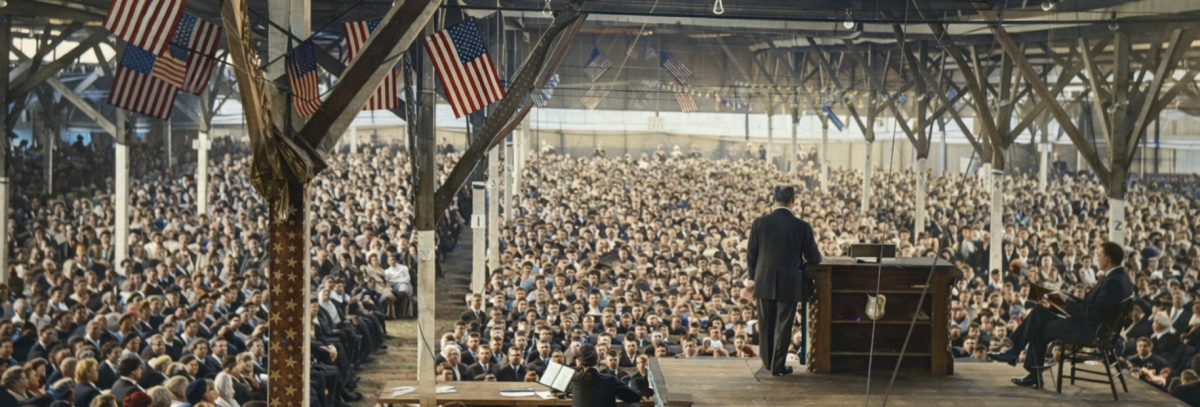
Billy Sunday’s 1918 revival campaign in Chicago, held from March 10 to May 20, was one of his most ambitious and high-profile efforts. It occurred during a pivotal moment in American history, as the nation grappled with World War I, the temperance movement, and the looming influenza pandemic.

Public domain.
Campaign Overview
The campaign was strategically timed to bolster support for Prohibition in Chicago, a city known for its vibrant nightlife and strong opposition to temperance reforms. Sunday, a fervent advocate for the ban on alcohol, delivered his fiery sermon “Get on the Water Wagon,” in which he vividly denounced the liquor industry. He likened the “booze interests” to a “rattlesnake that wriggled its miserable carcass out of hell,” vowing to fight them relentlessly—even “on ice” if hell froze over.
Despite his passionate rhetoric and widespread attention, Sunday’s efforts did not yield the desired political outcome. Chicago voters rejected a local Prohibition initiative during the campaign, a defeat famously referenced in Frank Sinatra’s song “Chicago (That Toddlin’ Town)” with the line: “The town that Billy Sunday could not shut down.”
Attendance and Impact
The campaign drew substantial crowds, with estimates suggesting that over 650,000 people attended the meetings over the course of seven weeks.
Sunday’s dynamic preaching style and the campaign’s extensive organization contributed to its broad reach and influence.
Legacy
Although the immediate goal of enacting local Prohibition in Chicago was not achieved, the campaign underscored Sunday’s significant role in the national temperance movement. His efforts contributed to the broader momentum that led to the ratification of the Eighteenth Amendment in 1919, establishing Prohibition across the United States. The Chicago campaign remains a notable example of Sunday’s impact on American society during a transformative era.

 Evangelist Billy Sunday (1862-1935)