This item was listed on eBay in April 2025.
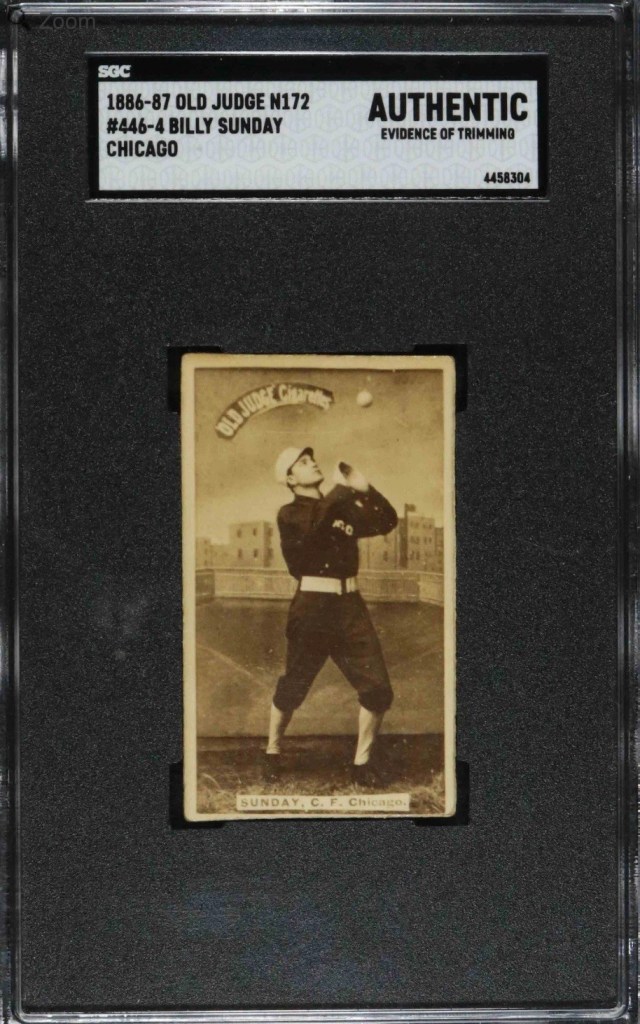
Evangelist Billy Sunday (1862-1935)
Former professional baseball player-turned urban evangelist. Follow this daily blog that chronicles the life and ministry of revivalist preacher William Ashley "Billy" Sunday (1862-1935)
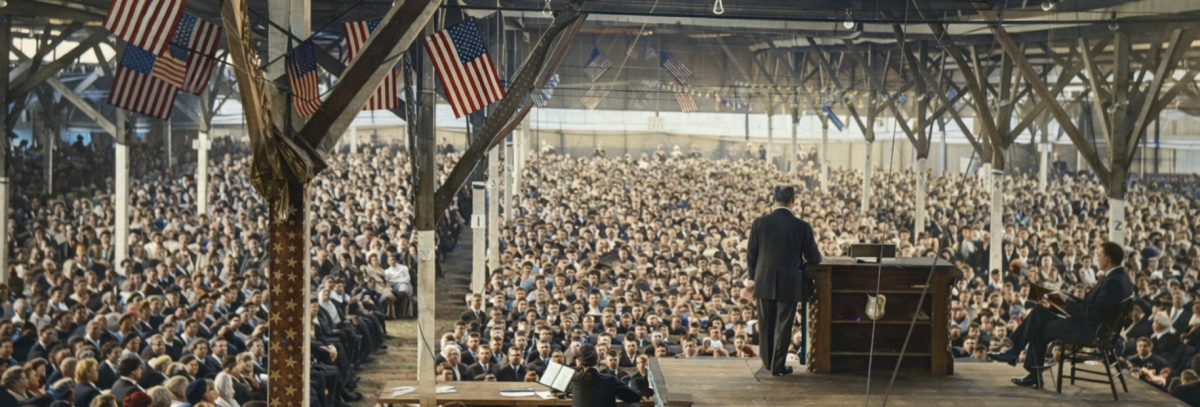
This item was listed on eBay in April 2025.
Billy Sunday conducted his Scranton, Pennsylvania revival campaign from March 29 to May 17, 1914.
Billy Sunday’s 1915 revival campaign in Syracuse was held in a massive tabernacle specially constructed on the grounds of the old Scranton Driving Park, a former racetrack near the intersection of Providence Road and Green Ridge Street. The venue, built to accommodate the large crowds drawn by Sunday’s fiery preaching, held around 8,000 people at full capacity.
Over the course of the campaign, tens of thousands streamed into the tabernacle, with some estimates suggesting that more than 100,000 people in total heard Sunday preach during the weeks-long revival. The response was overwhelming—not just in attendance but in impact. Reports from the time estimate that between 13,000 and 15,000 individuals made public decisions for Christ, “hitting the sawdust trail” as they came forward to commit their lives to faith. The scale and energy of the campaign made it one of the more memorable revivals of Sunday’s career, leaving a significant spiritual and cultural imprint on the city of Syracuse.
The Scranton campaign was notable for its massive local organization, media coverage, and impact on surrounding cities. It was one of his early high-profile campaigns in the northeast, setting the stage for later revivals in Boston (1916), New York (1917), and elsewhere.

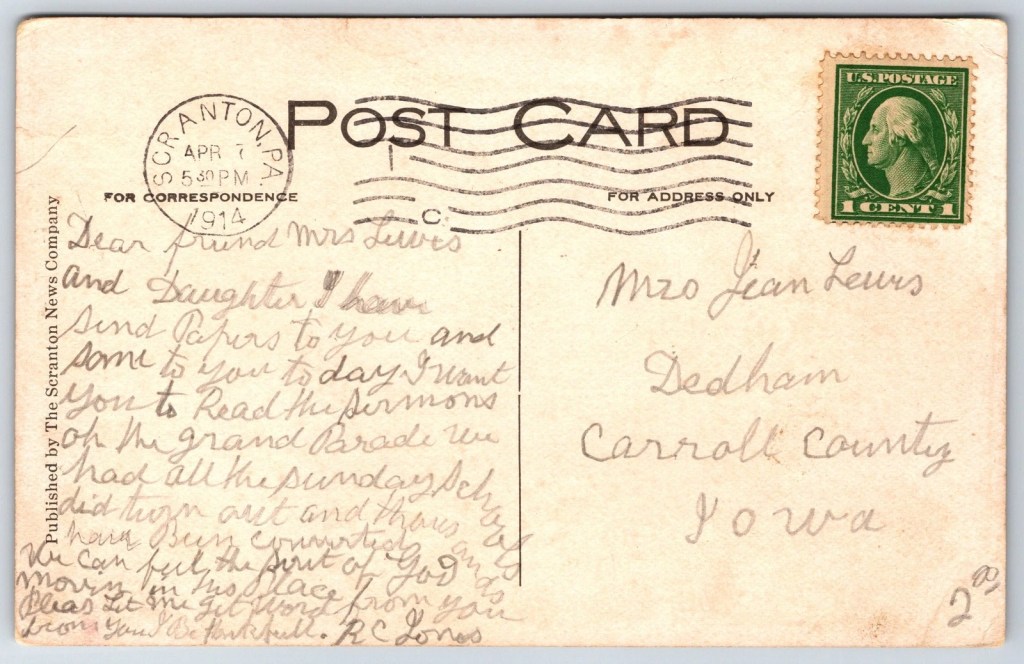
Here is the detail on the postcard and the handwritten message.
Postmarked 7 April (7:30 pm) from Scranton, PA
Dear Friend Mrs Lewis and Daughter
I have send papers to you and some to you to day. I want you to Read the sermons. Oh the grand Parade we had. All the Sunday’s school did turn out and those have been converted. We can feel the spirit of God in this place. Please let get word from you. I’d be thankful. RC Jones
To:
Mrs Jean Lewis
Dedham
Carroll County
Iowa
LANDMARKS IN BOSTON’S BILLY SUNDAY CAMPAIGN
1915
Feb. 22—Fifty Boston ministers and laymen go to Philadelphia; hear Sunday preach for first time; walk into his bedroom the next morning and demand that he come to Boston. Sunday accepts and date is fixed for Fall of 1916.
March 6—Organization of Boston committee announced at big meeting in Park Street Church.
March 7—Committee files papers at State House as “Boston Sunday Evangelistic Committee, Incorporated.”
1916
Jan. 21—Committee decides to build tabernacle on Huntington-av site.
March 22—Twenty members of Boston Committee go to Baltimore to learn their jobs from campaign workers in that city.
April 27—Wooden tabernacle bill vetoed by Gov McCall. Committee nonplussed.
April 30—Campaign for $100,000 in guaranty pledges launched.
Aug. 10—Ground broken for tabernacle. Mayor Curley attends. Joe Spiece begins work.
Oct. 2—Cottage prayer meetings open.
Nov. 12—BILLY SUNDAY PREACHES FIRST SERMON IN BOSTON.
As appearing in The Boston Globe Sun, Oct 15, 1916 • Page 80
Boston Post. Tue, Nov 14, 1916 • Page 18
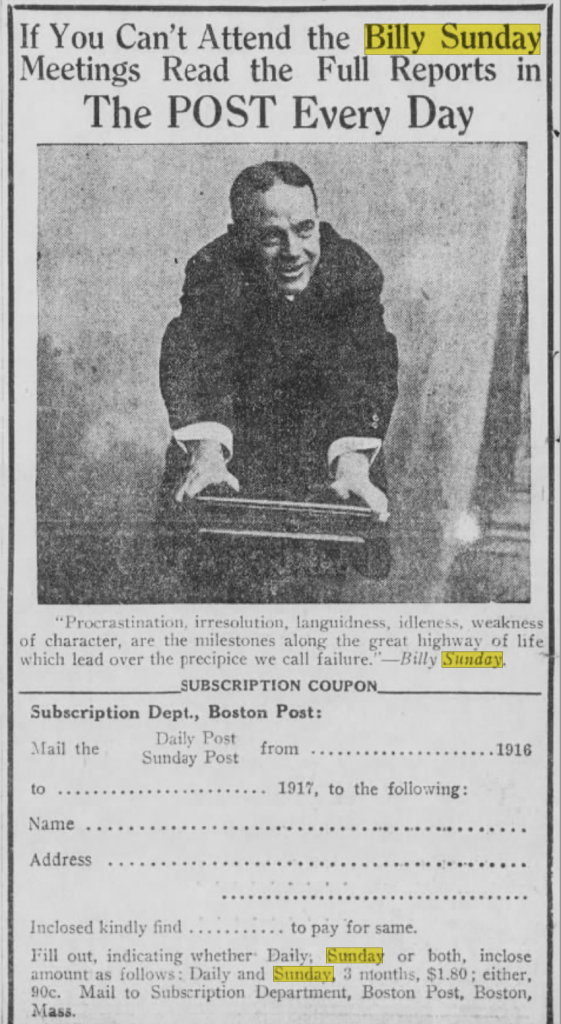
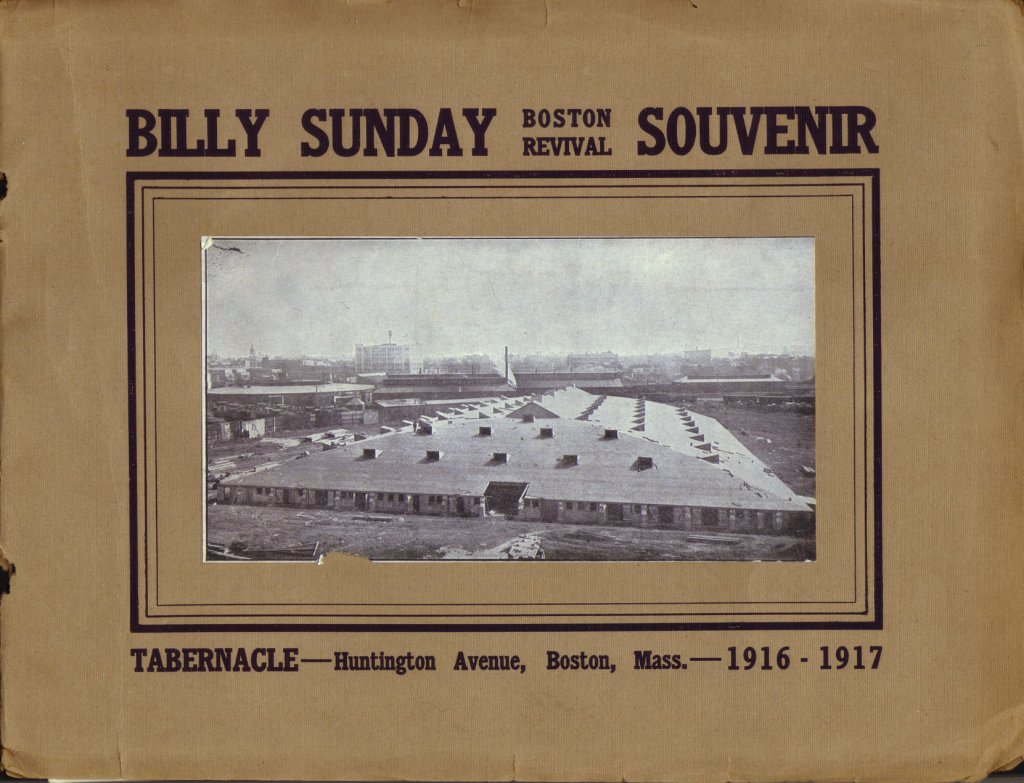
In early 1916, Billy Sunday launched one of the most ambitious evangelistic campaigns of his career in Boston—a city known for its intellectualism and religious diversity. Running from January through April, the campaign was meticulously organized, with more than 5,000 volunteers and significant cooperation from local churches. A massive tabernacle, seating up to 20,000 people, was specially constructed on Huntington Avenue, symbolizing the scale and seriousness of the effort.
Over the course of the revival, more than 1.5 million people attended Sunday’s fiery sermons. His preaching, characterized by dramatic flair and passionate appeals, emphasized personal salvation, moral reform, and national righteousness. At a time when World War I loomed and social tensions were high, Sunday’s message struck a chord. He was especially vocal against alcohol, aligning his campaign with the growing Prohibition movement.
Despite initial skepticism from Boston’s more refined religious circles, Sunday’s influence grew as thousands “hit the sawdust trail” in public commitment to Christ. Media coverage was extensive, and the revival became a citywide spectacle. The impact extended beyond the tabernacle, as many local churches reported a lasting spiritual renewal.
Sunday’s 1916 Boston campaign stands as a milestone in American revival history—an event that combined religious fervor, civic organization, and cultural theater in a way that few evangelists before or after have matched.
The Morning Call/ Thu, May 20, 1915 · Page 13
BILLY SUNDAYISMS
If there is no resurrection from the dead God is a liar and we are all liars.
You will go to hell just as fast from Broadway as from the Bowery and from Fifth avenue as from Pell street or Mott street or Mulberry street.
I expect to live long enough to stand by the grave of Christian Science.
It is impossible for any man to deny the divinity of Jesus Christ without committing moral suicide.
Jesus Christ was bigger than the Sabbath.
When the devil gets cornered he begins to whine.
I have more respect for the devil than for some people I’ve met.
Unitarianism is stoning Him today. They deny His divinity.
I’m not afraid of those new religions. Whatever is of man will fall. Whatever is of God will prevail.
I’d rather be a doorkeeper in the house of God than dwell in the tents of sin.
God looks upon a sinner as the government looked upon a rebel in the civil war.
The sinner is a rebel with God’s government.
God Almighty looks through the fig leaves behind which you must hide yourself.
Christ struck this old world with such a thud that He didn’t come up for three days.
I don’t see any surcease from sorrow until the coming of Jesus Christ.
The doctrine of universal salvation crawled out of the pit of hell.
You cannot argue against sin.
Midnight on earth is mid-day in hell.
Faith in Christ is the only way the door is going to fly open for you in this old world.
In the early 20th century, no evangelist captured the American imagination quite like Billy Sunday. With his blazing speed on the baseball diamond and firebrand preaching style in packed tabernacles, Sunday became a household name. But who was the man behind the headlines and revival tents?
While some 1930s newspapers portrayed him as a tragic figure in decline, the truth is both richer and more inspiring. Here are the most accurate and meaningful highlights of Billy Sunday’s life—stories that are not only true, but worth remembering.
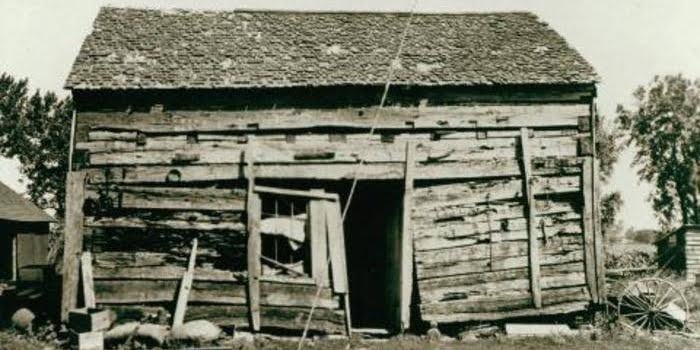
Billy Sunday was born on November 19, 1862, in a humble two-room cabin in Story County, Iowa. His father, a Civil War soldier, died when Billy was just a month old. Poverty and hardship followed. By age 8, Billy was working odd jobs to help support his family, and at 9 he was sent to live in state-run orphanages in Glenwood and Davenport with his brother Edward. It was a rough start—but one that forged a resilient spirit.
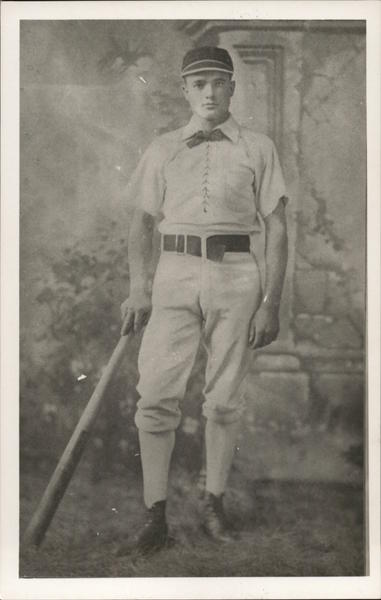
Billy’s speed made him a local legend in fire brigade races and eventually caught the attention of Cap Anson, manager of the Chicago White Stockings. In 1884, Billy went straight from sandlot baseball to the major leagues, where he played for Chicago, Pittsburgh, and Philadelphia. He was known for:
Though not a superstar at the plate, Sunday’s athleticism and work ethic made him a fan favorite.
In 1887, while still a ballplayer, Billy heard hymns outside the Pacific Garden Mission in Chicago. Drawn in by the music, he began attending services and was soon converted to Christianity. His transformation was real and lasting.
He turned down lucrative baseball contracts and took a $1,000-a-year job at the Chicago YMCA, launching a new career path—urban evangelism. He later joined J. Wilbur Chapman as an assistant before launching his solo revival ministry in 1896.

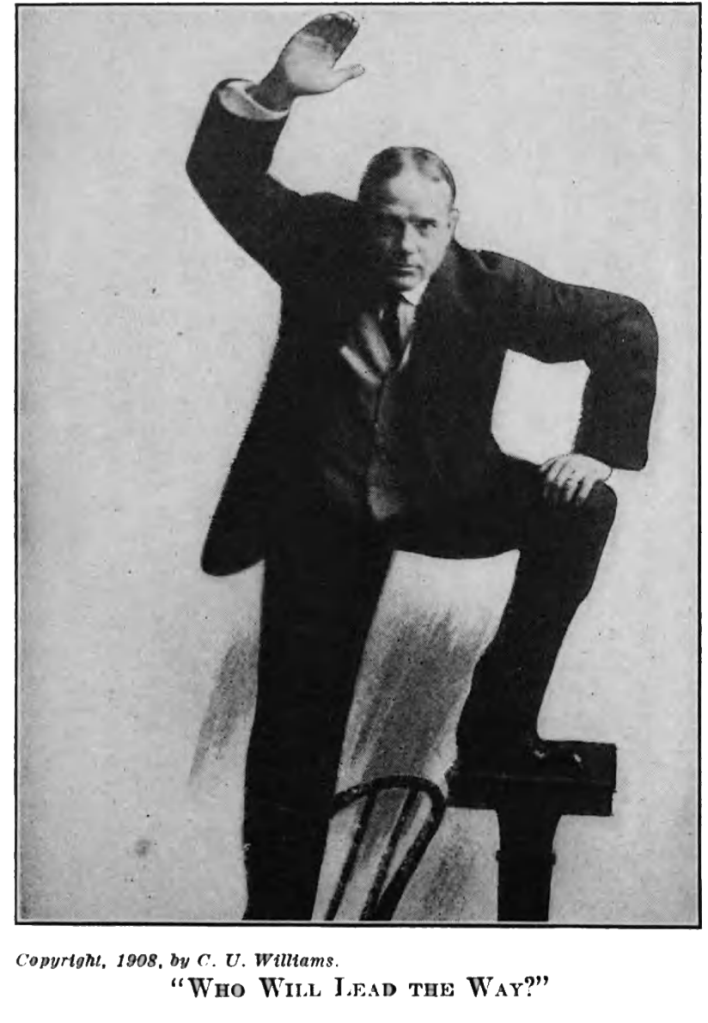
Billy Sunday became one of the most dynamic preachers in American history. His sermons were:
In New York City (1917), he preached to over 1.5 million people in ten weeks. He gave the entire $120,465 offering to war charities. In Chicago, he donated another $65,000 to the Pacific Garden Mission.
No other evangelist of his day had such reach—or gave so much away.
Billy met Nell Thompson in Sunday school, and after overcoming her family’s resistance to marrying a ballplayer, the two became partners for life. Nell—or “Ma,” as the nation came to know her—was the administrative backbone of Billy’s ministry. She managed his schedule, finances, and logistics, allowing him to focus on preaching.
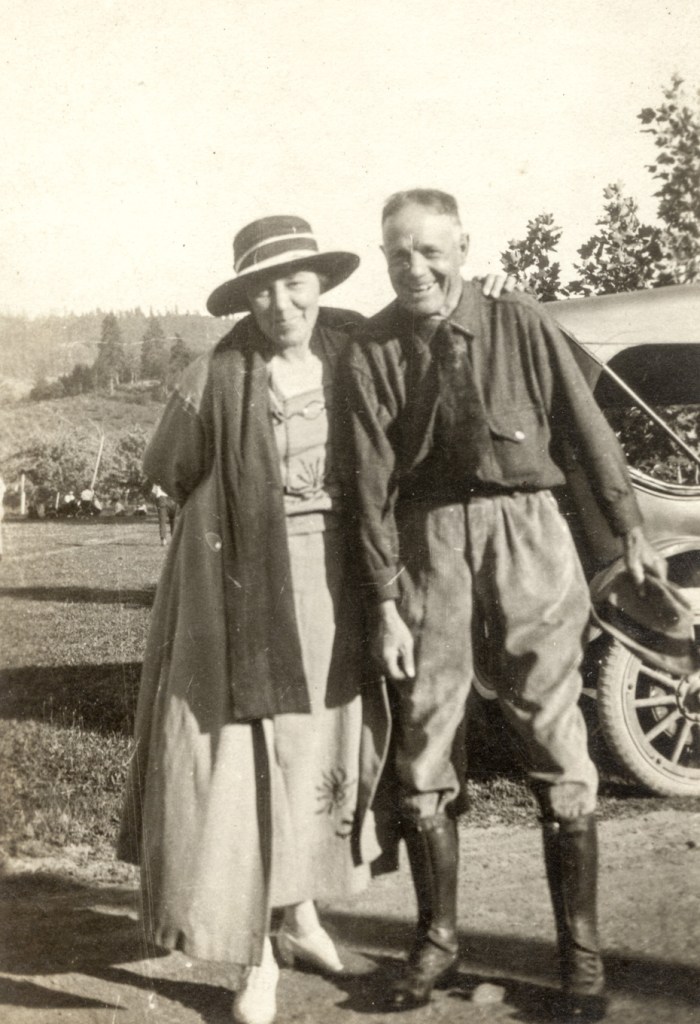
Though his ministry never lost its power, Billy’s later years were marked by tragedy:
Despite failing health and shrinking crowds, Billy Sunday kept preaching. Not for fame. Not for money. But because he believed the gospel still needed to be heard.

Billy Sunday’s story is often misunderstood. Yes, he lived through grief, made financial sacrifices, and returned to smaller venues. But he did not die penniless. He died spent—having poured out his life in the service of others and the cause of Christ.
“I want to preach until I can’t preach anymore, and then I want to crawl up into the pulpit and die.”
—Billy Sunday
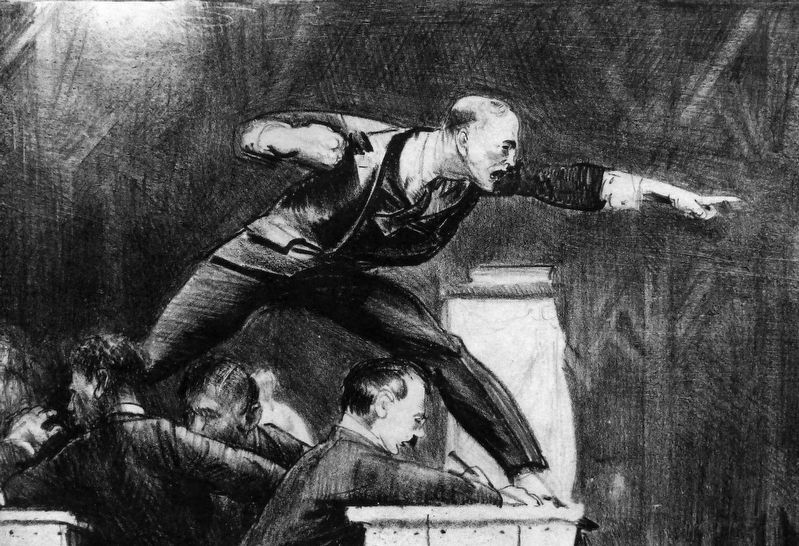
Billy Sunday’s most famous and widely covered sermon on “Booze” was first preached to major national attention in 1907 during his campaign in Decatur, Illinois—but it gained explosive press coverage during his Pittsburgh campaign in 1914, when the sermon on alcohol—often titled simply “Booze” or “Get on the Water Wagon”—became one of his most iconic addresses.
Booze
by Evangelist Billy Sunday
Here we have one of the strangest scenes in all the Gospels. Two men, possessed of devils, confront Jesus, and while the devils are crying out for Jesus to leave them, he commands the devils to come out, and the devils obey the command of Jesus. The devils ask permission to enter into a herd of swine feeding on the hillside. This is the only record we have of Jesus ever granting the petition of devils, and he did it for the salvation of men.
Then the fellows that kept the hogs went back to town and told the peanut-brained, weasel-eyed, hog-jowled, beetle- browed, bull-necked lobsters that owned the hogs, that “a long-haired fanatic from Nazareth, named Jesus, has driven the devils out of some men and the devils have gone into the hogs, and the hogs into the sea, and the sea into the hogs, and the whole bunch is dead.”
And then the fat, fussy old fellows came out to see Jesus and said that he was hurting their business. A fellow says to me, “I don’t think Jesus Christ did a nice thing.”
You don’t know what you are talking about.
Down in Nashville, Tennessee, I saw four wagons going down the street, and they were loaded with stills, and kettles, and pipes.
“What’s this?” I said.
“United States revenue officers, and they have been in the moonshine district and confiscated the illicit stills, and they are taking them down to the government scrap heap.”
Jesus Christ was God’s revenue officer. Now the Jews were forbidden to eat pork, but Jesus Christ came and found that crowd buying and selling and dealing in pork, and confiscated the whole business, and he kept within the limits of the law when he did it. Then the fellows ran back to those who owned the hogs to tell what had befallen them and those hog- owners said to Jesus: “Take your helpers and hike. You are hurting our business.” And they looked into the sea and the hogs were bottom side up, but Jesus said, “What is the matter?” And they answered,” Leave our hogs and go.” A fellow says it is rather a strange request for the devils to make, to ask permission to enter into hogs. I don’t know, if I was a devil I would rather live in a good, decent hog than in lots of men. If you will drive the hog out you won’t have to carry slop to him, so I will try to help you get rid of the hog.
And they told Jesus to leave the country. They said:
“You are hurting our business.”
Interest in Manhood
“Have you no interest in manhood?”
“We have no interest in that; just take your disciples and leave, for you are hurting our business.”That is the attitude of the liquor traffic toward the Church, and State, and Government, and the preacher that has the backbone to fight the most damnable, corrupt institution that ever wriggled out of hell and fastened itself on the public.
I am a temperance Republican down to my toes. Who is the man that fights the whisky business in the South? It is the Democrats! They have driven the business from Kansas, they have driven it from Georgia, and Maine and Mississippi and
North Carolina and North Dakota and Oklahoma and Tennessee and West Virginia. And they have driven it out of 1,756 counties. And it is the rock-ribbed Democratic South that is fighting the saloon. They started this fight that is sweeping like fire over the “United States. You might as well try and dam Niagara Falls with toothpicks as to stop the reform wave sweeping our land. The Democratic party of Florida has put a temperance plank in its platform and the Republican party of every state would nail that plank in their platform if they thought it would carry the election. It is simply a matter of decency and manhood, irrespective of politics. It is prosperity against poverty, sobriety against drunkenness, honesty against thieving, heaven against hell. Don’t you want to see men sober? Brutal, staggering men transformed into respectable citizens? “No,” said a saloonkeeper, “to hell with men. We are interested in our business, we have no interest in humanity.”
After all is said that can be said upon the liquor traffic, its influence is degrading upon the individual, the family, politics and business, and upon everything that you touch in this old world. For the time has long gone by when there is any ground for arguments as to its ill effects. All are agreed on that point. There is just one prime reason why the saloon has not been knocked into hell, and that is the false statement that “the saloons are needed to help lighten the taxes.” The saloon business has never paid, and it has cost fifty times more than the revenue derived from it.
Does the Saloon Help Business?
I challenge you to show me where the saloon has ever helped business, education, church, morals or anything we hold dear.
The wholesale and retail trade in Iowa pays every year at least $500,000 in licenses. Then if there were no drawback it ought to reduce the taxation twenty-five cents per capita. If the saloon is necessary to pay the taxes, and if they pay $500,000 in taxes, it ought to reduce them twenty-five cents a head. But no, the whisky business has increased taxes $1,000,000 instead of reducing them, and I defy any whisky man on God’s dirt to show me one town that has the saloon where the taxes are lower than where they do not have the saloon. I defy you to show me an instance.
Listen! Seventy-five per cent of our idiots come from intemperate parents; eighty per cent of the paupers, eighty-two per cent of the crime is committed by men under the influence of liquor; ninety per cent of the adult criminals are whisky- made. The Chicago Tribune kept track for ten years and found that 53,556 murders were committed by men under the influence of liquor.
Archbishop Ireland, the famous Roman Catholic, of St. Paul, said of social crime today, that “seventy-five per cent is caused by drink, and eighty per cent of the poverty.”
I go to a family and it is broken up, and I say, “What caused this?” Drink! I step up to a young man on the scaffold and say, “What brought you here?” Drink! Whence all the misery and sorrow and corruption? Invariably it is drink.
Five Points, in New York, was a spot as near like hell as any spot on earth. There are five streets that run to this point, and right in the middle was an old brewery and the streets on either side were lined with grog shops. The newspapers turned a searchlight on the district, and the first thing they had to do was to buy the old brewery and turn it into a mission.
The Parent of Crimes
The saloon is the sum of all villanies. It is worse than war or pestilence. It is the crime of crimes. It is the parent of crimes and the mother of sins. It is the appalling source of misery and crime in the land. And to license such an incarnate fiend of hell is the dirtiest, low-down, damnable business on top of this old earth. There is nothing to be compared to it.
The legislature of Illinois appropriated $6,000,000 in 1908 to take care of the insane people in the state, and the whisky business produces seventy-five per cent of the insane. That is what you go down in your pockets for to help support. Do away with the saloons and you will close these institutions. The saloons make them necessary, and they make the poverty and fill the jails and the penitentiaries. Who has to pay the bills? The landlord who doesn’t get the rent because the money
goes for whisky; the butcher and the grocer and the charitable person who takes pity on the children of drunkards, and the taxpayer who supports the insane asylums and other institutions, ” at the whisky business keeps full of human wrecks.
Do away with the cursed business and you will not have to put up to support them. Who gets the money? The saloonkeepers and the brewers, and the distillers, while the whisky fills the land with misery, and poverty, and wretchedness, and disease, and death, and damnation, and it is being authorized by the will of the sovereign people.
You say that “people will drink anyway.” Not by my vote. You say, “Men will murder their wives anyway.” Not by my vote. “They will steal anyway.” Not by my vote. You are the sovereign people, and what are you going to do about it?
Let me assemble before your minds the bodies of the drunken dead, who crawl away “into the jaws of death, into the mouth of hell,” and then out of the valley of the shadow of the drink let me call the appertaining motherhood, and wifehood, and childhood, and let their tears rain down upon their purple faces. Do you think that would stop the curse of the liquor traffic? No! No!
In these days when the question of saloon or no saloon is at the fore in almost every community, one hears a good deal about what is called “personal liberty.” These are fine, large, mouth-filling words, and they certainly do sound first rate; but when you get right down and analyze them in the light of common old horse-sense, you will discover that in their application to the present controversy they mean just about this: ” Personal liberty” is for the man who, if he has the inclination and the price, can stand up at a bar and fill his hide so full of red liquor that he is transformed for the time being into an irresponsible, dangerous, evil-smelling brute. But “personal liberty” is not for his patient, long-suffering wife, who has to endure with what fortitude she may his blows and curses; nor is it for his children, who, if they escape his insane rage, are yet robbed of every known joy and privilege of childhood, and too often grow up neglected, uncared for and vicious as the result of their surroundings and the example before them. “Personal liberty” is not for the sober, industrious citizen who from the proceeds of honest toil and orderly living, has to pay, willingly or not, the tax bills which pile up as a direct result of drunkenness, disorder and poverty, the items of which are written in the records of every police court and poorhouse in the land; nor is” personal liberty ” for the good woman who goes abroad in the town only at the risk of being shot down by some drink-crazed creature. This rant about “personal liberty” as an argument has no leg to stand upon.
The Economic Side
Now, in 1913 the corn crop was 2,373,000,000 bushels, and it was valued at $1,660,000,000. Secretary Wilson says that the breweries use less than two per cent; I will say that they use two per cent. That would make 47,000,000 bushels, and at seventy cents a bushel that would be about $33,000,000. How many people are there in the United States? Ninety millions. Very well, then, that is thirty-six cents per capita. Then we sold out to the whisky business for thirty-six cents apiece – the price of a dozen eggs or a pound of butter. We are the cheapest gang this side of hell if we will do that kind of business.
Now listen! Last year the income of the United States government, and the cities and towns and counties, from the whisky business was $350,000,000. That is putting it liberally. You say that’s a lot of money. Well, last year the workingmen spent $2,000,000,000 for drink, and it cost $1,200,000,000 to care for the judicial machinery. In other words, the whisky business cost us last year $3,400,000,000. I will subtract from that the dirty $350,000,000 which we got, and it leaves $3,050,000,000 in favor of knocking the whisky business out on purely a money basis. And listen, we spend $6,000,000,000 a year for our paupers and criminals insane, orphans, feeble-minded, etc., and eighty-two per cent of our criminals are whisky-made, and seventy-five per cent of the paupers are whisky-made. The average factory hand earns $450 a year, and it costs us $1,200 a year to support each of our whisky criminals. There are 326,000 enrolled criminals in the United States and 80,000 in jails and penitentiaries. Three-fourths were sent there because of drink, and then they have the audacity to say the saloon is needed for money revenue. Never was there a baser he. “But,” says the whisky fellow, “we would lose trade; I heard my friend ex-Governor Hanly, of Indiana, use the following illustrations:
“Oh, but,” they say, “Governor, there is another danger to the local option, because it means a loss of market to the farmer.
We are consumers of large quantities of grain in the manufacture of our products. If you drive us out of business you
strike down that market and it will create a money panic in this country, such as you have never seen, if you do that.” I might answer it by saying that less than two per cent of the grain produced in this country is used for that purpose, but I pass that by. I want to debate the merit of the statement itself, and I think I can demonstrate in ten minutes to any thoughtful man, to any farmer, that the brewer who furnishes him a market for a bushel of corn is not his benefactor, or
the benefactor of any man, from an economic standpoint. Let us see. A farmer brings to the brewer a bushel of corn. He finds a market for it. He gets fifty cents and goes his way, with the statement of the brewer ringing in his ears, that the brewer is the benefactor. But you haven’t got all the factors in the problem, Mr. Brewer, and you cannot get a correct solution of a problem without all the factors in the problem. You take the farmer’s bushel of corn, brewer or distiller, and you brew and distill from it four and one-half gallons of spirits. I don’t know how much he dilutes them before he puts them on the market. Only the brewer, the distiller and God know. The man who drinks it doesn’t, but if he doesn’t dilute it at all, he puts on the market four and a half gallons of intoxicating liquor, thirty-six pints. I am not going to trace the thirty- six pints. It will take too long. But I want to trace three of them and I will give you no imaginary stories plucked from the brain of an excited orator. I will take instances from the judicial pages of the Supreme Court and the Circuit Court judges’ reports in Indiana and in Illinois to make my case.
Several years ago in the city of Chicago a young man of good parents, good character, one Sunday crossed the street and entered a saloon, open against the law. He found there boon companions. There were laughter, song and jest and much drinking. After awhile, drunk, insanely drunk, his money gone, he was kicked into the street. He found his way across to his mother’s home. He importuned her for money to buy more drink. She refused him. He seized from the sideboard a revolver and ran out into the street and with the expressed determination of entering the saloon and getting more drink, money or no money. His fond mother followed him into the street. She put her hand upon turn in a loving restraint. He struck it from him in anger, and then his sister came and added her entreaty in vain. And then a neighbor, whom he knew, trusted and respected, came and put his hand on him in gentleness and friendly kindness, but in an insanity of drunken rage he raised the revolver and shot his friend dead in his blood upon the street. There was a trial; he was found guilty of murder. He was sentenced to life imprisonment, and when the little mother heard the verdict – a frail little bit of a woman – she threw up her hands and fell in a swoon. In three hours she was dead.
In the streets of Freeport, Illinois, a young man of good family became involved in a controversy with a lewd woman of the town. He went in a drunken frenzy to his father’s home, armed himself with a deadly weapon and set out for the city in search of the woman with whom he had quarreled. The first person he met upon the public square in the city, in the daylight, in a place where she had a right to be, was one of the most refined and cultured women of Freeport. She carried in her arms her babe, motherhood and babyhood, upon the streets of Freeport in the day time, where they had a right to be, but this young man in his drunken insanity mistook her for the woman he sought and shot her dead upon the streets with her babe in her arms. He was tried and Judge Ferand, in sentencing him to life imprisonment said: “You are the seventh man in two years to be sentenced for murder while intoxicated.”
In the city of Anderson, you remember the tragedy in the Blake home. A young man came home intoxicated, demanding money of his mother. She refused it. He seized from the wood box a hatchet and killed his mother and then robbed her. You remember he fled. The officer of the law pursued him and brought him back. An indictment was read to him charging him with the murder of the mother who had given him his birth, of her who had gone down into the valley of the shadow of death to give him life, of her who had looked down into his blue eyes and thanked God for his life. And he said, “I am guilty; I did it all.” And Judge McClure sentenced him to life imprisonment.
Now I have followed probably three of the thirty-six pints of the farmer’s product of a bushel of corn and the three of them have struck down seven lives, the three boys who committed the murders, the three persons who were killed and the little mother who died of a broken heart. And now, I want to know, my farmer friend, if this has been a good commercial transaction for you? You sold a bushel of corn; you found a market; you got fifty cents; but a fraction of this product struck down seven lives, all of whom would have been consumers of your products for their life expectancy. And do you mean to say that is a good economic transaction to you? That disposes of the market question until it is answered; let no man argue further.
More Economics
And say, my friends, New York City’s annual drink bill is $365,000,000 a year, $1,000,000 a day. Listen a minute. That is four times the annual output of gold, and six times the value of all the silver mined in the United States. And in New York there is one saloon for every thirty families. The money spent in New York by the working people for drink in ten years would buy every working man in New York a beautiful home, allowing $3,500 for house and lot. It would take fifty persons one year to count the money in $1 bills, and they would cover 10,000 acres of ground. That is what the people in New York dump into the whisky hole in one year. And then you wonder why there is poverty and crime, and that the country is not more prosperous.
The whisky gang is circulating a circular about Kansas City, Kansas. I defy you to prove a statement in it. Kansas City is a town of 100,000 population, and temperance went into effect July 1, 1905. Then they had 250 saloons, 200 gambling hells and 60 houses of ill fame. The population was largely foreign, and inquiries have come from Germany, Sweden and Norway, asking the influence of . the enforcement of the prohibitory law.
At the end of one year the president of one of the largest banks in that city, a man who protested against the enforcement of the prohibitory law on the ground that it would hurt business, found that his bank deposits had increased $1,700,000, and seventy-two per cent of the deposits were from men who had never saved a cent before, and forty-two per cent came from men who never had a dollar in the bank, but because the saloons were driven out they had a chance to save, and the people who objected on the grounds that it would injure business found an increase of 209 per cent in building operations; and, furthermore, there were three times as many more people seeking investment, and court expenses decreased $25,000 in one year.
Who pays to feed and keep the gang you have in jail? Why, you go down in your sock and pay for what the saloon has dumped in there. They don’t do it. Mr. Whisky Man, why don’t you go down and take a picture of wrecked and blighted homes, and of insane asylums, with gibbering idiots. Why don’t you take a picture of that?
At Kansas City, Kansas, before the saloons were closed, they were getting ready to build an addition to the jail. Now the doors swing idly on the hinges and there is nobody to lock in the jails. And the commissioner of the Poor Farm says there is a wonderful falling off of old men and women coming to the Poor House, because their sons and daughters are saving their money and have quit spending it for drink. And they had to employ eighteen new school teachers for 600 boys and girls, between the ages of twelve and eighteen, that had never gone to school before because they had to help a drunken father support the family. And they have just set aside $200,000 to build a new school house, and the bonded indebtedness was reduced $245,000 in one year without the saloon revenue. And don’t you know another thing: In 1906, when they had the saloon, the population, according to the directory, was 89,655. According to the census of 1907 the population was 100,835, or an increase of twelve per cent in one year, without the grogshop. In two years the bank deposits increased $3,930,000.
You say, drive out the saloon and you kill business – Ha! Ha! “Blessed are the dead that die in the Lord.”
I tell you, gentlemen, the American home is the dearest heritage of the people, for the people, and by the people, and when a man can go from home in the morning with the kisses of wife and children on his lips, and come back at night with an empty dinner bucket to a happy home, that man is a better man, whether white or black. Whatever takes away the comforts of home, whatever degrades that man or woman, whatever invades the sanctity of the home, is the deadliest foe to the home, to church, to state and school, and the saloon is the deadliest foe to the home, the church and the state, on top of God Almighty’s dirt. And if all the combined forces of hell should assemble in conclave, and with them all the men on earth that hate and despise God, and purity, and virtue, if all the scum of the earth could mingle with the denizens of hell to try to think of the deadliest institution to home, to church and state, I tell you, sir, the combined hellish intelligence could not conceive of or bring an institution that could touch the hem of the garment of the open licensed saloon to damn the home and manhood, and womanhood, and business and every other good thing on God’s earth.
In the Island of Jamaica the rats increased so that they destroyed the crops, and they introduced a mongoose, which is a species of the coon. They have three breeding seasons a year and there are twelve to fifteen in each brood, and they are deadly enemies of the rats. The result was that the rats disappeared and there was nothing more for the mongoose to feed upon, so they attacked the snakes, and the frogs, and the lizards that fed upon the insects, with the result that the insects increased and they stripped the gardens, eating up the onions and the lettuce and then the mongoose attacked the sheep and the cats, and the puppies, and the calves and the geese. Now Jamaica is spending hundreds of thousands of dollars to get rid of the mongoose.
The American Mongoose
The American mongoose is the open licensed saloon. It eats the carpets off the floor and the clothes from off your back, your money out of the bank, and it eats up character, and it goes on until at last it leaves a stranded wreck in the home, a skeleton of what was once brightness and happiness.
There were some men playing cards on a railroad train, and one fellow pulled out a whisky flask and passed it about, and when it came to the drummer he said, “No.” “What,” they said, “have you got on the water wagon?” and they all laughed at him- He said, “You can laugh if you want to, but I was born with an appetite for drink, and for years I have taken from five to ten glasses per day, but I was at; home in Chicago not long ago and I have a friend who has a pawn shop there. I was in there when in came a young fellow with ashen cheeks and a wild look on his face. He came up trembling, threw down a little package and said, ‘Give me ten cents.’ And what do you think was in that package? It was a pair of baby shoes.
“My friend said, ‘No, I cannot take them. ”But, he said, ‘give me a dime. I must have a drink.’ “‘No, take them back home, your baby will need them.’ “And the poor fellow said,’ My baby is dead, and I want a drink.’ “
Boys, I don’t blame you for the lump that comes up in your throat. There is no law, divine or human, that the saloon respects. Lincoln said, “If slavery is not wrong, nothing is wrong.” I say, if the saloon, with its train of diseases, crime and misery, is not wrong, then nothing on earth is wrong. If the fight is to be won we need men – men that will fight – the Church, Catholic and Protestant, must fight it or run away, and thank God she will not run away, but fight to the last ditch.
Who works the hardest for his money, the saloon man or you?
Who has the most money Sunday morning, the saloon man or you?
The saloon comes as near being a rat hole for a wage-earner to dump his wages in as anything you can find. The only interest it pays is red eyes and foul breath,’and the loss of health. You can go in with money and you come out with empty pockets. You go in with character and you come out ruined. You go in with a good position and you lose it. You lose your position m the bank, or in the cab of tile locomotive. And it pays nothing back but disease and damnation and gives an extra dividend in delirium. tremens and a free pass to hell. And then it will let you, wife be buried in the potter’s field, and your children go to the asylum, and yet you walk out and say the saloon is a good institution, when it is the dirtiest thing on earth. It hasn’t one leg to stand on and has nothing to commend it to a decent man, not one thing.
“But,” you say, “we will regulate it by high license.” Regulate what by high license? You might as well try and regulate a powder mill in hell. Do you want to pay taxes in boys, or dirty money? A man that will sell out to that dirty business I have no use for. See how absurd their arguments are. If you drink Bourbon in a saloon that pays $1,000 a year license, will it eat your stomach less than if you drink it in a saloon that pays $500 license? Is it going to have any different effect on you, whether the gang pays $500 or $1,000 license? No. It will make no difference whether you drink it over a mahogany counter or a pine counter, it will have the same effect on you; it will damn you. So there is no use talking about it.
In some insane asylums, do you know what they do? When they want to test some patient to see whether he has recovered his reason, they have a room with a faucet m in, and a cement floor, and they give the patient a mop and tell him to mop
up the floor. And if he has sense enough to turn off the faucet and mop up the floor they will parole him, but should he let the faucet run, they know that he is crazy.
Well, that is what you are trying to do. You are trying to mop it up with taxes and insane asylums and jails and Keeley cures, and reformatories. The only thing to do is to shut off the source of supply.
A man was delivering a temperance address at a fair grounds and a fellow came up to him and said: “Are you the fellow that gave a talk on temperance?” “Yes.”
“Well, I think that the managers did a dirty piece of business to let you give a lecture on temperance. You have hurt my business and my business is a legal one.”
“You are right there,” said the lecturer, “they did do a mean trick; I would complain to the officers.” And he took up a premium list and said: “By the way, I see there is a premium of so much offered for the best horse and cow and butter. What business are you in?”
“I’m in the liquor business.”
“Well, I don’t see that they offer any premium for your business. You ought t(? go down and compel them to offer a premium for your business and they ought to offer on the list $25 for the best wrecked home, $15 for the best bloated bum that you can show, and $10 for the finest specimen of broken-hearted wife, and they ought to give $25 for the finest specimens of thieves and gamblers you can trot out. You can bring out the finest looking criminals. If you have something that is good trot it out. You ought to come in competition with the farmer, with his stock, and the fancy work, and the canned fruit.”
The Saloon a Coward
As Dr. Howard said: “I tell you that the saloon is a coward. It hides itself behind stained-glass doors and opaque windows, and sneaks its customers in at a blind door, and it keeps a sentinel to guard the door from the officers of the law, and it marks its wares with false bills-of-lading, and offers to ship green goods to you and marks them with the name of wholesome articles of food so people won’t know what is being sent to you. And so vile did that business get that the legislature of Indiana passed a law forbidding a saloon to ship goods without being properly labeled. And the United States Congress passed a law forbidding them to send whisky through the mails.
I tell you it strikes in the night. It fights under cover of darkness and assassinates the characters that it cannot damn, and it lies about you. It attacks defenseless womanhood and childhood. The saloon is a coward. It is a thief; it is not an ordinary court offender that steals your money, but it robs you of manhood and leaves you in rags and takes away your friends, and it robs your family It impoverishes your children and it brings insanity and suicide. It will take the shirt off your back and it will steal the coffin from a dead child and yank the last crust of bread out of the hand of the starving child; it will take the last bucket of coal out of your cellar, and the last cent out of your pocket, and will send you home bleary-eyed and staggering to your wife and children. It will steal the milk from the breast of the mother and leave her with nothing with which to feed her infant. It will take the virtue from your daughter. It is the dirtiest, most low-down, damnable business that ever crawled out of the pit of hell. It is a sneak, and a thief and a coward.
It is an infidel. It has no faith in God; has no religion. It would close every church in the land. It would hang its beer signs on the abandoned altars. It would close every public school. It respects the thief and it esteems the blasphemer; it fills the prisons and the penitentiaries. It despises heaven, hates love, scorns virtue. It tempts the passions. Its music is the song of a siren. Its sermons are a collection of lewd, vile stories. It wraps a mantle about the hope of this world and that to come. Its tables are full of the vilest literature. It is the moral clearing house for rot, and damnation, and poverty, and insanity, and it wrecks homes and blights lives today.
God’s Worst Enemy
The saloon is a liar. It promises good cheer and sends sorrow. It promises health and causes disease. It promises prosperity and sends adversity. It promises happiness and sends misery. Yes, it sends the husband home with a lie on his lips to his wife; and the boy home with a lie on his lips to his mother; and it causes the employee to lie to his employer. It degrades. It is God’s worst enemy and the devil’s best friend. . It spares neither youth nor old age. It is waiting with a dirty blanket for the baby to crawl into the world. It lies in wait for the unborn.
It cocks the highwayman’s pistol. It puts the rope in the hands of the mob. It is the anarchist of the world and its dirty red flag is dyed with the blood of women and children. It sent the bullet through the body of Lincoln; it nerved the arm that sent the bullets through Garfield and William McKinley. Yes, it is a murderer. Every plot that was ever hatched against the government and law, was born and bred, and crawled out of the grog-shop to damn this country.
I tell you that the curse of God Almighty is on the saloon. Legislatures are legislating against it. Decent society is barring it out. The fraternal brotherhoods are knocking it out. The Masons and Odd Fellows, and the Knights of Pythias and the A. O. U. W. are closing their doors to the whisky sellers. They don’t want you wriggling your carcass in their lodges. Yes, sir, I tell you, the curse of God is on it. It is on the down grade. It is headed for hell, and, by the grace of God, I am going to give it a push, with a whoop, for all I know how. Listen to me. I am going to show you how we burn up our money. It costs twenty cents to make a gallon of whisky; sold over the counter at ten cents a glass, it will bring four dollars.
“But,” said the saloonkeeper, “Bill, you must figure on the strychnine and the cochineal, arid other stuff they put in it, and it will bring nearer eight dollars.”
Yes; it increases the heart beat thirty times more in a minute, when you consider the licorice and potash and logwood and other poisons that are put in. I believe one cause for the unprecedented increase of crime is due to the poison put in the stuff nowadays to make it go as far as they can.
I am indebted to my friend, George B. Stuart, for some of the following points:
I will show you how your money is burned up. It costs twenty cents to make a gallon of whisky, sold over the counter at ten cents a glass, which brings four dollars. Listen, where does it go? Who gets the twenty cents? The farmer for his corn or rye. Who gets the rest? The United States government for collecting revenue, and the big corporations, and part is used to pave our streets and pay our > police. I’ll show you. I’m going to show you how it is burned up, and you don’t need half sense to catch on, and if you don’t understand just keep still and nobody will know the difference.
I say, “Hey, Colonel Politics, what is the matter with the country?”
He swells up like a poisoned pup and says to me, “Bill, why the silver bugbear. That’s what is the matter with the country.”
The total value of the silver produced in this country in 1912 was $39,000,000. Hear me! In 1912 the total value of the gold produced in this country was $93,000,000, and we dumped thirty-six times that much in the whisky hole and didn’t fill it. What is the matter? The total value of all the gold and silver produced in 1912 was $132,000,000, and we dumped twenty-five times that amount in the whisky hole and didn’t fill it.
What is the matter with the country, Colonel Politics? He swells up and says, “Mr. Sunday, Standpatism, sir.”
I say, “You are an old windbag.”
“Oh,” says another, “revision of the tariff.” Another man says, “Free trade; open the doors at the ports and let them pour the products in and we will put the trusts on the sidetrack.”
Say, you come with me to every port of entry. Listen! In 1912 the total value of all the imports was $1,812,000,000, and we dumped that much m the whisky hole in twelve months and did not fill it.
“Oh,” says a man, “let us court South America and Europe to sell our products. That’s what is the matter; we are not exporting enough.”
Last year the total value of all the exports was $2,362,000,000, and we dumped that amount in the whisky hole in one year and didn’t fill it.
One time I was down in Washington and went to the United States treasury and said: “I wish you would let me go where you don’t let the general public.” And they took us around on the inside and we walked into a room about twenty feet long and fifteen feet wide and as many feet high, and I said, “What is this?”
“This is the vault that contains all of the national bank stock in the United States.”
I said, “How much is here?”
They said, “$578,000,000.”
And we dumped nearly four times the value of the national bank stock in the United States into the whisky hole last year, and we didn’t fill the hole up at that. What is the matter? Say, whenever the day comes that all the Catholic and Protestant churches, just when the day comes when you will say to the whisky business: “You go to hell,” that day the whisky business will go to hell. But you sit there, you old whisky-voting elder and deacon and vestryman, and you wouldn’t strike your hands together on the proposition. It would stamp you an old hypocrite and you know it.
Say, hold on a bit. Have you got a silver dollar? I am going to show you how it is burned up. We have in this country 250,000 saloons, and allowing fifty feet frontage for each saloon it makes a street from New York to Chicago, and 5,000,000 men, women and children go daily into the saloon for drink. And marching twenty miles a day it would take thirty days to pass this building, and marching five abreast they would reach 590 miles. There they go; look at them!
On the first day of January, 500,000 of the young men of our nation entered the grog-shop and began a public career hellward, and on the 31st of December I will come back here and summon you people, and ring the bell and raise the curtain and say to the saloon and breweries: “On the first day of January, I gave you 500,000 of the brain and muscle of our land, and I want them back and have come in the name of the home and church and school; father mother, sister, sweetheart; give me back what I gave you. March out.”
I count, and 165,000 have lost their appetites and have become muttering, bleary-eyed drunkards, wallowing in their own excrement, and I say, “What is it I hear, a funeral dirge?” What is that procession? A funeral procession 3,000 miles long and 110,000 hearses in the procession. One hundred and ten thousand men die drunkards in the land of the free and home of the brave. Listen! In an hour twelve men die drunkards, 300 a day and 110,000 a year. One man will leap in front of a train, another will plunge from the dock into a lake, another will throw his hands to his head and life will end. Another will cry, “Mother,” and his life will go out like a burnt match.
I stand in front of the jails and count the whisky criminals. They say, “Yes, Bill, I fired the bullet.” “Yes, I backed my wife into the corner and beat her life out. I am waiting for the scaffold; I am waiting.” “I am waiting,” says another, “to slip into hell.” On, on, it goes. Say, let me summon the wifehood, and the motherhood, and the childhood and see the tears rain down the upturned faces. People, tears are too weak for that hellish business. Tears are only salty backwater that well up at the bidding of an occult power, and I will tell you there are 865,000 whisky orphan children in the United States, enough in the world to belt the globe three times around, punctured at every fifth point by a drunkard’s widow.
Like Hamilcar of old, who swore young Hannibal to eternal enmity against Rome, so I propose to perpetuate this feud against the liquor traffic until the white-winged dove of temperance builds her nest on the dome of the capitol of ‘Washington and spreads her wings of peace, sobriety and joy over our land which I love with ail my heart.
What Will a Dollar Buy?
I hold a silver dollar in my hand. Come on, we are going to a saloon. We will go into a saloon and spend that dollar for a quart. It takes twenty cents to make a gallon of whisky and a dollar will buy a quart. You say to the saloonkeeper, “Give me a quart.” I will show you, if you wait a minute, how she is burned up. Here I am John, an old drunken bum, with a wife and six kids. (Thank God, it’s all a lie.) Come on, I will go down to a saloon and throw down my dollar. It costs twenty cents to make a gallon of whisky. A nickel will make a quart. My dollar will buy a quart of booze. Who gets the nickel? The farmer, for corn and apples. Who gets the ninety-five cents? The United States government, the big distillers, the big corporations. I am John, a drunken bum, and I will spend my dollar. I have worked a week and got my pay. I go into a grog-shop and throw down my dollar. The saloonkeeper gets my dollar and I get a quart of booze. Come home with me. I stagger, and reel, and spew in my ‘wife’s presence, and she says:
“Hello, John, what did you bring home?”
“A quart.”
What will a quart do? It will burn up my happiness and my home and fill my home with squalor and want. So there is the dollar. The saloonkeeper has it. Here is my quart. There you get the whisky end, of it. Here you get the workingman’s end of the saloon.
But come on; I will go to a store and spend the dollar for a pair of shoes. I want them for my son, and he puts them on his feet, and with the shoes to protect his feet he goes out and earns another dollar, and my dollar becomes a silver thread in the woof and warp of happiness and joy, and the man that owns the building gets some, and the clerk that sold the shoes gets some, and the merchant, and the traveling man, and the wholesale house gets some, and the factory, and the man that made the shoes, and the man that tanned the hide, and the butcher that bought the calf, and the little colored fellow that shined the shoes, and my dollar spread itself and nobody is made worse for spending the money.
I join the Booster Club for business and prosperity. A man said, “I will tell you what is the matter with the country: it’s overproduction.” You lie, it is under consumption.
Say, wife, the bread that ought to be in your stomach to satisfy the cravings of hunger is down yonder in the grocery store, and your husband hasn’t money enough to carry it home. The meat that ought to satisfy your hunger hangs in the butcher shop. Your husband hasn’t any money to buy it. The cloth for a dress is lying on the shelf in the store, but your husband hasn’t the money to buy it. The whisky gang has his money.
What is the matter with our country? I would like to do this. I would like to see every booze-fighter get on the water wagon. I would like to summon all the drunkards in America and say: “Boys, let’s cut her out and spend the money for flour, meat and calico; what do you say?” Say I $500,000,000 will buy all the flour in the United States; $500,000,000 will buy all the beef cattle, and $500,000,000 will buy all the cotton at $50 a bale. But we dumped more money than that in the whisky hole last year, and we didn’t fill it. Come on; I’m going to line up the drunkards. Everybody fall in. Come on, ready, forward, march. Right, left, here I come with all the drunkards. We will line up in front of a butcher shop. The butcher says, “What do you want, a piece of neck?”
“No; how much do I owe you?” “Three dollars.” “Here’s your dough. Now give me a porterhouse steak and a sirloin roast.”
“Where did you get all that money?”
“Went to hear Bill and climbed on the water wagon.” “Hello! What do you want?” “Beefsteak.”
“What do you want?” “Beefsteak.”
We empty the shop and the butcher runs to the telephone. “Hey, Central, give me the slaughter house. Have you got any beef, any pork, any mutton?”
They strip the slaughter house, and then telephone to Swift, and Armour, and Nelson Morris, and Cudahy, to send down trainloads of beefsteaks.
“The whole ,bunch has got on the water wagon.”
And Swift and the other big packers in Chicago say to their salesmen: “Buy beef, pork and mutton.”
The farmer sees the price of cattle and sheep jump up to three times their value. Let me take the money you dump into the whisky hole and buy beefsteaks with it. I will show what is the matter with America. I think the liquor business is the dirtiest, rottenest business this side of hell.
Come on, are you ready? Fall in! We line up in front of a grocery store.
“What do you want?”
“Why, I want flour. What do you want? Flour.”
“What do you want?”
“Flour.”
“Pillsbury, Minneapolis, ‘Sleepy Eye’?”
“Yes, ship in trainloads of flour; send on fast mail schedule, with an engine in front, one behind and a Mogul in the middle.”
“What’s the matter?”
“Why, the workingmen have stopped spending their money for booze and have begun to buy flour.”
They tell their men to buy wheat and the farmers see the price jump to over $2 per bushel. What’s the matter with the country? Why, the whisky gang has your money and you have an empty stomach, and yet you will walk up and vote for the dirty booze.
Come on, a blow.
Come on,
“What do
” Calico.”
“What do
“Calico.”
“What do
“Calico.”
cut out the booze, boys. Get on the water wagon; get on for the sake of your wife and babies, and hit the booze
ready, forward, march! Eight, left, halt! We are in front of a dry goods store.
you want?”
you want?”
you want?”
“Calico; all right, come on.” The stores are stripped. Marshall Field, Carson, Pirie, Scott & Co., J. V. Farreu, send down calico. The whole bunch has voted out the saloons and we have such a demand for calico we don’t know what to do. And
the big stores telegraph to Fall River to ship calico, and the factories telegraph to buy cotton, and they tell their salesmen to buy cotton, and the cotton plantation man sees cotton jump up to $150 a bale. What is the matter? Your children are going naked and the whisky gang has got your money. That’s what’s the matter with you. Don’t listen to those old whisky- soaked politicians who say “stand pat on the saloon.”
Come with me. Now, remember, we have the whole bunch of booze fighters on the water wagon, and I’m going home now. Over there I was John, the drunken bum, The whisky gang got my dollar and I got the quart. Over here I am John on the water wagon. The merchant got my dollar and I have his meat, flour and calico, and I’m going home now. “Be it ever so humble, there’s no place like home without booze.”
“Two porterhouse steaks, Sally.”
“What’s that bundle, Pa?”
“Clothes to make you a new dress, Sis. Your mother has fixed your old one so often, it looks like a crazy quilt.”
“And what have you there?”
“That’s a pair of shoes for you, Tom; and here is some cloth to make you a pair of pants. Your mother has patched the old ones so often, they look like the map of United States.”
What’s the matter with the country? We have been dumping into the whisky hole the money that ought to have been spent for flour, beef and calico, and we haven’t the hole filled up yet.
A man comes along and says: “Are you a drunkard?”
“Yes, I’m a drunkard.”
“Where are you going?”
“I am going to hell.”
“Why?’
“Because the Good Book says: ‘No drunkard shall inherit the kingdom of God,’ so I am going to hell.”
Another man comes along and I say: “Are you a church member?”
“Yes, I am a church member.”
“Where are you going?”
“I am going to heaven.”
“Did you vote for the saloon?”
“Yes.”
“Then you shall go to hell.”
Say, if the man that drinks the whisky goes to hell, the man that votes for the saloon that sold the whisky to him will go to hell. If the man that drinks the whisky goes to hell, and the man that sold the whisky to the men that drank it, goes to heaven, then the poor drunkard will have the right to stand on the brink of eternal damnation and put his arms around the pillar of justice, shake his fist in the face of the Almighty and say, “Unjust! Unjust!” If you vote for the dirty business you
ought to go to hell as sure as you live, and I would like to fire the furnace while you are there. Some fellow says, “Drive the saloon out and the buildings will be empty.” Which would you rather have, empty buildings or empty jails, penitentiaries and insane asylums? You drink the stuff and what have you to say? You that vote for it, and you that sell it? Look at them painted on the canvas of your recollection.
The Gin Mill
“Hello, there, what kind of a mill are you?”
“A sawmill.”
“And what do you make?”
“We make boards out of logs.”
“Is the finished product worth more than the raw material?”
“Yes.”
” We will make laws for you. We must have lumber for houses.”
He goes up to another mill and says:
“Hey, what kind of a mill are you?”
“A grist mill.”
“What
“Flour
“Is the
“Yes.”
“Then
do you make?”
and meal out of wheat and corn.”
finished product worth more than the raw material?”
come on. We will make laws for you. We will protect you.”
He goes up to another mill and says:
“What kind of a mill are you?” “A paper mill.” “What do you make paper out of?” “Straw and rags.”
“Well, we will make laws for you. We must have paper on which to write notes and mortgages.”
He goes up to another mill and says:
“Hey, what land of a mill are you?”
“A gin mill.”
“I don’t like the looks nor the smell of you. A gin mill; what do you make? What kind of a mill are you?”
“A gin mill.”
“What is your raw material?”
“The boys of America.”
The gin mills of this country must have 2,000,000 boys or shut up shop. Say, walk down your streets, count the homes and every fifth home has to furnish a boy for a drunkard. Have you furnished yours? No. Then I have to furnish two to make up.
“What is your raw material?”
“American boys.”
“Then I will pick up the boys and give them to you.”
A man says, “Hold on, not that boy, he is mine.”
Then I will say to you what a saloonkeeper said to me when I protested, “I am not interested in boys; to hell with your boys.”
“Say, saloon gin mill, what is your finished product?”
“Bleary-eyed, low-down, staggering men and the scum of God’s dirt.”
Go to the jails, go to the insane asylums and the penitentiaries, and the homes for feeble-minded. There you will find the finished product for their dirty business. I tell you it is the worst business this side of hell, and you know it.
Listen! Here is an extract from the Saturday Evening Post of November 9, 1907, taken from a paper read by a brewer. You will say that a man didn’t say it: “It appears from these facts that the success of our business lies in the creation of appetite among the boys. Men who have formed the habit scarcely ever reform, but they, like others, will die, and unless there are recruits made to take their places, our coffers will be empty, and I recommend to you that money spent in the creation of appetite will return in dollars to your tills after the habit is formed.”
What is your raw material, saloons? American boys. Say, I would not give one boy for all the distilleries and saloons this side of hell. And they have to have 2,000,000 boys every generation. And then you tell me you are a man when you will vote for an institution like that. What do you want to do, pay taxes in money or in boys?
I feel like an old fellow in Tennessee who made his living by catching rattlesnakes. He caught one with fourteen rattles and put it in a box with a glass top. One day when he was sawing wood his little five-year old boy;
Jim, took the lid off and the rattler wriggled out and struck him in the cheek. He ran to his father and said, “The rattler has bit me.” The father ran and chopped the rattler to pieces, and with his jackknife he cut a chunk from the boy’s cheek and then sucked and sucked at the wound to draw out the poison. -He looked at little Jim, watched the pupils of his eyes dilate and watched him swell to three times his normal size, watched his lips become parched and cracked, and eyes roll, and little Jim gasped and died.
The father took him in his arms, carried him over by the side of the rattler, got on his knees and said, “0 God, I would not give little Jim for all [the rattlers that ever crawled over the Blue Ridge mountains.”
And I would not give one boy for every dirty dollar you get from the hell-soaked liquor business or from every brewery and distillery this side of hell.
In a Northwest city a preacher sat at his breakfast table one Sunday morning. The doorbell rang; he answered it; and there stood a little boy, twelve years of age. He was on crutches, right leg off at the knee, shivering, and he said, “Please, sir, will you come up to the jail and talk and pray with papa? He murdered mamma. Papa was good and kind, but whisky did it, and I have to support my three little sisters. I sell newspapers and black boots. Will you go up and talk and pray with
papa? And will you come home and be with us when they bring him back? The governor says we can have his body after they hang him.”
The preacher hurried to the jail and talked and prayed with the man. He had no knowledge of what he had done. He said, “I don’t blame the law, but it breaks my heart to think that my children must be left in a cold and heartless world. Oh, sir, whisky did it.”
The preacher was at the little hut when up drove the undertaker’s wagon and they carried out the pine coffin. They led the little boy up to the coffin, he leaned over and kissed his father and sobbed, and said to his sister, “Come on, sister, kiss papa’s cheeks before they grow cold.” And the little hungry, ragged, whisky orphans hurried to the coffin, shrieking in agony. Police, whose hearts were adamant, buried their faces in their hands and rushed from the house, and the preacher fell on his knees and lifted his clenched fist and tear-stained face and took an oath before God, and before the whisky orphans, that he would fight the cursed business until the undertaker carried him out in a coffin.
A Chance for Manhood
You men have a chance to show your manhood. Then in the name of your pure mother, in the name of your manhood, in the name of your wife and the poor innocent children that climb up on your lap and put their arms around your neck, in the name of all that is good and noble, fight the curse. Shall you men, who hold in your hands the ballot, and in that ballot held the destiny of womanhood and childhood and manhood, shall you, the sovereign power, refuse to rally in the name of the defenseless men and women and native land? No.
I want every man to say, “God, you can count on me to protect my wife, my home, my mother and my children and the manhood of America.”
By the mercy of God, which has given to you the unshaken and unshakable confidence of her you love, I beseech you, make a fight for the women who wait until the saloons spew out their husbands and their sons, and send them home maudlin, brutish, devilish, stinking, blear-eyed, bloated-faced drunkards.
You say you can’t prohibit men from drinking. Why, if Jesus Christ were here today some of you would keep on in sin just the same. But the law can be enforced against whisky just the same as it can be enforced against anything else, if you have honest officials to enforce it. Of course it doesn’t prohibit. There isn’t a law on the books of the state that prohibits. We have laws against murder. Do they prohibit? We have laws against burglary. Do they prohibit? We have laws against arson, rape, but they do not prohibit. Would you introduce a bill to repeal all the laws that do not prohibit? Any law will prohibit to a certain extent if honest officials enforce it. But no law will absolutely prohibit. We can make a law against liquor prohibit as much as any law prohibits.
Or would you introduce a bill saying, if you pay $1,000 a year you can kill any one you don’t like; or by paying $500 a year you can attack any girl you want to; or by paying $100 a year you can steal anything that suits you? That’s what you do with the dirtiest, rottenest gang this side of hell. You say for so much a year you can have a license to make staggering, reeling, drunken sots, murderers and thieves and vagabonds. You say, “Bill, you’re too hard on the whisky.” I don’t agree. Not on your life. There was a fellow going along the pike and a farmer’s dog ran snapping at him. He tried to drive it back with a pitchfork he carried, and failing to do so he pinned it to the ground with the prongs. Out came the farmer: “Hey, why don’t you use the other end of that fork?” He answered “Why didn’t the dog come at me with the other end?”
Personal Liberty
Personal liberty is not personal license. I dare not exercise personal liberty if it infringes on the liberty of others. Our forefathers did not fight and die for personal license but for personal liberty bounded by laws. Personal liberty is the liberty of a murderer, a burglar, a seducer, or a wolf that wants to remain in a sheep fold, or the weasel in a hen roost. You have no right to vote for an institution that is going to drag your sons and daughters to hell.
If you were the only persons in this city you would have a perfect right to drive your horse down the street at breakneck speed; you would have a right to make a race track out of the streets for your auto; you could build a slaughter house in the public square; you could build a glue factory in the public square. But when the population increases from one to 600,000 you can’t do it. You say, “Why can’t I run my auto? I own it. Why can’t I run my horse? I own it. Why can’t I build the slaughter house? I own the lot.” Yes, but there are 600,000 people here now and other people have rights.
So law stands between you and personal liberty, you miserable dog. You can’t build a slaughter house in your front yard, because the law says you can’t. As long as I am standing here on this platform I have personal liberty. I can swing my arms at will. But the minute any one else steps on the platform my personal liberty ceases. It stops just one inch from the other fellow’s nose.
When you come staggering home, cussing right and left and spewing and spitting, your wife suffers, your children suffer. Don’t think that you are the only one that suffers. A man that goes to the penitentiary makes his wife and children suffer just as much as he does. You’re placing a shame on your wife and children. If you’re a dirty, low-down, filthy, drunken, whisky-soaked bum you’ll affect all with whom you come in contact. If you’re a God-fearing man you will influence all with whom you come in contact. You can’t live by yourself with my business?”
If I heard a man beating his wife and heard her shrieks and the children’s cries and my wife would tell me to go and see what was the matter, and I went in and found a great big, broad-shouldered, whisky-soaked, hog-jowled, weasel-eyed brute dragging a little woman around by the hair, and two children in the comer unconscious from his kicks and the others yelling in abject terror, and he said, “What are you coming in to interfere with my personal liberty for? Isn’t this my wife, didn’t I pay for the license to wed her?” You ought, or you’re a bigamist. “Aren’t these my children; didn’t I pay the doctor to bring them into the world?” You ought to, or you’re a thief. “If I want to beat them, what is that your business, aren’t they mine?” Would I apologize? Never! I’d knock seven kinds of pork out of that old hog.
The Moderate Drinker
I remember when I was secretary of the Y. M. C. A. in Chicago, I had the saloon route. I had to go around and give tickets inviting men to come to the Y. M. C. A. services. And one day I was told to count the men going into a certain saloon. Not the ones already in, but just those going in. In sixty-two minutes I could count just 1,004 men going in there. I went in then and met a fellow who used to be my side-kicker out in Iowa, and he threw down a mint julep while I stood there, and I asked him what he was doing.
” Oh, just come down to the theater,” he said, “and came over for a drink between acts.”
I said to my friend, “George, do you see that old drunken bum, down and out? There was a time when he was just like you. No drunkard ever intended to be a drunkard. Every drunkard intended to be a moderate drinker.”
“Oh, you’re unduly excited over my welfare,” he said. “I never expect to get that far.”
“Neither did that bum,” I answered. I was standing on another corner less than eight months afterward and I saw a bum coming along with head down, his eyes bloodshot, his face bloated, and he panhandled me for a flapjack before I recognized him. It was George. He had lost his job and was on the toboggan slide hitting it for hell. I say if sin weren’t so deceitful it wouldn’t be so attractive. Every added drink makes it harder.
Some just live for booze. Some say, “I need it. It keeps me warm in winter.” Another says, “It keeps me cool in summer.” Well, if it keeps you warm in winter and cool in summer, why is it that out of those who freeze to death and are sun-struck the greater part of them are booze-hoisters? Every one takes it for the alcohol there is in it. Take that out and you would as soon drink dish water.
I can buy a can of good beef extract and dip the point of my knife in the can and get more nourishment on the point of that knife than in 800 gallons of the best beer. If the brewers of this land today were making their beer in Germany, ninety per
cent of them would be in jail. The extract on the point of the knife represents one and three-quarter pounds of good beefsteak. Just think, you have to make a swill barrel out of your bellies and a sewer if you want to get that much nourishment out of beer and run 800 gallons through. Oh, go ahead, if you want to, but I’ll try to help you just the same.
Every man has blood corpuscles and their object is to take the impurities out of your system. Perspiration is for the same thing. Every time you work or I preach the impurities come out. Every time you sweat there is a destroying power going on inside. The blood goes through the heart every seventeen seconds. Oh, we have a marvelous system. In some spots there are 4,000 pores to the square inch and a grain of sand will cover 150 of them. I can strip you and cover you with shellac and you’ll be dead in forty-eight hours. Oh, we are fearfully and wonderfully made.
Alcohol knocks the blood corpuscles out of business so that it takes eight to ten to do what one ought to do. There’s a man who drinks. Here’s a fellow who drives a beer wagon. Look how pussy he is. He’s full of rotten tissue. He says he’s healthy. Smell his breath. You punch your finger in that healthy flesh he talks about and the dent will be there a half an hour afterwards. You look like you don’t believe it. Try it when you go to bed tonight. Pneumonia has a first mortgage on a booze-hoister.
Take a fellow with good, healthy muscles, and you punch them and they bound out like a rubber band. The first thing about a crushed strawberry stomach is a crushed strawberry nose. Nature lets the public on the outside know what is going on inside. If I could just take the stomach of a moderate drinker and turn it wrong side out for you, it would be all the temperance lecture you would need. You knew what alcohol does to the white of an egg. It will cook it in a few minutes. Well, alcohol does the same thing to the nerves as to the white of an egg. That’s why some men can’t walk. They stagger because their nerves are partly paralyzed.
The liver is the largest organ of the body. It takes all of the blood in the body and purifies it and takes out the poisons and passes them on to the gall and from there they go to the intestines and act as oil does on machinery. When a man drinks the liver becomes covered with hob nails, and then refuses to do the work, and the poisons stay in the blood. Then the victim begins to turn yellow. He has the jaundice. The kidneys take what is left and purify that. The booze that a man drinks turns them hard.
That’s what booze is doing for you. Isn’t it tune you went red hot after the enemy? I’m trying to help you. I’m trying to put a carpet on your floor, pull the pillows out of the window, give you and your children and wife good clothes. I’m trying to get you to save your money instead of buying a machine for the saloonkeeper while you have to foot it.
By the grace of God I have strength enough to pass the open saloon, but some of you can’t, so I owe it to you to help you.
I’ve stood for more sneers and scoffs and insults and had my life threatened from one end of the land to the other by this God-forsaken gang of thugs and cutthroats because I have come out uncompromisingly against them. I’ve taken more dirty, vile insults from this low-down bunch than from any one on earth, but there is no one that will reach down lower, or reach higher up or wider, to help you out of the pits of drunkenness than I.
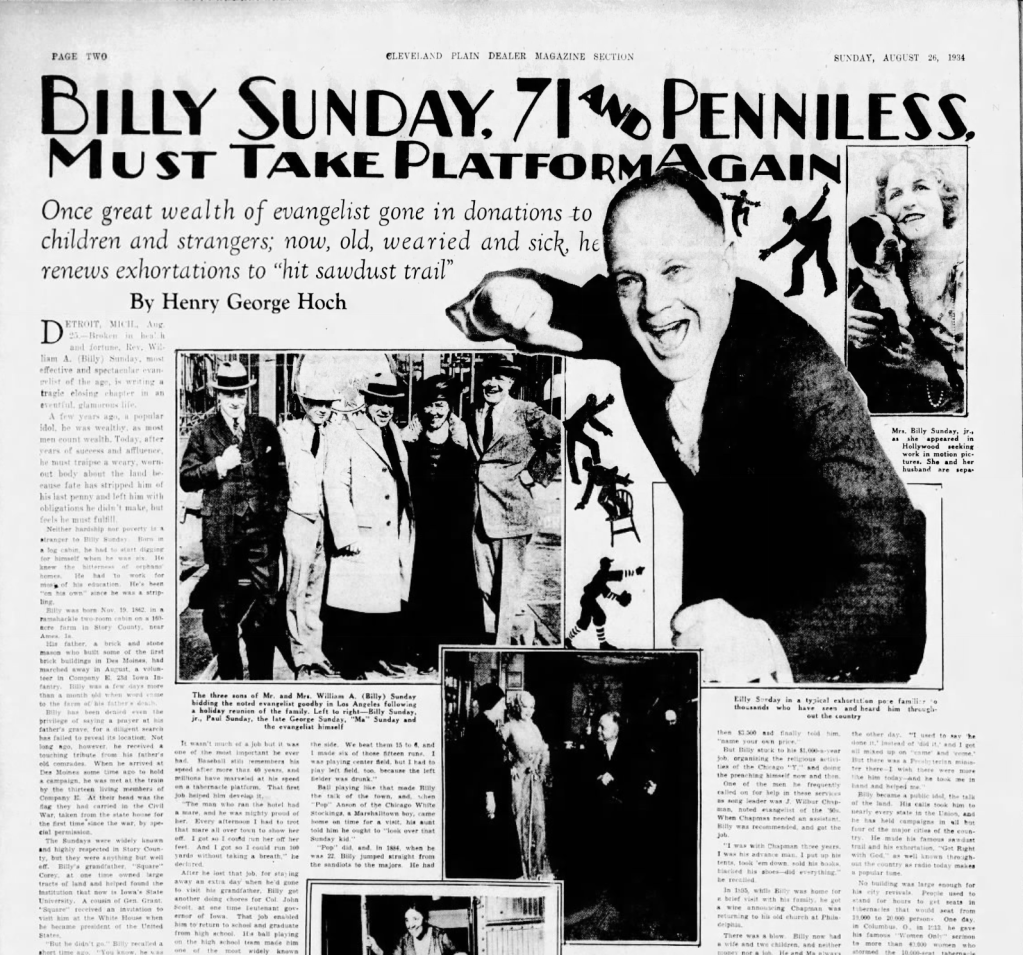
Once great wealth of evangelist gone in donations to children and strangers; now, old, wearied and sick, he renews exhortations to “hit sawdust trail”
By Henry George Hoch
DETROIT, MICH., Aug.
Broken in health and fortune, Rev. William A. (Billy) Sunday, most effective and spectacular evangelist of the age, is writing a tragic closing chapter in an eventful, glamorous life.
A few years ago, a popular idol, he was wealthy, as most men count wealth. Today, after years of success and affluence, he must traipse a weary, worn-out body about the land because fate has stripped him of his last penny and left him with obligations he didn’t make, but feels he must fulfill.
Neither hardship nor poverty is a stranger to Billy Sunday. Born in a log cabin, he had to start digging for himself when he was six. He knew the bitterness of an orphan’s home. He had to work for most of his education. He’s been “on his own” since he was a stripling.
Billy was born Nov. 19, 1862, in a ramshackle two-room cabin on a 160-acre farm in Story County, near Ames, Ia.
His father, a brick and stone mason who built some of the first brick buildings in Des Moines, had marched away in August, a volunteer in Company E, 23d Iowa Infantry. Billy was a few days more than a month old when word came to the farm of his father’s death.
Billy has been denied even the privilege of saying a prayer at his father’s grave, for a diligent search has failed to reveal its location. Not long ago, however, he received a touching tribute from his father’s old comrades. When he arrived at Des Moines some time ago to hold a campaign, he was met at the train by the thirteen living members of Company E. At their head was the flag they had carried in the Civil War, taken from the state house for the first time since the war, by special permission.
The Sundays were widely known and highly respected in Story County, but they were anything but well off. Billy’s grandfather, “Squire” Corey, at one time owned large tracts of land and helped found the institution that now is Iowa State University, a cousin of Gen. Grant. “Squire” received an invitation to visit him at the White House when he became president of the United States.
“But he didn’t go,” Billy recalled a short time ago. “You know, he was just an Iowa hill Billy, and he thought he’d better stay home where he belonged.”
Billy’s widowed mother did her best to keep her three boys at home, but the wolf was close to their door, and at 8 years of age he had to start running errands and doing odd jobs to help along the family income. Of course, it wasn’t all work and no play, and Billy had a game he liked immensely.
“I used to make a ball of string and cover it with strips I’d tear from mother’s old dresses. Then, when I was going after the cows, I’d toss it way up in the air, close my eyes and run, and then try to find it and catch it,” he recalled.
“When I was just a kid I used to play on a grown-up ball team because I could play better than any of them. They’d wait for me to come to them. I was the only one that knew how to go after it.
Billy was 9 when his mother finally had to give up the struggle to keep the little home together, and he and his older brother, Edward, were packed off to the Soldiers Orphans Home at Glenwood, Ia.
Thousands upon thousands throughout the land have heard Billy tell the story of that trip. His mother was so poor she lacked the money to pay their fare all the way, and the two little boys had to beg a meal at Council Bluffs and then “bum” a ride on a freight train for the last twenty miles to Glenwood.
It was years later that Billy and his mother were reunited, when he was a successful and famous evangelist. She lived with him the last 30 years of her life in the rainy days when he could do more for her materially than she ever had been able to do for him.
The brothers stayed at orphanages, first at Glenwood and then at Davenport, five years. Edward then had reached the age limit of 14, and when he was dismissed, the fourteen-year-old Billy left with him.
For a time they lived with their grandfather “Square” Corey, on his farm near Ames. But Billy didn’t take to farm life, and soon, after an undeserved tongue lashing over a broken yoke, he went to Nevada, Ia., to make his own way in the world.
His first job, in a hotel, gave him board and room. “I was bellhop, bus boy, clerk and everything else. Every morning at 5 o’clock I had to meet the train bulletin: Welton Hotel, dollar a day,” he remembered.
It wasn’t much of a job but it was one of the most important he ever had. Baseball still remembers his speed after more than 40 years, and millions have marveled at his speed on a tabernacle platform. That first job helped him develop it.
“The man who ran the hotel had a mare, and he was mighty proud of her. Every afternoon I had to trot that mare all over town to show her off. I got so I could run her off her feet. And I got so I could run 100 yards without taking a breath,” he declared.
After he lost that job, for staying away an extra day when he’d gone to visit his grandfather, Billy got another doing chores for Col. John Scott, at one time lieutenant governor of Iowa. That job enabled him to return to school and graduate from high school. His ball playing on the high school team made him one of the most widely known youngsters.
A volunteer fire department had much to do with getting Billy into professional baseball.
“All the towns had volunteer fire departments in those days, and they wanted men that could run fast,” he recalled. “They used to hold state tournaments to locate the speedy fellows. I was one of the contests and was asked to come to Marshalltown to join the fire department.
“We had a team at Marshalltown that could pull a 325-pound wagon 300 yards and attach the hose, all in 34 seconds,” he said.
Of course, young Elly got on the Marshalltown built team, and a big time at it, his speed and his ability to get the hard ones made him the star of the team.
“Once we played Des Moines for the state championship and $50 on
the side. We beat them 15 to 4, and I made six of those fifteen runs. I was playing center field, but I had to play left field, too, because the left fielder was drunk.
Ball playing like that made Billy the talk of the town, and, when ‘Pop’ Anson of the Chicago White Stockings, a Marshalltown boy, came home on time for a visit, his aunt told him he ought to ‘look over that Sunday kid.’ ‘Pop’ did, and, in 1884, when he was 22, Billy jumped straight from
the sandlots to the majors. He had several years there and if he hadn’t got religion his speed and pep and natural bent for the dramatic might have made him as much of a gate attraction as Babe Ruth with his brain and bat.
Pop Anson once said that Billy was a bit weak on the hitting side and not the smartest base runner in the game, but a brilliant fielder, a strong and accurate thrower, and one of the fastest men in the game.
There never was a speedier man on the diamond, nor one who liked to take longer chances. One of the fast men in the country to do 100 yards in ten seconds, Billy was the first man to circle the diamond in fourteen seconds “from a standing start, and touching all the bases.”
“No one ever beat that,” he declared recently, with pardonable pride. “Not even Ty Cobb, and he was the greatest baseball player that ever lived.”
Billy wanted more education and while he was with the old White Stockings he attended Northwestern University after the season closed. He had a winter job there coaching the football and baseball teams. Billy was not what you could call a hard drinker, but he used to take a little beer or wine with the boys now and then.
One night in 1887 he was in a downtown Chicago saloon with some other players—among them Mike Kelly and Ed Williamson—when a group from the Pacific Garden Mission started an outdoor meeting at State and Van Buren Streets, near by. Their hymns caught Billy’s attention and interest.
“I used to hear those hymns in Sunday school at home. I’d never heard another sing them. When one of the workers came into the saloon and invited us to attend their meeting at the mission I decided to go. The fellows laughed at me but I went. And I liked it. “I wasn’t converted that night.
But I liked their meetings and I went back several times. One night when Harry Monroe was preaching I found my way to God,” is Billy’s story of his conversion.
Many years later he was to repay in big measure his debt to the mission where he was converted.
Billy didn’t quit baseball immediately after his conversion but he joined the church and became an active worker. And baseball teams had to get along without him when he tore loose on a preaching star. He used to get frequent calls from Y. M. C. A.’s and other men’s groups to lead services and preach, both at home and on the road. He always responded and the novelty of hearing a diamond star deliver a sermon attracted big crowds and got him a lot of attention.
It was in Sunday school Billy first met Nell Thompson, whom millions in America know as “Ma” Sunday. It was love at first sight for him, but she had another beau, and Billy’s suit didn’t progress with the speed with which he circled the bases. Her family didn’t like the idea of her getting too thick with a ball player, either, and at the time forbade her to see him. But Billy was persistent, and soon he began to get a little encouragement. Finally, they overcame the family’s disapproval, and were married.
In the spring of 1891, the Brotherhood Association, forerunner of the American League, broke up and the market was flooded with players.
Billy got his release, and with a wife and baby to support, he left a job which paid him good money to become the first “Y” religious secretary in the country at $1,000 a year.
The Pittsburgh team, to which he had been transferred wanted him back to finish the season. Those weren’t the days of big money in sports, but they offered him $2,500, then $3,500 and finally told him, ‘name your own price.’
But Billy stuck to his $1,000-a-year job, organizing the religious activities of the Chicago Y. M. C. A. and doing the preaching himself now and then.
One of the men he frequently called on for help in these services as song leader was J. Wilbur Chapman, noted evangelist of the ’90s. When Chapman needed an assistant, Billy was recommended, and got the job.
‘I was with Chapman three years. I was his advance man. I put up his tents, took ’em down, sold his books, blacked his shoes—did everything,’ he recalled.
In 1893, while Billy was home for a brief visit with his family, he got a wire announcing Chapman was returning to his old church at Philadelphia.
There was a blow. Billy now had a wife and two children, and neither money nor a job. He and Ma always took their troubles to God in prayer, and they prayed hard and long over that one. Both say what happened is the most convincing answer to prayer they’ve ever had.
It was a letter from Garner, Ia., asking Billy to hold a ten-day revival in their 300-seat opera house. That call always has been a mystery to Billy. So far as he knows, no one in Garner knew him or had heard him preach.
That first campaign was a tough one. Billy, who’d never been on his own before, had to preach at ten meetings, and he had only eight sermons. A lot of midnight oil was burned in Garner before Billy filled the gap.
While that meeting was in progress Billy was invited to hold a campaign at Pawnee City, Neb., and another at Tecumseh, Neb. From that day to this there never has been a day when there weren’t calls ahead for Billy and Ma.
Billy started out with ‘sort of high falutin’ sermons with words as long as your arm, but he soon discovered his real forte, the Anglo-Saxon speech of the man in the street, with plenty of slang and action—the ‘Billy Sunday’ kind of preaching and preaching that nearly everyone in this country has heard, or heard about.
People liked his preaching. His crowds grew bigger and bigger until the Iowa and Nebraska Opera Houses—usually the biggest halls in town—couldn’t begin to hold the crowds, and he had to take to tent meetings.
Constantly the calls kept coming from larger and larger towns, and the middle west was filled with talk of this baseball evangelist who pulled off his coat and vest, tore off his collar and tie, and hopped about like a jumping jack as he blazed away at sin and the devil and booze with salty slang and blunt words never before heard from a pulpit.
There were some who criticized his language, calling it vulgar and out of place, but others talked of how people walked the famous sawdust trail, and how ‘deadbeats’ began to pay their bills after Billy had been in town a few days, and how churches were revitalized after his campaign, and saloons and dens of vice gave way to Y. M. C. A.’s and W. C. T. U.’s and places like that. The cities called to him. He went reluctantly. Elgin, Ill., was the first city to hear him.
“I was scared stiff,” he recalled the other day. “I used to say ‘he done it,’ instead of ‘did it,’ and I got all mixed up on ‘come’ and ‘come.’ But there was a Presbyterian minister there I wish there were more like him today and he took me in hand and helped me.
Billy became a public idol, the talk of the land. His calls took him to nearly every state in the Union, and he has held campaigns in all but four of the major cities of the country. He made his famous sawdust trail and his exhortation, “Get Right with God,” as well known throughout the country as radio today makes a popular tune.
No building was large enough for his city revivals. People used to stand for hours to get seats in tabernacles that would seat from 10,000 to 20,000 persons. One day, in Columbus, O., in 1913 he gave his famous “Women Only” sermon to more than 4,000 women who stormed the 10,000-seat tabernacle there and forced him to hold extra meetings.
During a ten-week campaign in New York he spoke to 1,500,000 people and nearly 100,000 of them hit the trail. His greatest campaigns were held in New York and Chicago in 1917. John D. Rockefeller, Jr., was the financial “angel” of the New York meeting.
“He told me, don’t worry about the collections. You won’t have to worry about anything,” Billy said. This Billy Sunday who talked at meeting after meeting from early morning till late at night one New York newspaper estimated he spoke 1,290,000 words in ten weeks of
preaching there was an amazing thing to his old cronies on the ball clubs.
When Billy was in Detroit in the fall of 1933, he renewed acquaintance with Fred E. Goldie Goldsmith. They had been teammates on the old Chicago White Stockings in the ’80s, when that team came to Detroit and set an all-time record by scoring eighteen runs in one inning. “That Billy Sunday has got to be quite a talker,” Goldie commented. “He was such a quiet lad on the team. Never said hardly anything.”
Other friends have commented on that trait. The man who has preached to greater visible crowds than any other living American, talking generally for much more than an hour, is at heart a silent, retiring man. Away from his work he prefers to let others do the talking.
Through the years of success such as no other evangelist has known, great sums of money passed through Billy’s hands, hundreds of thousands of dollars. Most of it was given away to needy people and institutions. Today, all of it is gone. New York gave him the biggest ‘love offering’ he, or any other evangelist, ever has received.
We had just entered the war when I began my New York campaign,’ he said. ‘The first day of the campaign I told them whatever they gave me I would give to the boys overseas through the Red Cross, the Y.M.C.A., the Salvation Army, and the like.
‘They gave me $120,465, and every penny of it went to the boys over- there. When I left New York I had to draw on my own funds for my railroad fare.’
Chicago also gave him a great offering $65.00, and all of that was given to the old Pacific Garden Mission, in which he had been converted 38 years before.
One of his converts, a former convict, once came to Billy and related the story of losing his home because he couldn’t meet the payments. Billy wrote him a check for $500 to pay off the mortgage.
Friends say he has financed the college education of more than 70 young men and that the country is dotted with homes and institutions that have been helped through dark days by Billy’s checks.
It was about six years ago that the tragic series of events began which he himself has called his worst years. He is on the road, although he needs rest — and wants it.
His eldest son, George, had worked with him for a time in his campaigns, but, after his first marriage he had established a real estate business in Los Angeles. His brother, Billy, Jr., was with him. In 1928, Billy, Jr., was sued for divorce by his actress wife. A week later George and his wife parted and she sued for a separation and support.
One October night in 1932 Billy was speaking in Detroit for the Michigan Anti-Saloon League. After the meeting, he received a call that his daughter, Helen, wife of Frank E. Hagan, surgeon of Mich., was about to die. A friend drove him there before she died, and Billy, marked by grief, returned for the remainder of his tour for the Anti-Saloon League.
A year ago he buried George in a grave beside Helen at Sturgis. And in that grave he buried his hopes of retirement and rest.
When the depression came along, George’s business was hard hit, and then he had family trouble. ‘I used the $8000 I’d saved up to try and save his business and help him out of his troubles. It’s all gone, every penny. And now, George is dead,’ he cried, sobbing with his sobs.
Then he revealed that he had pledged to pay George’s two children $15 a month until they are 21—the eldest now is 17.
A year ago February, at Des Moines, he was stricken by a heart attack during a sermon. A blood clot was found in the coronary artery. He had to spend three months in bed, with Ma nursing him back to health. Then three more months of rest.
He needed more rest, but, last September, past his allotted three-score years and ten, he had to take up again the hard grind of the itinerant evangelist, answering, for the first time in his career, calls from individual churches, and returning once again to the smaller towns.
For Billy Sunday is broke because he sacrificed everything for his children. ‘As long as he lives he must work to live and to meet the obligations he has assumed for others.’
Copyright, 1935, by the Plain Dealer Publishing Co. in co-op with American Newspaper Alliance.
In the twilight of Billy Sunday’s life, the press painted a picture of a once-glorious evangelist now broken in body and fortune. A 1934 article in the Cleveland Plain Dealer claimed that Sunday had been “stripped of his last penny” and was forced to continue preaching out of sheer necessity. But how much of that is true?
Let’s take a closer look at the facts and exaggerations surrounding the closing chapter of one of America’s most dynamic preachers.
Billy Sunday endured crushing personal tragedies in his later years. His daughter, Helen, died in 1932. Just a year later, his son George died—after financial ruin, a failed marriage, and spiritual drift. These losses left Billy heartbroken and emotionally drained.
Sunday wasn’t just a fiery preacher—he was known for extraordinary generosity. During his 1917 campaign in New York City, he received a staggering $120,465 love offering—and gave every penny to soldiers and wartime charities. He also gave generously to students, struggling families, and institutions like Pacific Garden Mission (where he himself had been converted).
In 1933, Sunday suffered a heart attack while preaching in Des Moines. Doctors discovered a blood clot in his coronary artery and urged rest. He spent months recuperating—but eventually resumed his preaching schedule despite serious health concerns.
In his final years, Sunday no longer drew the massive urban crowds of earlier decades. Instead, he accepted invitations from small-town churches—returning to the kind of humble venues where he began. This wasn’t a forced exile but a sober shift that reflected the times and his own desire to keep preaching.
| Claim | Analysis |
|---|---|
| “Stripped of his last penny” | Overstated. Sunday had certainly lost most of his wealth by 1934, but he was not destitute. He still owned property in Winona Lake, Indiana, and had the means to travel. |
| “He must work to live” | Partially true. Sunday continued preaching due to personal obligation—particularly to support his grandchildren—but not because he was facing homelessness or poverty. |
| “Broken in health and fortune” | Dramatic tone. He was declining physically, yes—but he still traveled, preached, and maintained a basic household. His condition was serious, but not total ruin. |
| “All of it is gone” (money) | Unverifiable. He likely had very little liquid wealth by the 1930s, but “all” is a strong word. He retained enough assets to live modestly, and continued to support others financially. |
Billy Sunday’s final years were indeed marked by sorrow, sacrifice, and strain—but not by absolute destitution. While the press dramatized his story for emotional impact, the truth is more nuanced: Sunday gave away fortunes, suffered deeply, and kept preaching to the end—not because he had to survive, but because he felt called.
He didn’t die penniless.
He died spent.
“I want to preach until I can’t preach anymore, and then I want to crawl up into the pulpit and die.”
—Billy Sunday
By Kraig McNutt
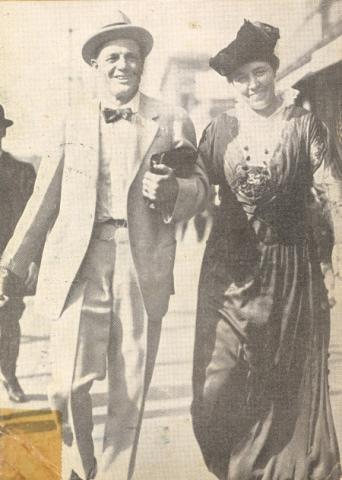
1. The Revival Shook the City
—Literally From November 9 to December 17, 1905, Billy Sunday preached daily to crowds of 6,000–10,000 in a massive wooden tabernacle. On the final night, 7,000 packed the building, with 5,000 more turned away.
2. Sunday Preached Himself to Collapse
On December 18, Sunday collapsed in front of 4,000 people, fainting from exhaustion after weeks of near-constant preaching. Newspapers feared for his life. He had been preaching “day and night for months” with little rest.
3. 2,500 Converts Publicly Responded
By the end of the campaign, 2,484 people had “hit the trail”, coming forward in response to Sunday’s bold calls for repentance. Men’s meetings alone drew thousands, with hundreds responding in a single afternoon.
4. $4,000 Raised in Free-Will Offerings
The people of Burlington gave Sunday over $4,000, a substantial sum for the time, reflecting both appreciation and the revival’s reach across economic lines.
5. The Mayor Ordered Saloons Closed on Sundays
The revival’s influence extended beyond the pulpit. Mayor Caster issued a public order to close all saloons on Sundays, a clear response to Sunday’s fiery sermons against the liquor trade.
6. A Civic Reform League Was Born
Sunday’s preaching catalyzed long-term impact: 150 citizens formed the Civic Reform League to continue fighting for moral reform and social change after the campaign ended.
7. His Style Divided the Crowd
While many were inspired, others were offended. The Cedar Rapids Gazette praised his sincerity but criticized his “gutter language” and aggressive tone. Sunday, however, refused to hold back: “You say, ‘It’s nobody’s business what I do.’ Hear me—it’s everybody’s business what everybody does.”
8. His Sermons Were a Fusion of Gospel and Social Commentary
Sunday denounced profanity, spiritual apathy, poor parenting, and cultural decay with equal fire. His sermons were revival messages with a conscience, tackling both personal sin and systemic vice.
9. Sunday Preached to a City, Not Just a Crowd
He reached every class—from maids to manufacturers, skeptics to civic leaders. His revival stirred the homes, workplaces, newspapers, and even local politics of Burlington.
10. Burlington Witnessed Both the Brilliance and the Breaking of a Revivalist
The Burlington campaign was a turning point in Sunday’s early career. It showed his remarkable reach, but also the cost of his calling. He preached with such intensity that it nearly ended his ministry—or his life.
By Kraig McNutt
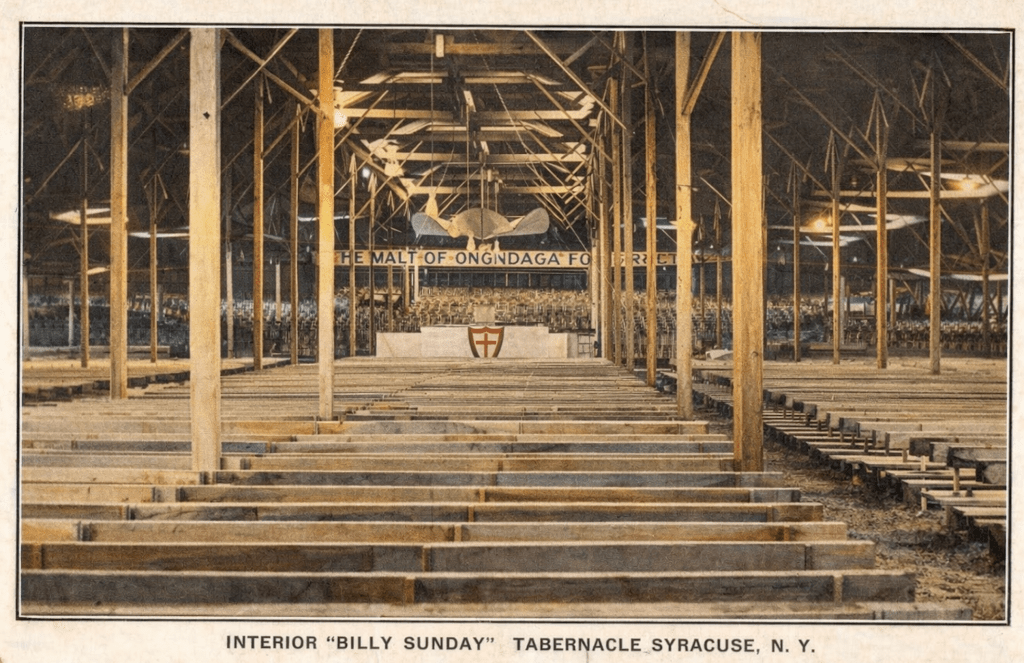
1. Massive Crowds Turned Out
—Even in the Snow From October 31 to December 19, 1915, Sunday preached to 911,000 total attendees across seven weeks. Even snowstorms didn’t deter the crowds of 12,000 to 15,000 per service, and many were turned away due to overflow.
2. More Than 22,000 “Hit the Trail”
A stunning 22,449 people came forward during the campaign to publicly commit to Christ—among them hundreds of university students, local business leaders, bartenders, and skeptics.
3. Syracuse University Played a Major Role
Over 3,000 faculty and students marched to the tabernacle on “University Night,” led by the Syracuse University brass band. Sunday addressed students in chapels, dorms, and fraternities, resulting in over 400 student conversions.
4. Sunday Preached to Every Layer of Society
From “maids in kitchens” to “people of refinement and wealth,” no social group was overlooked. Even those who initially rejected the campaign—like certain churches—eventually joined in.
5. A Choir of 4,500 Lifted the Campaign
A multi-racial, interdenominational choir of 4,500 singers, broken into rotating choruses of 1,500, filled the tabernacle with powerful music. One men’s chorus was directed by “Rhody,” Sunday’s trombone-playing music leader.
6. Sunday’s Preaching Hammered the Liquor Trade
Sunday’s infamous “booze sermon” hit hard. One bartender gave up his bar and called his brewery partners to end the business. Liquor sales dropped as much as 80% in some saloons, and 18,000 voters signed a petition for better Sabbath law enforcement.
7. The Campaign Reached Beyond Syracuse
Sunday’s team held satellite revivals and Bible classes in towns within a 50-mile radius. People traveled from as far as Buffalo to attend his services.
8. The Campaign Raised Over $50,000
The free-will offering totaled $23,112, with some reports suggesting over $50,000 collected when including uncounted checks and charitable gifts. Sunday received $11,155 of that total, with much going to local causes.
9. The Local Press Gave Him Their Blessing
Even once-skeptical newspapers eventually endorsed the revival, noting “cleaner speech,” moral renewal, and a “fresh and bracing moral ozone” in the city’s atmosphere.
10. It Ended with Song, Tears, and a Chautauqua Salute
On December 19, at the closing service attended by 13,000, Sunday invited his team to the platform, and the crowd sang “God Be With You Till We Meet Again.” Thousands followed him to the train station to sing one final goodbye.

 Evangelist Billy Sunday (1862-1935)