By Kraig McNutt
1. Massive Crowds Turned Out
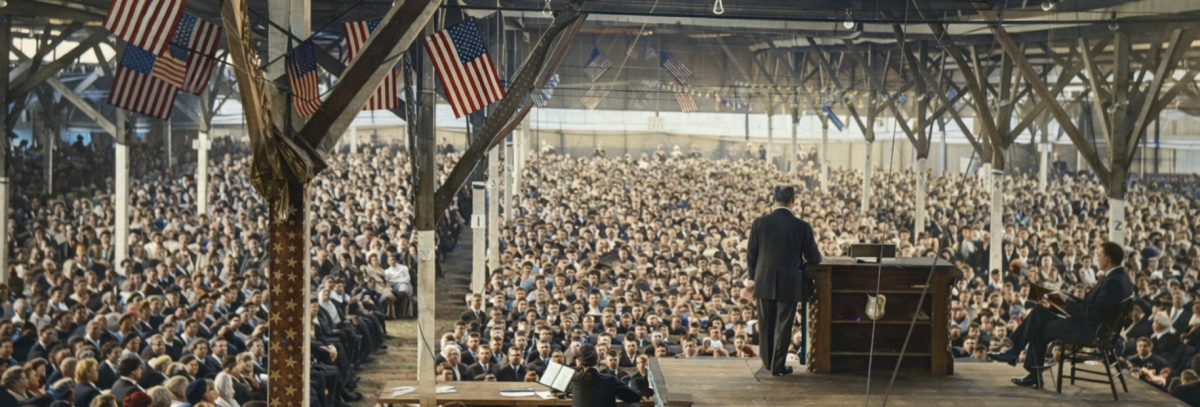
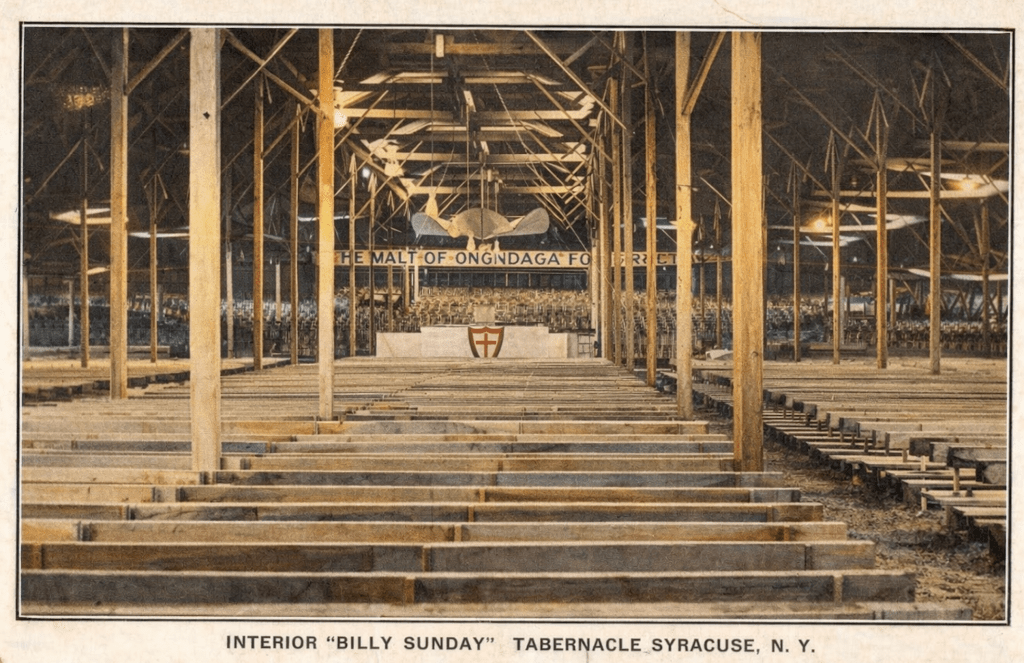
—Even in the Snow From October 31 to December 19, 1915, Sunday preached to 911,000 total attendees across seven weeks. Even snowstorms didn’t deter the crowds of 12,000 to 15,000 per service, and many were turned away due to overflow.
2. More Than 22,000 “Hit the Trail”
A stunning 22,449 people came forward during the campaign to publicly commit to Christ—among them hundreds of university students, local business leaders, bartenders, and skeptics.
3. Syracuse University Played a Major Role
Over 3,000 faculty and students marched to the tabernacle on “University Night,” led by the Syracuse University brass band. Sunday addressed students in chapels, dorms, and fraternities, resulting in over 400 student conversions.
4. Sunday Preached to Every Layer of Society
From “maids in kitchens” to “people of refinement and wealth,” no social group was overlooked. Even those who initially rejected the campaign—like certain churches—eventually joined in.
5. A Choir of 4,500 Lifted the Campaign
A multi-racial, interdenominational choir of 4,500 singers, broken into rotating choruses of 1,500, filled the tabernacle with powerful music. One men’s chorus was directed by “Rhody,” Sunday’s trombone-playing music leader.
6. Sunday’s Preaching Hammered the Liquor Trade
Sunday’s infamous “booze sermon” hit hard. One bartender gave up his bar and called his brewery partners to end the business. Liquor sales dropped as much as 80% in some saloons, and 18,000 voters signed a petition for better Sabbath law enforcement.
7. The Campaign Reached Beyond Syracuse
Sunday’s team held satellite revivals and Bible classes in towns within a 50-mile radius. People traveled from as far as Buffalo to attend his services.
8. The Campaign Raised Over $50,000
The free-will offering totaled $23,112, with some reports suggesting over $50,000 collected when including uncounted checks and charitable gifts. Sunday received $11,155 of that total, with much going to local causes.
9. The Local Press Gave Him Their Blessing
Even once-skeptical newspapers eventually endorsed the revival, noting “cleaner speech,” moral renewal, and a “fresh and bracing moral ozone” in the city’s atmosphere.
10. It Ended with Song, Tears, and a Chautauqua Salute
On December 19, at the closing service attended by 13,000, Sunday invited his team to the platform, and the crowd sang “God Be With You Till We Meet Again.” Thousands followed him to the train station to sing one final goodbye.


 Evangelist Billy Sunday (1862-1935)