By Kraig McNutt
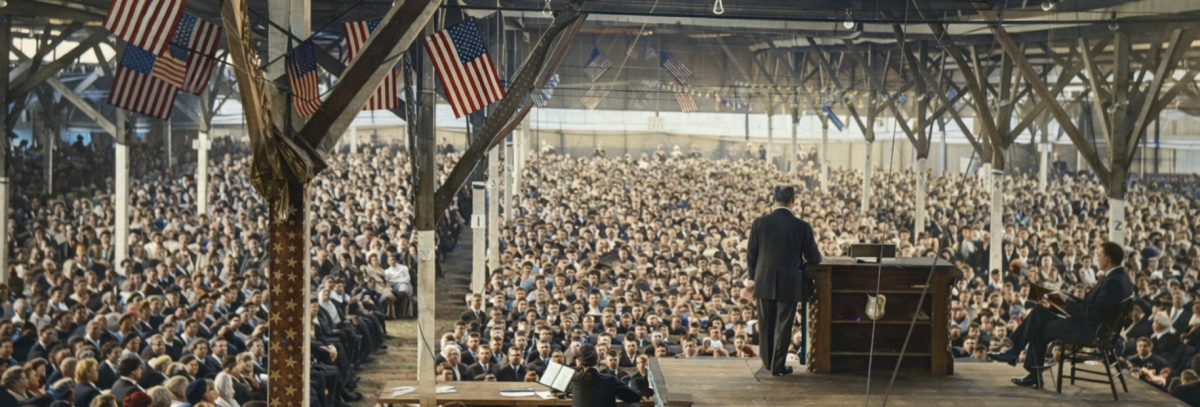
In the early 20th century, few public figures stirred the American soul quite like Billy Sunday. A former professional baseball player turned dynamic evangelist, Sunday launched revival campaigns that were part gospel meeting, part moral crusade, and entirely unforgettable.
But beyond the sawdust trails and thunderous preaching, what do the numbers tell us about his real impact?
Let’s dive into an analysis of over twenty of Sunday’s campaigns—spanning from the industrial sprawl of Philadelphia to the steel towns of Ohio and Pennsylvania—to find out.
Big Cities, Big Numbers
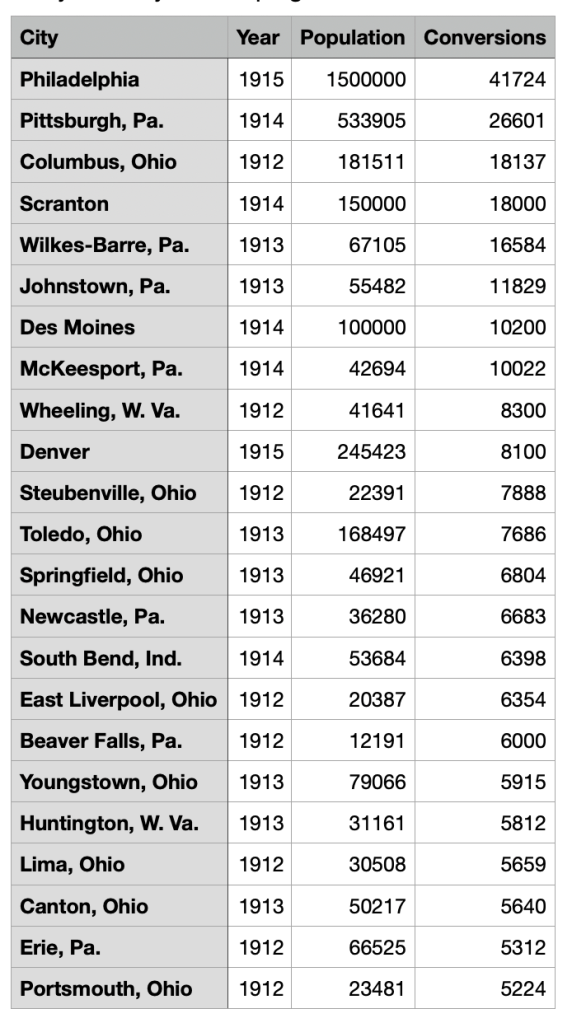
Unsurprisingly, the nation’s largest cities saw the highest total conversions:
- Philadelphia (1915): 41,724 conversions
- Pittsburgh, PA (1914): 26,601 conversions
- Columbus, OH (1912): 18,137 conversions
Impressive, no doubt. But when measured per capita, a surprising truth emerges…
The Real Revival Was in Small-Town America
Here’s where it gets fascinating:
- Beaver Falls, PA (1912): 6,000 conversions in a city of 12,191 – nearly 49%!
- East Liverpool, OH (1912): 6,354 conversions in a population of 20,387 – over 31%
- Steubenville, OH (1912): 7,888 conversions out of 22,391 – over 35%
In these towns, Sunday didn’t just stir hearts—he helped reshape the entire community’s spiritual identity.
A Strategy Rooted in the Industrial Heartland
Most of Sunday’s campaigns concentrated in:
- Pennsylvania
- Ohio
- West Virginia
- Indiana
Why here?
These regions were filled with working-class cities grappling with the social challenges of industrialization: alcoholism, labor unrest, poverty, and moral uncertainty.
Sunday’s sermons, full of vivid illustrations and uncompromising moral appeals, landed powerfully in these settings. He spoke their language, addressed their fears, and challenged their habits.
His Peak Impact Years: 1912–1914
Many of the most spiritually responsive campaigns occurred just before World War I:
- Scranton (1914)
- Wilkes-Barre (1913)
- McKeesport (1914)
- Des Moines (1914)
- Johnstown (1913)
This was Sunday’s sweet spot—a season where both momentum and message aligned. Before the war brought cultural upheaval, Sunday’s campaigns offered a moral anchor to cities teetering on the edge of change.
The Bottom Line: Revival by the Numbers
Across 23 cities analyzed:
- Total population: 3,559,070
- Total conversions: 250,872
- Average conversion rate: ~7.05%
That’s 1 in every 14 people making a spiritual decision.
But the real story is this: Sunday’s numerical reach was greatest in big cities, but his transformational impact was most profound in smaller towns where community bonds were tighter, distractions were fewer, and the message spread like wildfire.
Final Thoughts: When Revival Was a Shared Story
Billy Sunday didn’t have Instagram reels or livestream sermons. He had sawdust floors, a voice like thunder, and a message about Jesus that could shake a city.
And in towns like Beaver Falls, East Liverpool, and Steubenville, it did more than shake—it changed lives. Not in abstract theological terms, but in the daily rhythms of work, family, and community.
In these places, revival wasn’t just a moment. It was a movement.
Want more historical insights like this? Subscribe to my newsletter or explore more at https://evangelistbillysunday.com/
Total population 3,559,070
Total conversions 250,872
Data from The Man and His Message, Ellis

 Evangelist Billy Sunday (1862-1935)