By Kraig McNutt

From the moment he arrived in Burlington, Iowa, in November 1905, Rev. William “Billy” Sunday brought with him more than a revival campaign—he brought a storm. For six intense weeks, Sunday preached to thousands daily, confronted sin with his trademark “hammer and tongs” style, and called the city to spiritual awakening.
But the campaign didn’t just stir souls. It nearly cost him his life.
A Town on Fire—Spiritually Speaking
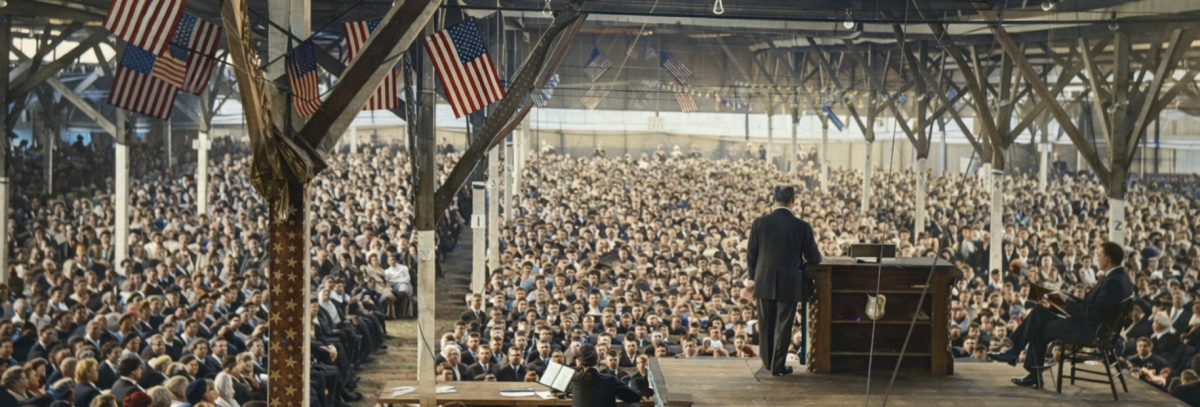
Sunday’s campaign in Burlington ran from November 9 to December 17, 1905. In that span, he preached to crowds of 6,000 to 10,000 in a massive wooden tabernacle built for the occasion. The energy was electric. At one point, over 1,279 converts had been counted, and by the end of the campaign, the total reached 2,484.
The Muscatine Journal described Sunday’s preaching as if “swaying a storm-beaten ocean.” In a men’s meeting alone, 112 responded to the call, with many more turned away due to overcrowding.
But Sunday’s sermons weren’t just altar calls—they were cultural critiques. He lambasted spiritual apathy, criticized parental neglect, and took direct aim at profanity, indifference, and moral complacency. In one memorable line, he warned:
“You say, ‘It is nobody’s business what I do.’ But hear me—it is everybody’s business what everybody does.”
His sermons were equal parts gospel and social conscience.
Revival or Overkill?
Not everyone was thrilled. A Cedar Rapids Gazette editorial warned that while Sunday was sincere, his tone could be offensive and even vulgar. Some churchgoers felt he used “language of the gutter” and painted humanity as far too depraved. They admired his passion but questioned his method:
“Offensiveness and vulgarity may emanate from the pulpit as well as from any other source… but ‘Billy’ Sunday is sincere, and sincerity is a virtue that is not to be despised.”
It was this very sincerity—his relentless, full-throttle commitment—that finally broke him.
The Collapse Heard Across the Midwest
On Monday, December 18, 1905, as Sunday prepared to preach to yet another crowd of 4,000, he suddenly collapsed on stage, fainting in front of the shocked audience. Reports soon circulated that his life was in danger, and that weeks of nonstop preaching had led to total physical and nervous exhaustion.
The Dixon Evening Telegraph wrote:
“He had been preaching steadily day and night for months and during the preceding week had not slept.”
While Sunday recovered and eventually continued his national ministry, the Burlington collapse marked a critical moment—a reminder that even spiritual giants are still human.
A Lasting Impact on Burlington
Despite the toll on Sunday’s health, the Burlington campaign left deep footprints in the city. By the time the tabernacle closed:
- 2,500 had publicly confessed Christ
- $4,000 had been raised in free-will offerings
- The mayor ordered all saloons closed on Sundays
- A Civic Reform League with 150 members formed to continue the moral reform efforts sparked by Sunday’s preaching
According to The Grand Rapids Press, the final night saw 7,000 people crammed inside, with 5,000 more unable to get in. It was one of the most dramatic and consequential campaigns of Sunday’s early career.
Legacy: The Revival That Cost Everything
The Burlington campaign reveals the paradox of Billy Sunday’s revivalism:
- His methods were polarizing—but effective.
- His energy was boundless—but not limitless.
- His message stirred the masses—but came at personal cost.
Still, Sunday “played ball” in the pulpit the way he had on the baseball field: heart first, full speed, no reserve.
And in December 1905, Burlington, Iowa, witnessed both the brilliance—and the breaking—of a man determined to bring America back to God.

 Evangelist Billy Sunday (1862-1935)